At 6:30 on the morning of January 7, 2025, as I set out for my daily swim at the Pacific Palisades High School pool, I noticed a thin column of smoke rising above the mountain to the north, about a mile from our house. It seemed, at first, the ordinary language of fire in Southern California — an old threat we had learned to respect but also to live with. For 24 years, we had made our home two thousand feet above the Pacific, on a narrow shelf of land that juts into Topanga State Park. To dwell there was to accept impermanence: The bluffs erode, the winds shift, the chaparral burns. Fire was always the other presence at the table.
Four years earlier, in May 2021, a great blaze had swept close enough to singe the trees around us. That time, the fire department fought back with an almost orchestral force — convoys of trucks, helicopters hovering low in the smoke, tankers trailing lines of crimson retardant through the canyons. We evacuated, and one of the crew, shoulder-deep in hoses, promised they would save our house. They did.
But the morning of January 7 felt different. When I returned from my swim, the air still held that faint, decisive tension that comes before calamity. The smoke had not thickened, but a lone fire truck climbed our road broadcasting a calm command to prepare for evacuation. By afternoon, I had packed what I could — mostly my vintage photographs, images that seemed to hold the texture of our lives there. Across the canyon, flames leapt up the Paseo Miramar trail, still two miles away as the crow flies, but already too close to ignore. When the sun went down, the Santa Anas began to blow, and the fire shifted into the familiar, frightening rhythm of inevitability.

Taken from the author’s front yard as flames tore through the Paseo Miramar trail.
Courtesy of Jonathan Taplin
Unlike 2021, there were no helicopters, no tankers, no thunder of coordinated defense — only silence and wind. My wife, Maggie, drove through the neighborhood begging fire crews for help until she persuaded one exhausted pumper to follow her home. But when they connected their hoses to the hydrant, the water came in a stuttering trickle. The firefighter explained that the reservoir had been drained for repairs by the Department of Water and Power, and the nearest tank nearly emptied by the battle to the north. Even the hoses in our yard coughed and went dry. There was nothing left to do but obey the captain’s order: Take the dogs, take the pictures, and leave.
Editor’s picks
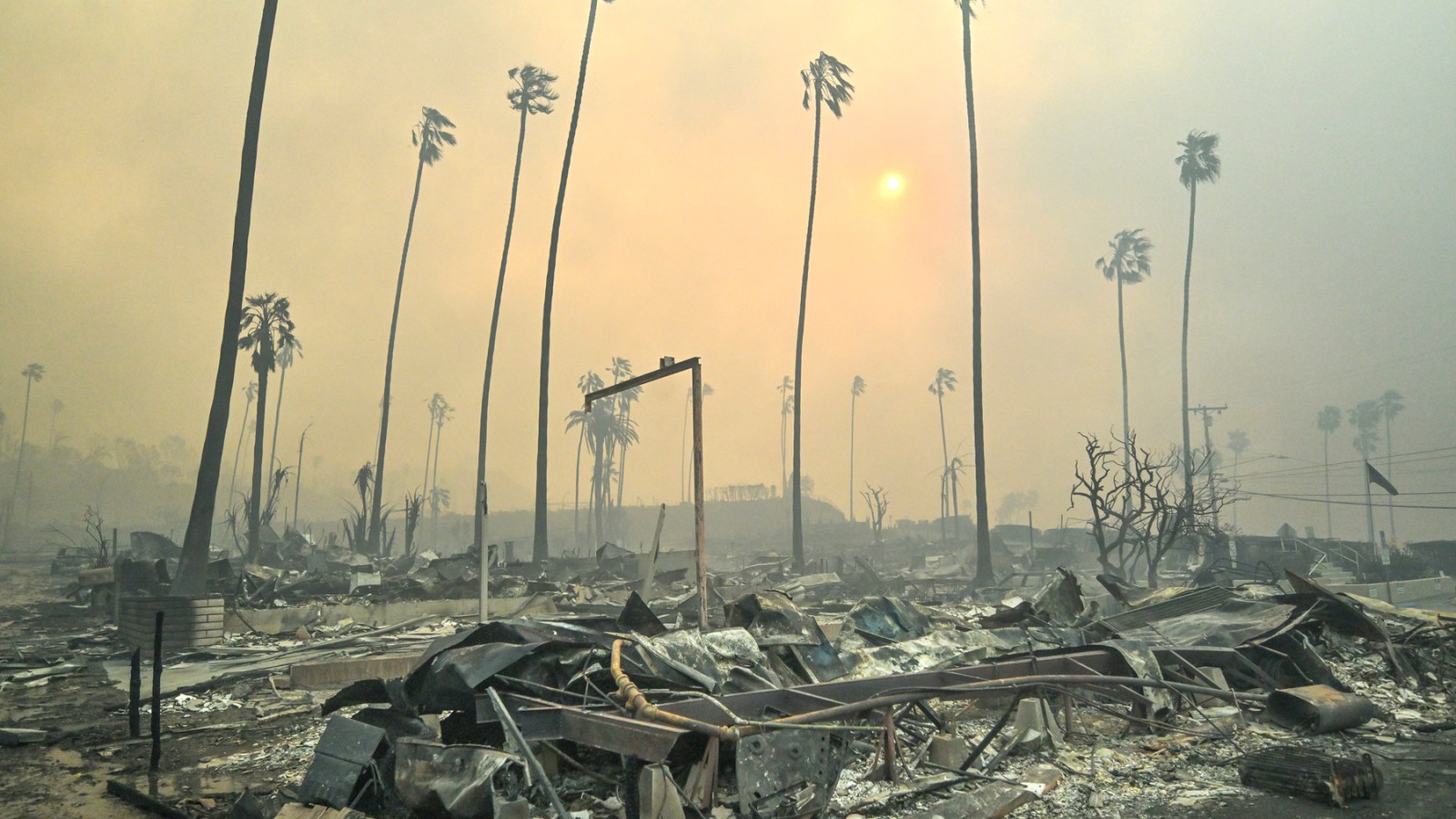
Two days later a friend who works for the police department drove me up to our home. All that remained was now a gray field of ash and twisted metal, almost unrecognizable even in form. The stoves had melted into contorted sculptures, the air still sour with smoke. In the ruins of the kitchen sat two cast-iron Le Creuset stew pots — the only survivors. They seemed less like remnants than symbols, mute witnesses to endurance itself.
The author’s pots were all that remained of his kitchen.
Courtesy of Jonathan Taplin
In the strange calm that followed, Maggie and I shared a reaction that surprised many of our friends. She had been reading Marie Kondo before the fire, a book about letting go of material attachments. Now, as we sat in a one-bedroom Airbnb in Santa Monica, the irony was too sharp not to laugh at. No need to hold each sweater to the heart to see if it sparked joy — the fire had decided.
“It is what it is,” Maggie said. “We still have each other, and the dogs.” The next morning we went to the Gap and bought new clothes, the cashier giving us 30 percent off after hearing our story. That small gesture seemed to open a door. For months afterward, kindness arrived in unexpected forms — neighbors bringing food, strangers offering furniture, friends calling daily. The catastrophe uncovered a familiar truth: that much of what we call loss is simply the old illusion of possession stripped away, leaving only the bare essentials of love and solidarity. When our friends wondered how we could be so zen, we replied we had both been freelancers most of our lives. I was a film producer, Maggie was a photographer. Maggie was 48 when we got married, I was 52. We were used to lives of feast or famine. We knew how to be adaptable.
Related Content
But beyond that circle of compassion, the larger public world revealed its harder edges. In February, Governor Newsom requested 40 billion dollars in federal assistance for Los Angeles — a fraction of what the Gulf Coast had once received after Katrina. The president refused. Weeks became months; by December, even FEMA declined to meet with the governor. Newsom’s words about federal duty — the reminder that the republic’s promises extend to every citizen — echoed but did not change the outcome.
And so the same pattern that had haunted our personal loss began to mirror itself on the political stage: the indifference of systems meant to sustain us, the slow abandonment of shared obligation. The numbers only underscored the irony. Californians, according to federal accounts, had sent $275 billion more to Washington in 2024 than we received in return. For decades, blue states had quietly subsidized red ones, in an unspoken exchange that once passed for national unity. Now that old equilibrium seemed to crumble. A court filing from the administration even claimed it was lawful to withhold federal funds from states that did not align politically.
Standing in the ruins of our home, I could not help but see the parallel. The house that burned was one small piece of a larger unraveling — the erosion not just of walls but of trust. Here in California, our determination to defend our own laws, to hold fast to climate protections and civil rights, felt no longer like partisanship but survival. Paying into a union that no longer honored reciprocity seemed, like everything else the fire consumed, an arrangement too fragile to last.
Trending Stories
Loss, it turned out, was not confined to what could be touched or held; it reached into the institutions that once bound us together. But even in that recognition, some ember of resilience remained. As in the orange pots that endured our fire, there was still the quiet suggestion that what withstands destruction — love, memory, conscience — can bear the weight of rebuilding, if only we have the courage to begin again.
Jonathan Taplin is the Director Emeritus of the Annenberg Innovation Lab at the University of Southern California and the author of Move Fast and Break Things, The Magic Years, and The End of Reality.