In the vast calm of the solar system, planetary orbits often appear orderly, stable, and insulated from the broader mechanics of the galaxy. Earth circles the Sun with regularity. The outer planets move in predictable paths. Over generations, this apparent constancy has shaped our understanding of how planetary systems evolve.
Yet that perception is incomplete. The solar system does not exist in isolation. It travels through a densely populated region of the Milky Way, surrounded by stars with their own trajectories, their own gravitational fields, their own histories. Occasionally, those stars pass close enough to make their presence felt.
When this happens, the influence may seem negligible at first. A small tug. A slight variation in a distant orbit. But under the right conditions, a single passing star could alter the configuration of multiple planets. The consequences, though improbable in any short-term frame, are significant across cosmic time.
New research now quantifies that risk. And it finds the solar system is more susceptible to outside disruption than long believed.
Flyby Stars Introduce New Instability to Earth’s Orbit
A study conducted by Nathan Kaib of the Planetary Science Institute and Sean Raymond of the University of Bordeaux has introduced a critical update to our understanding of long-term solar system stability. Their simulations, run over a five-billion-year period, incorporate the gravitational influence of passing stars, also known as field stars, that move through the galaxy and occasionally near the solar system.
In contrast to earlier models that treated the solar system as an isolated system, Kaib and Raymond show that stellar flybys, while rare, can produce meaningful gravitational effects. Their analysis, published on the arXiv preprint server, finds that Earth faces a 0.2 percent chance of either being ejected from the solar system or experiencing a planetary collision over that period. Mars, too, has a 0.3 percent probability of being lost due to similar mechanisms.
These findings are based on thousands of simulations. Researchers modelled a wide range of flyby scenarios using varied stellar masses, approach distances, and relative velocities. Results show that even a single strong encounter can trigger a series of orbital disturbances, beginning with the innermost planets and propagating outward.
Gravitational Cascades and the Role of Mercury
The simulations frequently identify Mercury as the initial point of instability. Already subject to orbital shifts due to Jupiter’s gravity, Mercury becomes far more unstable under the influence of a passing star. In many simulations, the planet’s orbit grows increasingly elliptical until it either collides with the Sun or with Venus. That disruption, in turn, can destabilise other inner planets.
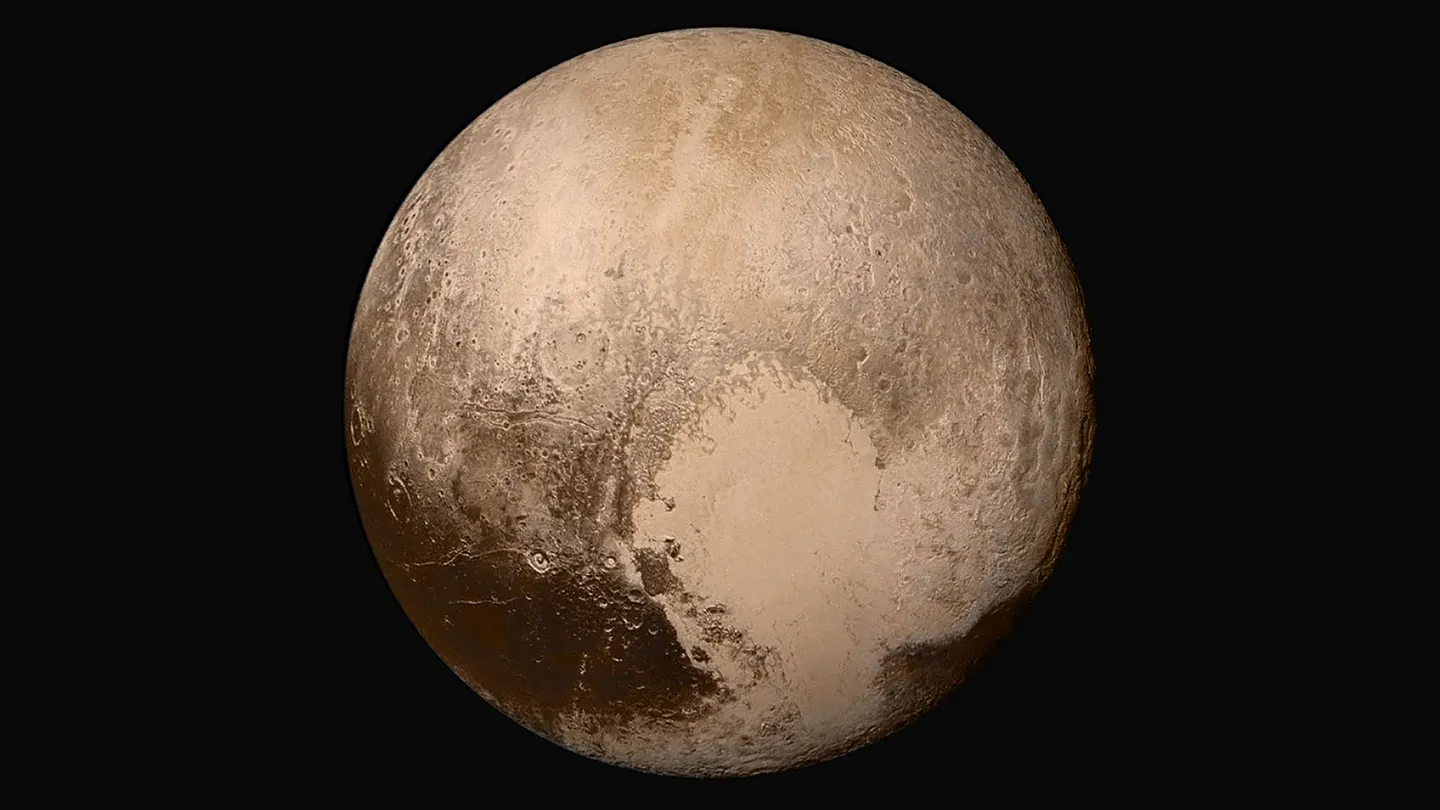 Once thought to be safe, poor Pluto (true-color image from the New Horizons spacecraft shown) faces a 4 percent risk of ejection by or collision with a giant planet during the next 5 billion years due to gravitational mischief from passing stars. Credit: NASA/Johns Hopkins University Applied Physics Laboratory/Southwest Research Institute
In the most severe scenarios, Venus or Mars is nudged into a path that interferes with Earth’s orbit. This can lead to a direct collision or, more often, an encounter that sends Earth toward Jupiter, whose powerful gravitational field could then eject the planet entirely.
The overall likelihood of such a chain reaction is low but significant. The study notes that Mercury’s instability increases by 50 to 80 percent when field stars are considered.
“It’s a little scary how vulnerable we may be to planetary chaos,” said Renu Malhotra, a planetary scientist at the University of Arizona, in remarks to Science News. She was not involved in the research.
Not All Stars Pose a Threat, but Some Come Close
The gravitational influence of a flyby depends on proximity and speed. Stars passing within 100 astronomical units (AU) of the Sun, or roughly 100 times the distance from Earth to the Sun, are the most disruptive. Those moving at less than 10 kilometres per second relative to the solar system are especially significant, as their slower pace allows more time for gravitational effects to take hold.
Kaib and Raymond estimate that there is a 5 percent chance of such a close encounter occurring within the next five billion years. Though still unlikely, this is substantially higher than previous estimates, which often excluded these stellar interactions entirely.
Stellar flybys are not purely theoretical. In a 2015 paper in The Astrophysical Journal Letters, researchers documented the close passage of Scholz’s Star about 70,000 years ago. That star likely came within 0.8 light-years of the Sun and passed through the outer Oort Cloud, potentially disturbing comets or icy bodies.
Ongoing data from the Gaia space observatory, operated by the European Space Agency, may help identify additional stars on paths that could intersect with the solar system in the distant future.
Pluto’s False Security and Wider System Implications
The research also casts doubt on the long-term stability of Pluto. Previously viewed as safe due to its 3:2 resonance with Neptune, Pluto was thought to be protected from close approaches with its giant neighbour. But Kaib and Raymond’s findings suggest that external gravitational interference could break this resonance.
Once disrupted, Pluto is more likely to pass near the outer planets and be either ejected or destroyed. The probability of such an event affecting Pluto is between 4 and 5 percent, which the authors note is 20 times greater than Earth’s risk.
“Once you allow stars to alter the solar system and push things around, you can actually knock Pluto out of its resonance with Neptune,” Kaib explained in Science News.
These results revise a foundational assumption in planetary science. Most long-term orbital models assume the solar system evolves under internal forces alone. But by integrating realistic stellar flyby rates and parameters, this study demonstrates that the structure of the solar system is more dynamic—and more fragile—than previously thought.