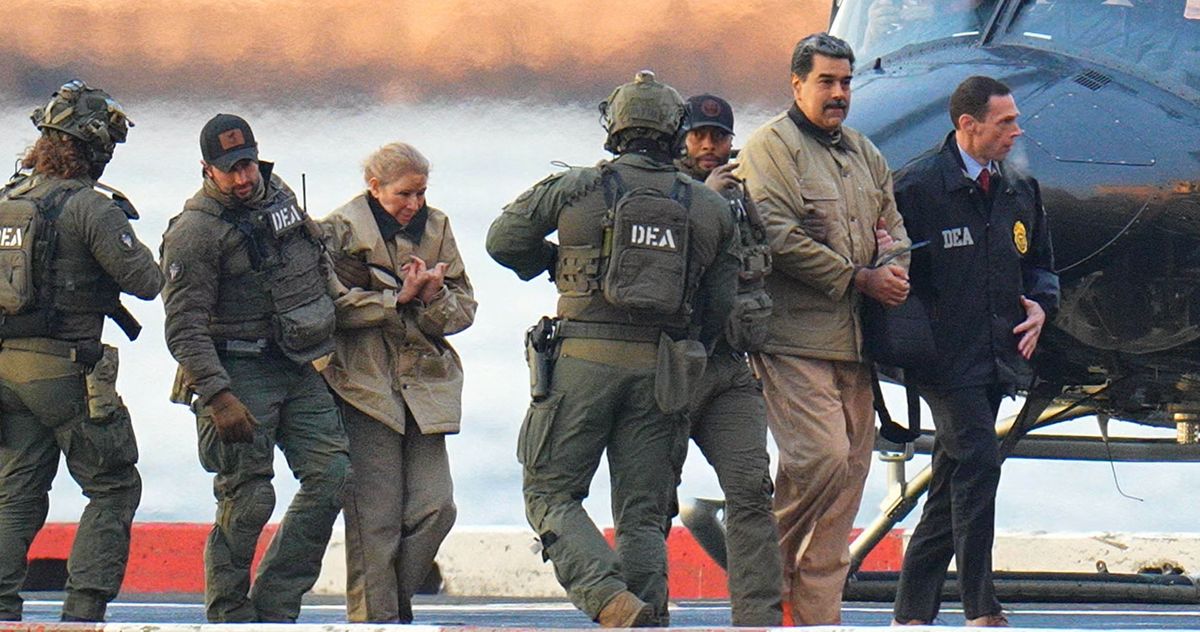
Welcome to the SDNY.
Photo: XNY/Star Ma/Getty Images
An email rarely elicits genuine, audible gasps, but I opened one in late 2009 that did just that.
I was a fifth-year federal prosecutor at the United States Attorney’s Office for the Southern District of New York, and the Obama administration had just begun to settle in. My colleagues and I learned by email that Attorney General Eric Holder had determined that 9/11 mastermind Khalid Shaikh Mohammad — who had been held in U.S. military custody at Guantánamo Bay since his capture by American forces in Pakistan in 2003 — would stand trial in our ordinary civilian criminal courts. KSM would face a judge and jury in the SDNY, likely in the courthouse a hundred or so steps across the plaza from our office, and less than a mile from the World Trade Center site. It would be the trial of the century, and it would make every other purported trial of the century look like a puppet show.
But the buzz wore off quickly as a bipartisan procession of politicians jumped straight to freakout mode: too expensive; too dangerous; terrorists don’t deserve due process. Eventually, the hand-wringers got their way. Obama and Holder caved to political pressure and pulled the plug. KSM stayed in Guantánamo, where he resides to this day, his case still unresolved — somehow, astonishingly, unforgivably — nearly a quarter-century after the crime.
Nicolás Maduro is no KSM, and the case for his rendition to the United States is far murkier. But if Maduro is going to be held in the custody of the United States, the right move is to give him a trial in our civilian federal courts. While the case poses daunting constitutional and evidentiary challenges, prosecutors in the SDNY are uniquely positioned to obtain a conviction and bring the former Venezuelan leader to justice.
During his initial court appearance on Tuesday, in response to standard questioning by Judge Alvin Hellerstein intended to confirm that Maduro was in fact the person charged in the indictment, Maduro repeatedly offered up gratuitous protestations: “I am innocent,” “I am here kidnapped,” and “I am the president of Venezuela.” Maduro’s proclamations were more than defiant political posturing; they presaged a series of unusual legal arguments that he surely will make to challenge his indictment. Watch for Maduro’s defense team to claim that his abduction in Venezuela violated core precepts of international law, and that he is entitled to immunity from prosecution as a foreign head of state.
He’s unlikely to prevail. The closest precedent is the federal prosecution of Panamanian dictator Manuel Noriega in the early 1990s. His legalistic arguments about international law and immunity failed, and he was tried, convicted, and sentenced in the United States. As Georgetown Law professor Steve Vladeck notes in his One First Substack, the Supreme Court (and other federal courts) have been surprisingly permissive of extraterritorial arrests that don’t strictly comport with international law and have allowed federal prosecutions to proceed even in cases where a defendant has been forcibly kidnapped by U.S. authorities in a foreign country.
The charges against Maduro are gaudy — narco-terrorism conspiracy, cocaine importation, and weapons offenses — but the prosecution’s case remains hazy. The indictment presents a dramatic narrative in which Maduro abused his political power for decades to coordinate with the world’s most notorious drug cartels and commit a string of serious crimes inside the United States, including importation of 200 to 250 tons of cocaine annually. But the charging document is short on details about the government’s specific proof.
Prosecutors need not itemize their evidence in an indictment, but they often choose to do so, particularly when they know a case will be the subject of broad public attention. Yet there’s no obvious smoking gun cited in the Maduro indictment — no incriminating recording or electronic communications, no seizure of drugs or weapons from Maduro himself, no self-defeating admission of guilt by the defendant. Rather, it seems that prosecutors have built their case largely on testimony from cooperating witnesses. One alleged co-conspirator of Maduro’s, General Hugo Armando Carvajal Barrios, pled guilty to similar offenses in June 2025 and has not yet been sentenced — suggesting he likely has agreed to cooperate with prosecutors, who typically prefer to postpone the sentencing of cooperators until after they have testified at trial.
The key question, then, is whether prosecutors will be able to present proof sufficient to corroborate the testimony from former insiders turned cooperators. SDNY prosecutors do this all the time; it’s the lifeblood of the office’s prosecutorial units that routinely take down powerhouse gangsters, drug traffickers, and terrorists. Given the stakes here, I’d expect that while prosecutors are keeping their cards close to their vest, they have their proof firmly in hand. They’d better. (Even if not, purely as a practical matter, it’s tough to envision a jury of 12 New Yorkers unanimously voting to acquit and set free the deposed Venezuelan dictator.)
All of these legal arguments, and Maduro’s eventual trial, will play out in the SDNY — and that’s by design. The administration could have chosen to charge and try Maduro in any of the 94 federal judicial districts. An obscure federal law permits prosecution of a crime committed abroad wherever the defendant “is first brought” – meaning, in practical terms, that prosecutors can charge a case wherever the airplane carrying the defendant to the United States first touches down. This is why Maduro was originally flown to Stewart Air National Guard Base in Newburgh, New York – just north of New York City, within the SDNY. (We SDNY prosecutors would take a bit of competitive pride when the FBI flew high-profile defendants right past JFK and Laguardia Airports — both located in the adjacent Eastern District of New York — and landed at humble Stewart, to place the case in the SDNY.)
The lawyerly joke is that the SDNY — which covers Manhattan, the Bronx, and six counties north of the city — should be called the Sovereign District of New York. (The comedic bar is low.) The idea is that the SDNY is so independent that it essentially functions as its own sovereign entity, and does whatever, however, and whenever it wants. There’s undoubtedly a bit of swagger — arrogance, even — to the SDNY. The New Yorker in 2013 referred to the office’s stable of prosecutors and alums as the “Killer Elite.” If anyone who has worked at the SDNY claims he didn’t smile at that characterization, he’s lying. (I loved it.)
Despite its illustrious history, the SDNY has fallen on hard times under the current Trump administration. Trump upended the prosecution of former New York mayor Eric Adams for overtly political purposes, prompting a string of protest resignations by experienced SDNY leaders. The administration also fired Maurene Comey, one of the SDNY’s top trial prosecutors, for reasons that remain unclear (and might have to do with payback against her father, James Comey, served as the U.S. Attorney for the SDNY in the early 2000s).
The Maduro prosecution will require the SDNY to call on its pre-Trump standing and credentials. Indeed, more than any other prosecutor’s office in the nation, the SDNY has the historical chops to handle a massive narco-terrorism case against a former president of a sovereign nation. Consider the pedigree. The SDNY prosecuted Ramzi Yousef and other Al Qaeda terrorists who bombed the World Trade Center in 1993; Omar Abdel Rahman (the “Blind Sheikh”) and nine other terrorists who planned to blow up the World Trade Center, United Nations, and other landmarks around New York City in the late 1990s; Osama Bin Laden and his Al Qaeda disciples, who bombed U.S. embassies in Kenya and Tanzania in 1998 (Bin Laden was never apprehended, but four co-conspirators were tried and convicted); Faisal Shazhad, who attempted to detonate a car in Times Square in 2010; Victor Bout, the Russian arms dealer known as the “Merchant of Death”; and Sayfullo Saipov, the Islamic extremist who drove a truck into a crowded West Side bike path in 2017, killing eight civilians. The SDNY also boasts the nation’s foremost international narcotics unit, which has taken down leaders and other members of major violent cartels including the FARC, Sinaloa, Trinitarios, and MS-13.
Maduro will be held pending trial in the Metropolitan Detention Center, a massive, nine-story former warehouse just off the water in the Sunset Park neighborhood of Brooklyn, within sight of the Statue of Liberty. He’s in for a miserable time. Federal judges have described conditions at the MDC as “barbaric” and “contemptuous of human dignity,” and have granted bail or reduced sentences because of conditions at the facility. In a series of March 2025 indictments, prosecutors charged 25 MDC inmates and a corrections officer with violent assaults and smuggling of drugs and other contraband. Maduro, accustomed to living in Venezuela’s opulent Miraflores Palace, now resides in a filthy, dangerous federal holding facility commonly described as “hell on earth.” I’ve been to the MDC many times; that description tracks.
District court Judge Alvin K. Hellerstein, a 1998 appointee of President Bill Clinton, will preside over the Maduro case. I appeared in front of Judge Hellerstein in countless cases, including three jury trials. On one hand, Hellerstein is not exactly revered within the SDNY as an intellectual giant. For example, as a second-year prosecutor, I got him reversed by the Second Circuit Court of Appeals after he made a glaring error of law in an attempted murder case. But Judge Hellerstein can handle a complex trial. He’s got 28 years of experience on the bench, and he’s a consummate street-smart New Yorker: flexible as appropriate, tough when necessary, intolerant of bullshit.
Hellerstein took senior status and a reduced caseload in 2011. Yet, since then, he’s had a Forrest Gump-like knack for historical adjacency. He has recently handled a 2019 civil case against Harvey Weinstein; the 2020 release of Michael Cohen from prison after retaliatory action from the first Trump administration; a 2025 lawsuit that barred Trump from using emergency powers to deport immigrants under the Alien Enemies Act; and a portion of Trump’s ongoing appeal of his New York state-level hush money conviction. Hellerstein is now 92 years old and, when I last appeared in front of him in court in 2019, he was competent and kind, but also a bit frail and noticeably slowed. Now he’ll have to decide whether to keep the Maduro trial or to reassign it to a colleague. Given his track record — he hasn’t removed himself from any other high-profile matters, and seems to enjoy the limelight — I suspect he’ll keep it.
When the United States government decided to seize Maduro, it knowingly leapt into a quagmire around what to do with the deposed leader thereafter. There’s no perfect solution but, as we learned during the KSM debacle after 9/11, no answer is the worst answer. A federal criminal trial is the right way to handle Maduro, and the optimal practical approach. More than any other district, the SDNY can deliver the process, certainty, and finality that the Maduro case requires.
Sign Up for the Intelligencer Newsletter
Daily news about the politics, business, and technology shaping our world.
Vox Media, LLC Terms and Privacy Notice