
A Bar-Ilan University researcher wants Israelis to take “small steps” and incorporate a few more minutes of walking into their daily lives.
Prof. Jonathan Rabinowitz of Bar-Ilan’s Weisfeld School of Social Work spoke to The Times of Israel as he stepped off a bus and walked to his daughter’s house, explaining that walking to work, or even integrating a few more steps of walking into one’s commute, can improve health without adding extra travel time.
The proof-of-concept study, part of Rabinowitz’s More Walking Project, analyzed potential commuting routes for over 2,100 employees traveling to Bar-Ilan University. By increasing the walking distance thresholds in trip planning, the researcher found that most commuters would be able to maintain their total travel time and benefit from an average of nine minutes of walking.
“This means you can leave home at the same time, get to work at the same time, and walk more along the way,” said Rabinowitz, 67. “It’s a simple shift with significant benefits.”
Many transportation apps, such as Google Maps, Moovit, Efobus, and HopOn, have a “less or least walking” preference, which helps those who are unable to walk.
Get The Times of Israel’s Daily Edition
by email and never miss our top stories
By signing up, you agree to the terms
“That is obviously important,” he said. “But I want to add to existing navigation/trip planning apps a button that will give users the option to get a route that has more walking.”
Contrary to common assumptions, increasing one’s walking time does not necessarily increase commute time, Rabinowitz said, and in some cases, it actually reduces it.
The research, recently published in the peer-reviewed BMC Public Health, was led by the late Bar-Ilan University researcher Dr. Yuval Hadas and graduate student Dan Katz. The scientists say this represents the first phase in a broader national initiative to promote walking through smart transportation planning.
“We’re trying to help people make small tweaks to their everyday life that will have an impact on their wellness,” Rabinowitz said. “We’re encouraging people to take small steps, so to speak.”
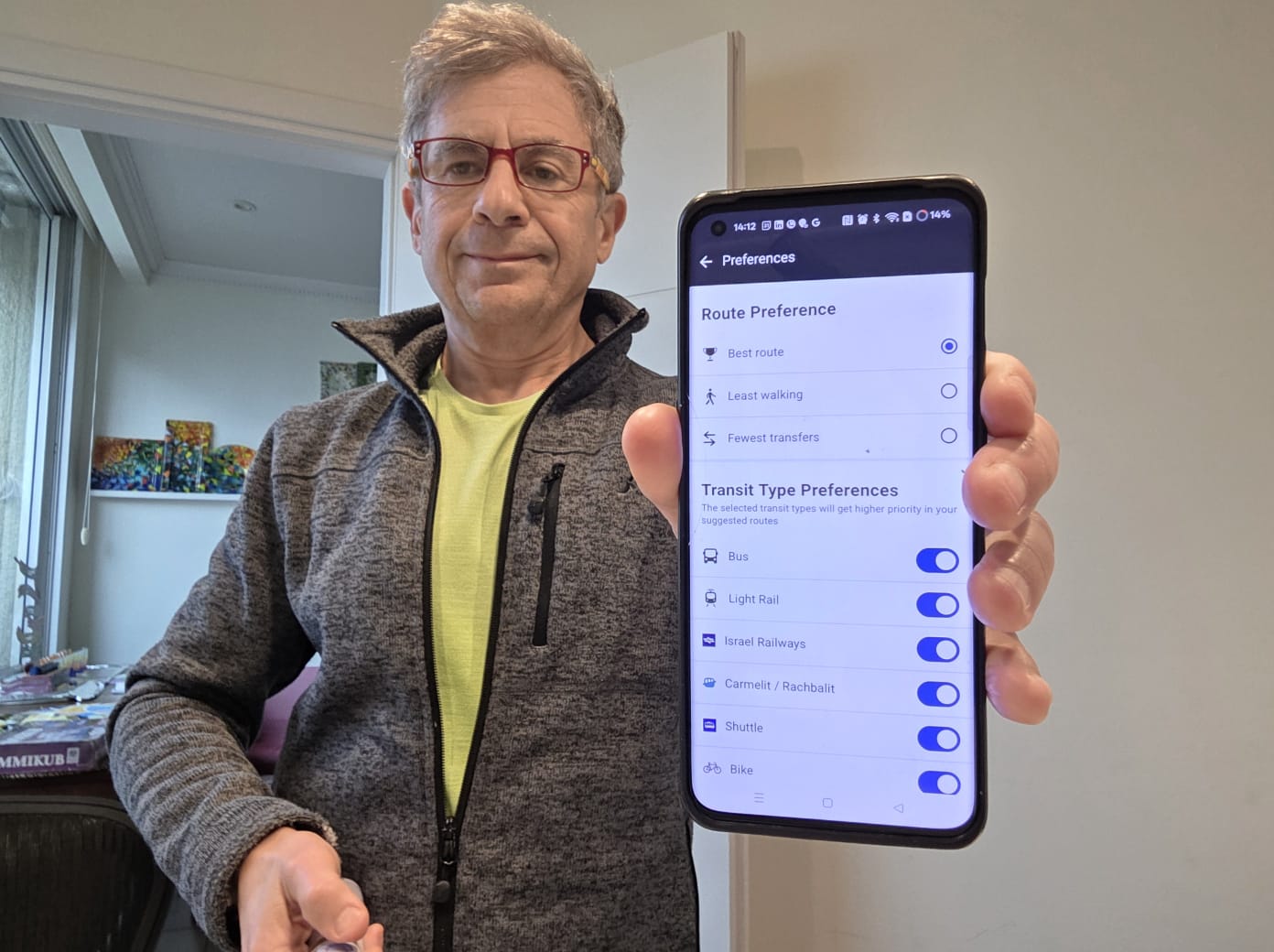
Prof. Jonathan Rabinowitz of Bar-Ilan University’s Weisfeld School of Social Work holds a transportation app showing user preferences. He’s lobbying companies to add a ‘more walking’ preference in addition to the ‘less walking’ preference. (Courtesy)
A 20-minute walk can reduce the risk of early death
According to Rabinowitz, the health implications of a little extra walking are “powerful.”
Research has shown that a brisk 20-minute walk each day can reduce the risk of early death by up to 25%, he said.
“Integrating walking into daily commutes can be a practical and sustainable way to boost physical activity, especially for those who struggle to fit exercise into busy schedules,” he said.
Although there are fitness apps that track or encourage physical activity, he said, “they don’t tell you which route to walk to get from point A to B.”
The idea behind the study grew out of Rabinowitz’s personal experience helping his son recover from an army injury. His son had a commute of an hour and 40 minutes to a coding course that he was taking as he recovered.
“He found that if he got off in the middle and walked between lines or walked more on either end, he could get to his destination quicker,” Rabinowitz said. “And that is the genesis of this whole project.”
Rabinowitz offered an easy tip to people to increase walking during their commute.
“You can get on a bus stop before the closest stop to your destination to add more walking time instead of sitting,” he said. “You can also get off one stop before your destination and walk.”
Yossi Sairov, founder of the pedestrians’ organization Our Streets, who was not involved in the study, told The Times of Israel that Rabinowitz’s initiative to encourage walking through public transportation apps is a “necessary and healthy step in today’s dense and polluted urban reality.”
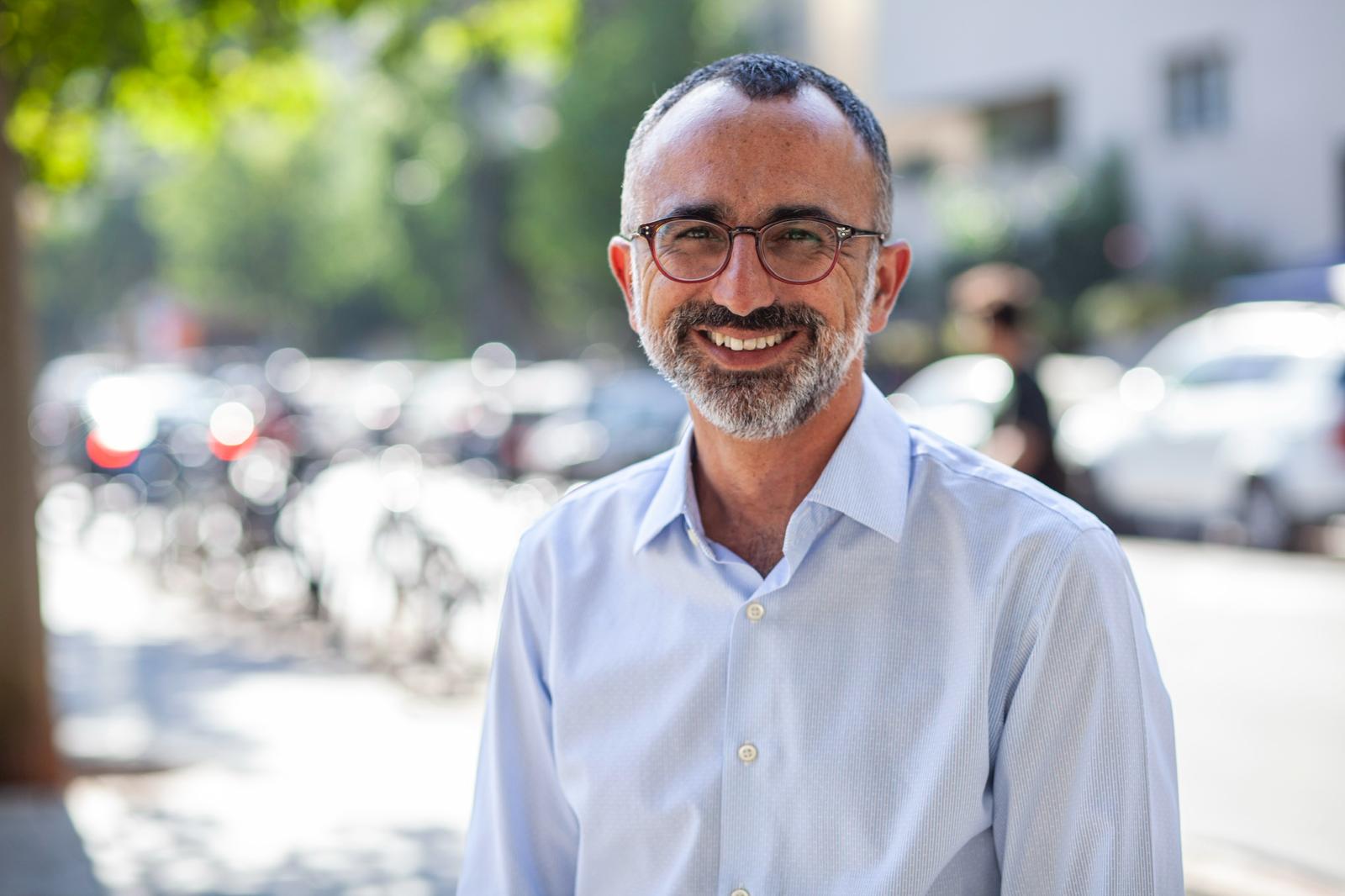
Yossi Saidov, founder of the pedestrians’ organization, Our Streets. (Courtesy)
“Efficient public transport does not begin on the bus or the train, but with the first steps toward them,” Saidov said. “Smart integration of information, incentives, and guidance within the apps people already use can turn walking from an overlooked default into a legitimate and rewarded mode of transport.”
He added, however, that an app alone “is not enough. Responsibility now also lies with local authorities: to invest in continuous and safe sidewalks, shade, lighting, high-quality crosswalks, and convenient connections to transit stops. If we want people to walk more, walking must be safe, pleasant, and intuitive. This is where real urban leadership is measured.”

Sarit Spector Turkeniz walks to work at Bar-Ilan University each day instead of driving her car after participating in a study by Prof. Jon Rabinowitz’s More Walking Project at Bar-Ilan University. (Courtesy)
Sarit Spector Turkeniz, an executive secretary at the Weisfeld School of Social Work, said that she used to drive her car 2.5 kilometers (1.5 miles) to commute to the university, a journey that used to take her 40 to 50 minutes each way.
When she first heard about the Walking Project, she decided to drive part of the way to work and then walk. Soon after that, she decided to walk the whole way.
“Walking from my house to reach my chair at my desk takes me 30 minutes,” she told The Times of Israel. “I never considered walking a sport before, but now I feel so much better.” The idea of the More Walking Project gives her motivation, she said, and she has also convinced two other people to walk to work.
Rabinowitz said the walking research was conducted as part of his Wellness Research Lab, which focuses on three areas: walking, sleeping, and hydrating.
He said there is an ongoing study that involves providing commuters with guidance on increasing walking using existing transportation apps while measuring how it affects their behavior.
The research is part of the Israeli Smart Transportation Research Center at the Technion-Israel Institute of Technology, and supported by the Smart Mobility Initiative in the Prime Minister’s Office and the Council for Higher Education. The goal is to “translate research insights into actionable lifestyle changes,” Rabinowitz said.
“We’re trying to change people’s habits,” he explained. “That’s exactly what I look for, small tweaks to everyday life.”