The Athletic has live coverage of Miami vs. Ole Miss in the College Football Playoff Fiesta Bowl game.
There was a clip going around this week from when Larry David’s character said in the season 10 premiere of “Curb Your Enthusiasm” that the statute of limitations for wishing someone Happy New Year’s is three days into the year.
However, come the following season, while canvassing door-to-door for a mayoral candidate, he tells someone who answers the door that one of the candidate’s stances is “you can’t say Happy New Year’s until after Jan. 7.”
I assume he extended the grace period once the CFP pushed the semifinals back a week.
What more will it take for the media and committee to accept that the SEC isn’t the power it used to be? There is no need for a five-bid league, especially when the middle of the conference sure looks mediocre. — Evan B.
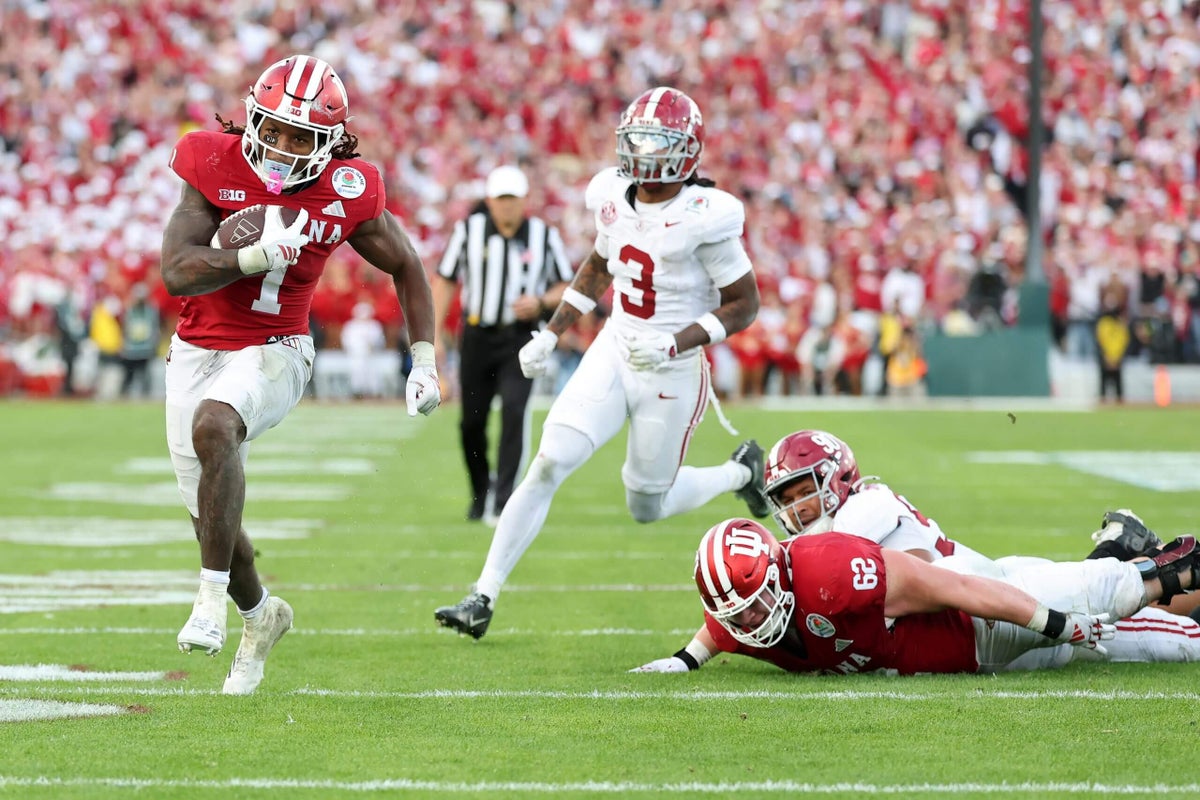
Many of you didn’t love that I turned this legit question into a one-liner last week, so I’m bringing it back. In my defense, that mailbag went up the day before the Indiana-Alabama Rose Bowl, and I wanted to hold off writing the SEC’s obit lest the Tide upset the Hoosiers and vindicate Greg Sankey.
Obviously, the opposite happened.
The SEC is having its worst postseason since I began covering the sport. Its teams are now 2-7 in the CFP/bowls when not facing each other.
To the SEC apologists who say you shouldn’t read anything into non-CFP bowl results, I’d respond by saying, first of all, I didn’t hear much of that when the league was going 8-2, but also, if we go just by the CFP, the SEC is now 2-5 in the 12-team era.
Not great, Bob.
While it’s been clear for two years that the league was slipping, I was slow to recognize how much. For most of the season, I felt the conference, though not what it once was, is still top-to-bottom the best in the country. Hard to say anymore now that the Big Ten is 8-3 against other conferences in the 12-team era and 8-2 head-to-head against the SEC in all postseason games over the past two years.
Ole Miss winning the national championship would save some face for the league, but it wouldn’t change the bigger-picture issues.
Bruce Feldman wrote an interesting piece earlier this week with opposing/former coaches’ observations about the SEC’s decline, with many correctly pointing out the trend started shortly after NIL became a factor. NIL and the portal have leveled not just the sport overall but also the SEC internally. Alabama and Georgia no longer operate in a separate tier, as shown by the fact that Ole Miss — one of the early adapters to the new landscape — is now the league’s last team standing. Much like Texas last year.
Georgia, the SEC’s back-to-back champion, is still pretty darn good, but it’s not as stacked as it was a few years ago. Kirby Smart remained adamant for several years that he wouldn’t throw money at guys; I’m guessing that’s now changed. Meanwhile, you only need to listen to Nick Saban bemoan the state of things repeatedly on TV to realize that the program started falling behind even before he retired.
The SEC’s brutal postseason came at a bad time, just as the league is about to move to a nine-game schedule. Come selection time, we will hear even more than ever how their schedules are the hardest in the history of humanity and thus all their 9-3 teams should get in. But this time, no one that’s not employed by SEC Network will believe them.
How long can Indiana stay good? Before I was an Indiana alum my family was big Michigan State fans because my sister in-law is a Sparty grad. But after Mark Dantonio, the program imploded. Is a similar fall to be expected from the Crimson and Cream? — Randell M.
Early returns are promising. Starting with the fact Indiana is spending the money to keep this thing going.
Within days of the Penn State job opening in October, IU made sure to lock in Curt Cignetti with a new contract worth $11.6 million annually, which at the time made him the third-highest coach in the sport behind only Kirby Smart and Ryan Day. Lane Kiffin’s LSU deal bumped him to fourth, but that might not last long. The Hoosiers reaching the semifinals touched off a unique clause in Cignetti’s contract that requires the school to renegotiate the deal and get him back into the top 3, or else his buyout to leave drops to $0. The number to beat is Day’s $12.6 million.
But IU’s investment extends beyond the head coach. The school also gave defensive coordinator Bryant Haines a raise from $2 million to $3 million, the same amount Penn State paid Jim Knowles last year, which makes him the highest-paid coordinator in the country. Offensive coordinator Mike Shanahan, who was earning $1.2 million previously, has also signed a new deal, though that number hasn’t been disclosed yet.
All told, Indiana, which even two years ago was paying coach Tom Allen closer to the bottom of the Big Ten than the top, is now spending more on its head coach and two coordinators than any school in the Big Ten besides Ohio State. Wild.
Meanwhile, Cignetti is already off to a hot start in the portal. He’s landed TCU’s Josh Hoover — The Athletic’s No. 4 QB in the portal — as Fernando Mendoza’s successor. Based on the current market, Hoover is likely getting $4 million to $5 million. Also: The Athletic’s No. 2 receiver, Michigan State’s Nick Marsh; Boston College running back Turbo Richard; and Kansas State edge rusher Tobi Osunsanmi.
This is what roster-building looks like for a new-age power.
None of this guarantees the Hoosiers will be back in national title contention next year. But Cignetti is a tremendous coach who’s being given all possible resources to compete at the highest level.
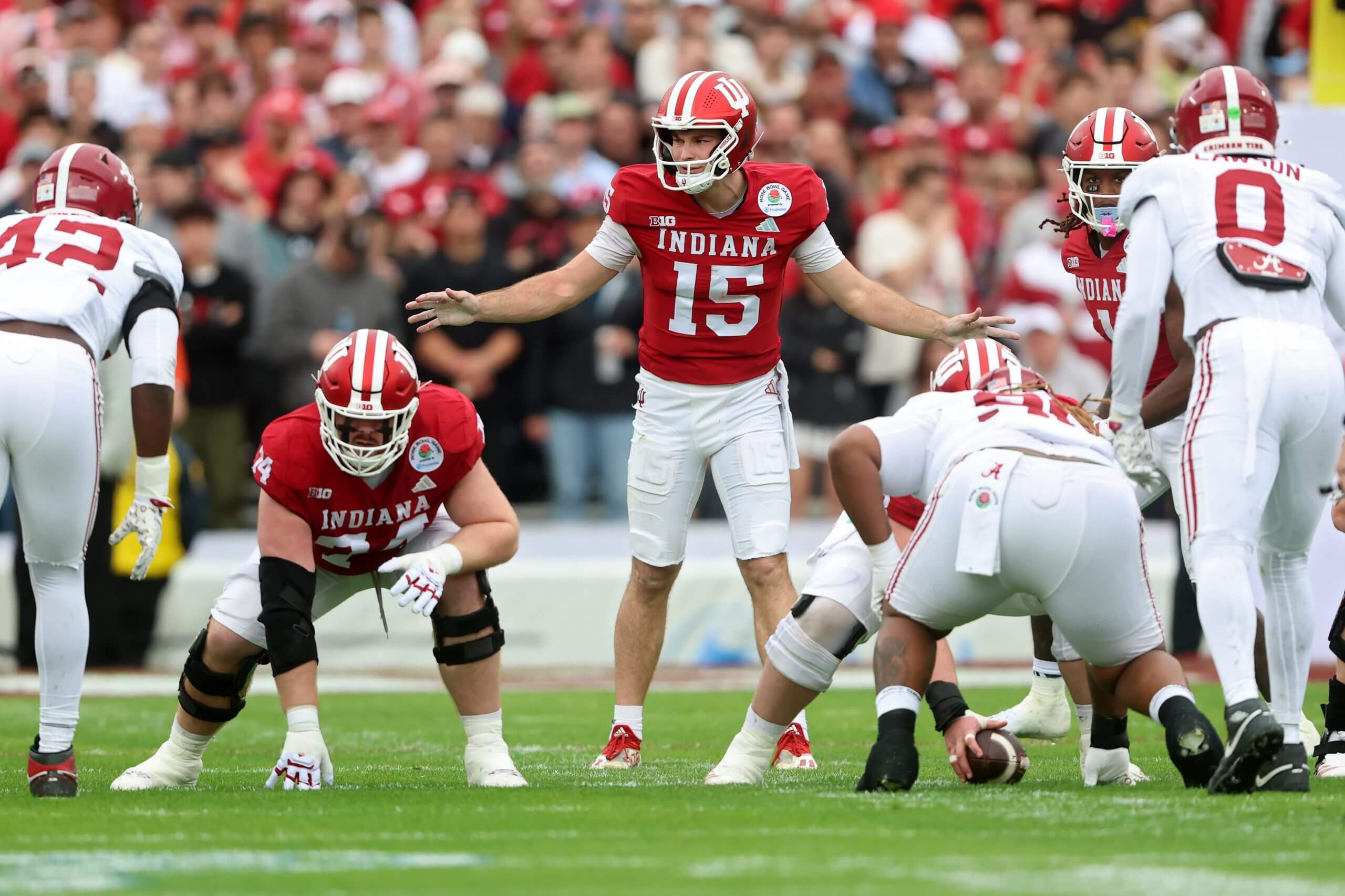
Fernando Mendoza became the first Indiana player to win the Heisman Trophy after transferring from Cal. (Sean M. Haffey / Getty Images)
How incompetent does the committee look now? They spent a month telling us Miami was a borderline Playoff team at best or not in and now they are in the semifinal. Couple that with Alabama getting in as a three-loss team that got completely destroyed. — Brian S.
I’m not a big fan, in either football or basketball, of using postseason results as a referendum on the selections, good or bad. The committees select the fields based on how the teams performed in the regular season. They can’t predict how the teams will perform in what is then essentially a brand-new season.
I got deluged post-Rose Bowl with Notre Dame fans claiming, “Notre Dame would have been more competitive with Indiana,” while ignoring that Alabama had to win a game first to get there. Should Oklahoma have been out too? Also, you do realize if both Miami and Notre Dame had been in, the Canes would have been the 9 seed and the Irish the 10 seed? You’re just assuming Notre Dame would have won at Texas A&M – a team it previously lost to.
That being said, I said at the time Notre Dame should have been in and Alabama out. And the main reason was the Tide’s backslide over the last month of the season, losing at home to the Sooners, getting outgained by Auburn and getting killed by Georgia. Meanwhile, Notre Dame was on a 10-game winning streak and Miami had rebounded from its Louisville and SMU losses to crush its last four opponents.
The committee isn’t “incompetent,” but I think it should put more emphasis on how teams perform at the end of the season. I understand every game needs to matter, and it did send that message by finally moving Miami above Notre Dame, but a team’s performance over the last month is much more representative of the version you’re going to see in the Playoff than the one that struggled early.
Stewart — if Ole Miss goes on to win the national championship, does Lane Kiffin get “National Champion Head Coach” associated with his name? —Michael M.
Absolutely not. But I have no doubt he’ll add it to his Twitter bio.
Stewart, there are tons of fans who understandably complain about the current state of college football with NIL and transfers, but there are obviously plenty of fans who are fine with it as well. So I’ve been wondering, which teams do these fans root for who are so vehemently opposed, or fine with it? — Ben
Sometimes I feel like I’m living in a twilight zone, because to me, as a neutral observer, it’s so plainly obvious that NIL and the portal have improved college football as a product. Who wouldn’t want a sport with more parity? Where Vanderbilt can win 10 games and Indiana and Ole Miss can go farther in the Playoff than Ohio State and Georgia?
And yet, almost everything I hear about those subjects is overwhelmingly negative.
But again, I’m neutral. I get why these issues are more divisive if they negatively impact your own school. If I’m an Alabama fan, I don’t love that a program we used to thumb our nose at can now beat my school for a five-star recruit. If I’m an Iowa State fan, I’m pretty distraught that my coach can leave for a blue blood and take double-digit players with him. And if I’m a James Madison fan, I’m pretty frustrated that our whole starting lineup left for a P4 payday.
But for every school that suffers from the new system, someone else is gaining from it. Schools like Indiana/Ole Miss/Texas Tech/Vanderbilt, which have spent most of their histories trapped under a low-hanging ceiling, now have a path to upward mobility. For schools that have fallen on hard times, your new coach no longer needs four years of his own recruiting classes to turn it around. And while G5 and FCS schools have to deal with P4 schools poaching their best players, they also benefit from the trickle-down of displaced P4 players.
One thing I find fascinating about the new model is that it has introduced a whole new Moneyball-esque element of strategy. No longer is recruiting just about the logo on a coach’s quarter-zip or his ability to smooth-talk a guy’s mom. Now it’s about which coaches and GMs are the shrewdest in how they value specific personnel and how they deploy their budgets.
No question, it’s harder than before to keep up with who’s staying and who’s going. But it’s also kind of fun. Unless of course your favorite team is getting raided.
I have been proposing for years that players who transfer be required to reimburse schools they leave a certain amount to reflect the sunk costs such as recruiting expenses, training, meals, etc. The House settlement payments put my idea on a better legal footing. Are you hearing that UGA will have experts lined up for its litigation against Damon Wilson to justify its position along these lines? — Tom W.
No, I don’t think anyone’s bringing receipts from Wilson’s training table breakfasts. But Georgia will presumably have experts lined up to assert why losing a stud pass-rusher after he’s already re-upped caused $390,000 in damage to this year’s team.
I heard they’re just going to show the jury tape of the Sugar Bowl.
In 2024, Indiana came out of nowhere to make the Playoff, but then got outclassed once they got there. This year, the Hoosiers got a top QB and are back and better than ever. With Texas Tech getting Cincinnati’s Brendan Sorsby, could you see the Red Raiders making a similar jump next season? — Andrew G.
It’s an interesting comparison because Texas Tech is almost in the exact opposite situation as Indiana’s.
While Mendoza is the face of Indiana’s ascendence from “good” in 2024 to “elite” in 2025, it’s not like predecessor Kurtis Rourke was holding the Hoosiers back. Last year’s 11-2 team was not lacking for explosiveness on offense and was very good on the back end of its defense. It got exposed in the losses to Ohio State and Notre Dame on the offensive and defensive lines. This year’s Hoosiers upgraded along the lines considerably, and it’s shown in top-10 wins over Oregon, Ohio State and Alabama.
Whereas Texas Tech’s 2025 team was purposefully built along the lines of scrimmage. Its D-line in particular was dominant all season, even in that 23-0 quarterfinal loss to Oregon. But that game exposed its offensive limitations, especially at quarterback. The Red Raiders addressed that immediately in the portal by landing Sorsby, but now they have to replace all those studs on defense (David Bailey, Lee Hunter, Romello Height, Jacob Rodriguez) who helped get them to the CFP in the first place.
It’s a tall order, but GM James Blanchard had a high hit rate with this year’s portal class and could well do it again. If nothing else, we know Texas Tech won’t be hurting for money.
One note on Sorsby, though. The two-year Big 12 starter is unquestionably talented and earned The Athletic’s No. 1 QB rating for a reason. Statistically, he got a lot better this season (27 TDs, 5 INTs, 8.3 YPA passing, plus 580 yards and 9 TDs rushing). But I’m a bit concerned that both his Cincinnati teams collapsed over the last month of the season, going a combined 0-8 in November. Obviously, that’s not all the QB’s fault, but his three worst performances this season were in the opener against Nebraska, and then late-season losses to Top 25 Utah and Arizona teams.
But Mendoza himself went 9-11 as a starter at Cal. Better coaching and better supporting cast go a long way.
Was Nebraska’s decision to extend Matt Rhule a mistake in hindsight? Would Nebraska have struggled to find a replacement with this year’s competition in the coaching carousel? — Mitch
Nebraska wouldn’t have fired Rhule after this season even if the buyout was $0. But that midseason extension the school gave him because … uh oh, Penn State’s AD is buddies with Rhule … might be the most extreme example of a school negotiating against itself.
I get why AD Troy Dannen was feeling bullish about Rhule at the time. Coming off the miserable Scott Frost era and Rhule’s own rough first season, he ended Nebraska’s eight-year bowl drought in Year 2, going 7-6, and had the Huskers off to a 6-2 start in Year 3. Losing him after the season would have been less than ideal, but nor had he reached irreplaceable status. At the time, he was still 0-7 against Top 25 foes (after going 0-11 at Baylor) and was barely a week removed from losing 24-6 at Minnesota.
That did not stop Dannen from giving him a two-year extension through 2032 that was celebrated in Lincoln at the time for bumping Rhule’s buyout to leave from $5 million to $15 million.
But that didn’t tell the full story. The contract is heavily backloaded, with Rhule going from making $7.5 million this year to $12.5 million by the end, and 90 percent of it is guaranteed. So those two extra years added another $22.5 million in guaranteed money, pushing next year’s buyout number above $60 million. For a coach who was 18-15 at the time, and now 19-19, after QB Dylan Raiola was lost for the season and the Huskers’ defense imploded down the stretch in three blowout losses.
Adding insult to injury, it turned out that Rhule was never a serious candidate at Penn State, based on my colleague Ralph Russo’s reporting. And Raiola, once the great hope, went in the portal.
Rhule, now coming off back-to-back 7-6 seasons, would ordinarily enter Year 4 on the hot seat, but I don’t see Nebraska paying $60 million-plus to fire its coach even if the bottom falls out. All it can do is hope Rhule signs one heck of a portal class and gets over the seven-win hump.
I recall a leading sports pundit opine in his seminal treatise entitled “Bowls, Polls, and Tattered Souls” that college football is inherently cyclical. I imagine that some — perhaps even the pundit himself — wondered whether that was still true in the modern game, but I also imagine that the current season reinforces the original argument. — Mo H.
Yes indeed, way back in 2007, I assured everyone the SEC’s dominance would not continue indefinitely because college football is cyclical.
It only took a decade and a half to prove I was right.