A Good Morning Britain guest opened up about how reaching for a nasal spray when she had a cold sparked a 23-year health battle while on Thursday’s episode of the show.
Charlotte Johnstone, 30, appeared on the latest instalment to chat to hosts Susanna Reid, 55, and Richard Madeley, 69, about her addiction to decongestant nasal sprays, which came about after she started using them as a little girl.
This comes as concerning new research by the Royal Pharmaceutical Society (RPS) revealed that nearly 60 per cent of people are unaware that these sprays shouldn’t be used long-term, putting them at serious risk of rebound-congestion.
Susanna explained to viewers that one in five users are exceeding the seven day usage limit of the product, meaning that up to 5.5million people are at a risk of dependency – so the Royal Pharmaceutical Society are calling for clearer instructions on packaging.
Richard asked Charlotte: ‘So how old were you when you first used the spray?’
Charlotte, who uses it up to eight times a day, replied: ‘I must have been about seven or eight.
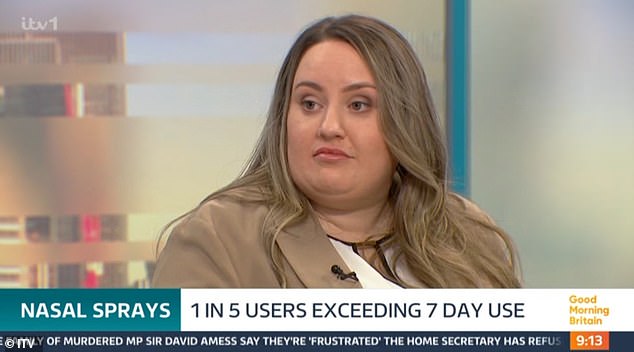
A Good Morning Britain guest (pictured) opened up about how reaching for a nasal spray when she had a cold has sparked a 23-year health battle on Thursday’s show

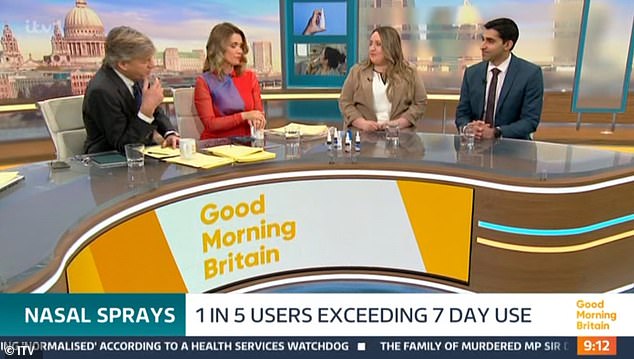
Charlotte Johnstone, 30, appeared on the latest instalment to chat to hosts Susanna Reid, 55, and Richard Madeley, 69, (pictured) about her addiction to decongestant nasal sprays after she started using them as a little girl
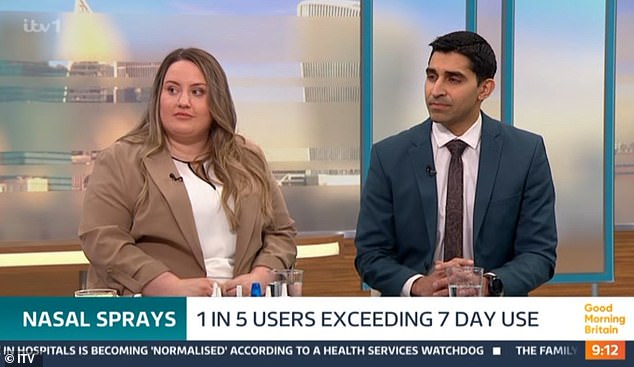
Pharmacist Sanjeev Panesar also joined Charlotte in the studio to talk about the issue
‘It started off with a cold and I just couldn’t stop.’
Richard pointed out: ‘Not because it gives you any “high”, when we say addiction, we don’t mean that you’re getting some sort of buzz out of it.
‘It’s just that straight away it cleared your nose up for you so you could breathe better.’
Charlotte confessed: ‘It was so open. It’s such a fresh feeling and then I got addicted to that feeling of it and now I’ve got this rebound congestion.’
An intrigued Susanna asked: ‘What happens if you don’t use it?’
Charlotte told her: ‘I haven’t been in a position where I won’t use it.’
Explaining what it feels like when she doesn’t use the product, Charlotte said: ‘You feel like you’re blocked up, mucus and stuff but there is no mucus.’
Charlotte wants a warning to be made clearer that you should only use the spray for seven days.
Explaining what it feels like when she doesn’t use the product, Charlotte said: ‘You feel like you’re blocked up, mucus and stuff but there is no mucus’

‘I mean, on the bottles it says don’t use for X amount of days, but it doesn’t say why,’ she told Susanna and Richard.
Pharmacist Sanjeev Panesar, who joined Charlotte in the studio, explained: ‘Like Charlotte said, when you first use a nasal spray, it gives you that relief so it helps constrict the blood vessels and the inflammation in the nasal passages to help increase that air flow.
‘But then what happens is, why that restriction for over seven days is there is your body can get used to that quite quickly, and then what happens is, you need more of that spray to get that relief.
‘Essentially, what happens then, is your body overcompensates by creating inflammation.
‘So when you stop using it, overcompensates, more inflammation, more congestion, you feel like you need to use the spray again to get that relief and it’s a vicious cycle.’
Talking to ITV News, Charlotte said: ‘I find my heart is just racing, I’m just thinking I need it.
‘It’s probably how any other addict feels.
‘It’s been super late in the night or early hours of the morning, and I’ve driven an hour plus to go to a 24-hour supermarket.
‘If they don’t have it there, I will drive until I find it.
‘It’s really sad, but I know that in some of these bottles there will be at least one or two drops, if I’m in a situation where I can’t find a full bottle, or I’m running out, I will bite the tops off and just put them all into one bottle so I’ve got enough to last me until I can get some more.’
She later added: ‘I was referred to go see an ENT consultant, I must have been in there about five minutes, he didn’t know anything about it…
‘He made me throw it away in front of him.
‘I ended up going home and having a panic attack.
‘It’s frustrating as well at the same time, you’re reaching out to people to try and get help, but they don’t really know about it themselves.’
Now, the RPS are calling for the risks of overusing these medications, such as Sudafed and Vicks, to be clearly labelled on packaging.
Professor Amira Guirguis, chief scientist at the RPS, said: ‘Our research shows that many people are unaware of this risk, which means they may continue using these sprays without realising they could be prolonging their symptoms.
‘We’d like to see clearer warnings on the packaging which you can’t miss and greater awareness of the seven-day limit.’
She added: ‘The response needs to be proportionate to the risk, and at the moment, the immediate, important step to take is to clarify the message and the health advice with a waning on the front of the packing that this product should not be used beyond the seven-day limit.’
Medically known as rhinitis medicamentosa, rebound congestion can affect anyone who overuses nasal sprays, triggering irritation, runny nose, sneezing and congestion.
Most patients routinely using nasal sprays will be able to successfully wean themselves off the drug and suffer no long-term nasal damage, experts say.
But others suffering from the condition will have to use a stronger, steroid-based spray before symptoms improve.
Good Morning Britain airs weekdays from 6am on ITV1 and ITVX.