Good afternoon! It’s Thursday, and get ready to pay up if you’re looking for tickets to the Packers-Bears game this weekend: The cheapest option goes for $400. Here’s what else you need to know today.
1. High schoolers are training to be election judges in the March primary
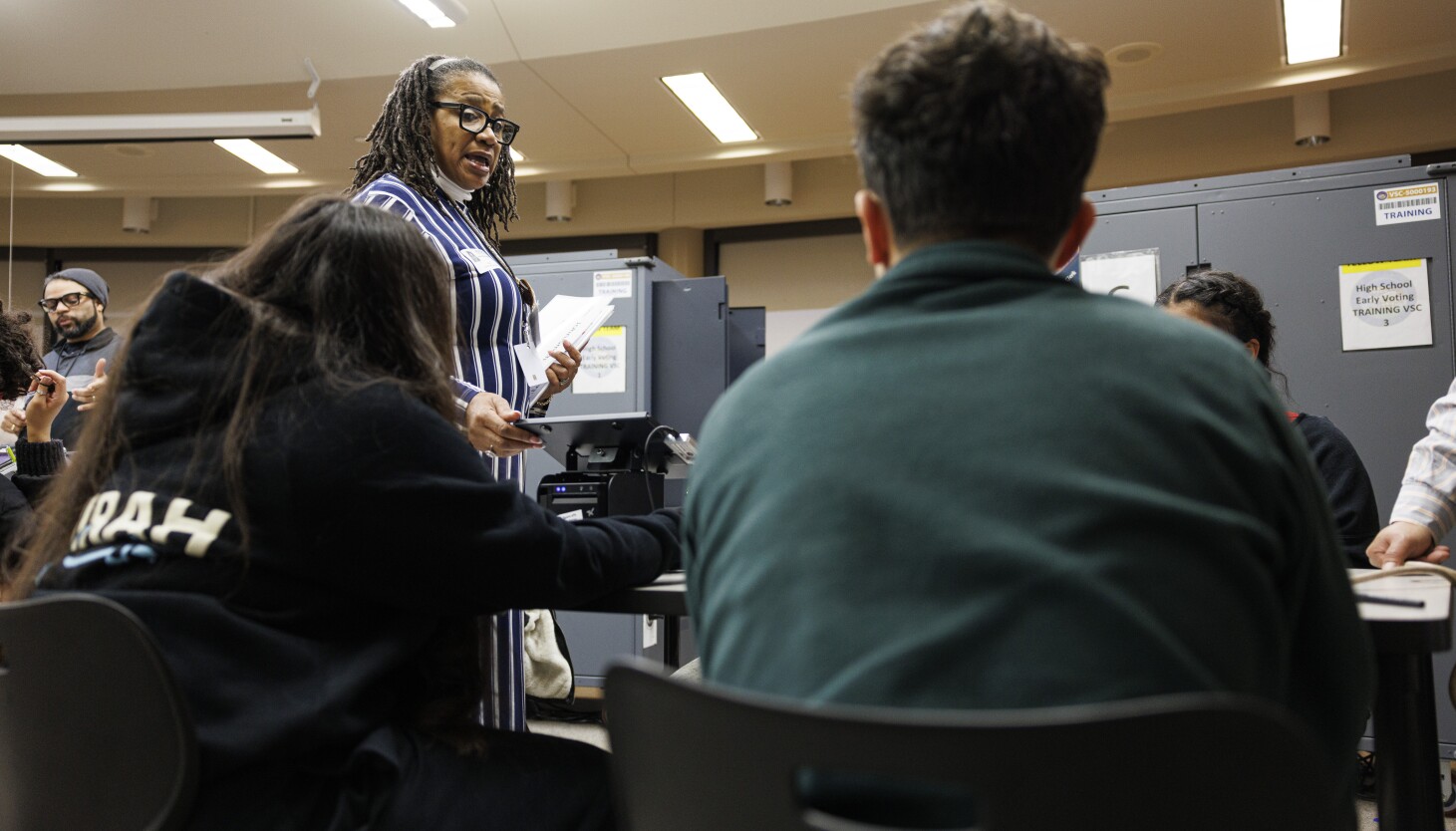
The Cook County Clerk’s Office and Chicago Bears this week launched Defenders of DA’Mocracy, a program to train 150 high school juniors and seniors to serve as election judges during their schools’ early voting day on Feb. 26.
As my WBEZ colleague Somer Van Benton reports, students from 24 participating schools will learn how to check in voters, handle ballots and manage voting equipment.
The program aims to “transform students from passive observers into active participants in the electoral process,” said Frank Herrera, the clerk’s office deputy of communications. The program not only provides student judges a chance to run their school polls; it also intends to give eligible students the opportunity to register and vote.
Illinois has allowed high school students to serve as election judges since the early 2000s. But this program is the first of its kind in Cook County to train students to operate primary early voting sites on their own campuses.
“It’s going to be run by the high school students, for the high school students,” Deputy Clerk of Elections Edmund Michalowski said. [WBEZ]
2. A ‘death doula’ provides comfort and support to the terminally ill on their final journey
Tiffany Johnson works with the dying to navigate the last months and weeks of life, my colleague Stefano Esposito reports for the Chicago Sun-Times. She also helps healthy people prepare for the inevitable, from putting together a videotaped message for those left behind to deciding who should be in the room at the very end.
Johnson has recently found herself talking publicly about her work and advocating for Illinois’ so-called right-to-die legislation.
The law allows someone 18 or older to request a fatal medication; to be eligible, the person must have been diagnosed (by two physicians) with an illness expected to lead to death within six months. Many religious leaders and disability rights activists see it as legalized physician-assisted suicide and oppose the measure.
“This is why I get so frustrated,” Johnson said. “People say, ‘assisted suicide.’ It’s not suicide. … Folks already understand that their lives are shorter than they want them to be. These are not individuals who want to die. Their health has changed to the degree that they no longer have a prolonged future ahead. And they want to have some sense of autonomy about how those last days look.” [Chicago Sun-Times]
3. The city awarded $33 million to dozens of businesses and organizations
Grant winners were chosen through competitive application rounds through the city’s Department of Planning and Development Community Development Grant and Neighborhood Opportunity Fund programs, totaling $90 million in public-private neighborhood investments.
The West Garfield Park-based Institute for Nonviolence received $4.8 million to create a new $9.5 million headquarters for the nonprofit that focuses on gun violence prevention.
Meanwhile, the owners of Los Candiles Restaurant in Little Village will receive nearly $96,000 to expand and hire new employees. Business declined as immigration enforcement agents targeted the neighborhood. [WBEZ]
4. Mayda Alexandra del Valle has been named Chicago’s next poet laureate
Born and raised on the South Side, the renowned poet and educator is an interdisciplinary artist with a rich cultural history of the city, my colleague Mike Davis writes for WBEZ.
Del Valle, 47, will serve a two-year term as poet laureate and receive $70,000 as commission for new works. The poet laureate also serves as an ambassador for Chicago’s literary and creative communities and creates initiatives for youth, students and community members across the city.
Her previous work includes the poetry collections “A South Side Girl’s Guide to Love and Sex” and “The University of Hip-Hop.” In 2016, she won the Drinking Gourd Chapbook Poetry Prize from Northwestern University Press. [WBEZ]
5. Hear prominent Chicagoans read Carl Sandburg’s iconic 1914 poem, ‘Chicago’
The work, which coined the phrase “City of Big Shoulders,” has inspired proud political speeches, launched a comic series and even decorated buildings. It has been analyzed in classrooms and has surely served as a rousing nightcap at many an Uptown poetry slam.
But the poem recently gained fresh relevance when a judge read it aloud in a court ruling addressing use of force by federal immigration agents.
As the year begins anew, with a rush of civic pride going into this weekend’s Bears playoffs, WBEZ’s arts desk asked some well-known Chicagoans to recite it. We caught on tape broadcaster Bill Kurtis, Mayor Brandon Johnson, emcee Sir Michael Rocks of the Cool Kids, “The House on Mango Street” author Sandra Cisneros, Congressman Danny Davis, Bears tight end Colston Loveland and WBEZ host Mary Dixon.
You can hear it in the link. [WBEZ]
Here’s what else is happening
- Minnesota investigators said the U.S. attorney’s office has prevented it from taking part in the investigation into an ICE officer’s fatal shooting of a Minneapolis woman. [AP]
- The U.S. Senate advanced a resolution to limit Trump’s ability to attack Venezuela. [AP]
- Mayor Brandon Johnson braced City Hall for midyear layoffs if revenue projections in the alternative city budget fall short. [Chicago Sun-Times]
- The oldest living Chicago Bear, 92, hopes the team has a Super Bowl in its future. [Chicago Sun-Times]
Oh, and one more thing …
“Material Worlds,” an exhibition currently on view at the Art Institute of Chicago, offers a glimpse into the unusual mind and prolific creativity of late architect Bruce Goff.
He grew up and launched his architecture career in Oklahoma but spent close to a decade in Chicago, from 1934 to 1942, teaching and developing an independent architectural practice. It was here Goff began to create residences that still to this day overturn preconceived ideas about home design.
Some of those structures still exist, and they may be homes you’ve driven past, with little more than a small marker to designate their architectural significance.
You can see a map of these buildings in the link. (If you go, be aware these are all private properties and not open to the public or tours.) [WBEZ]
Tell me something good …
What’s something you’re looking forward to this year? It can be something small or a major life event.
Regina writes:
“I’m looking forward to welcoming my first grandchild. My stepdaughter is due in June. I’m thrilled for them and can’t wait to be Grandma!”
Feel free to email me, and your response may be included in the newsletter this week.