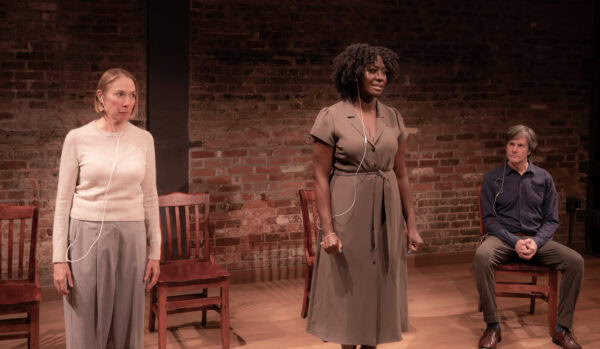
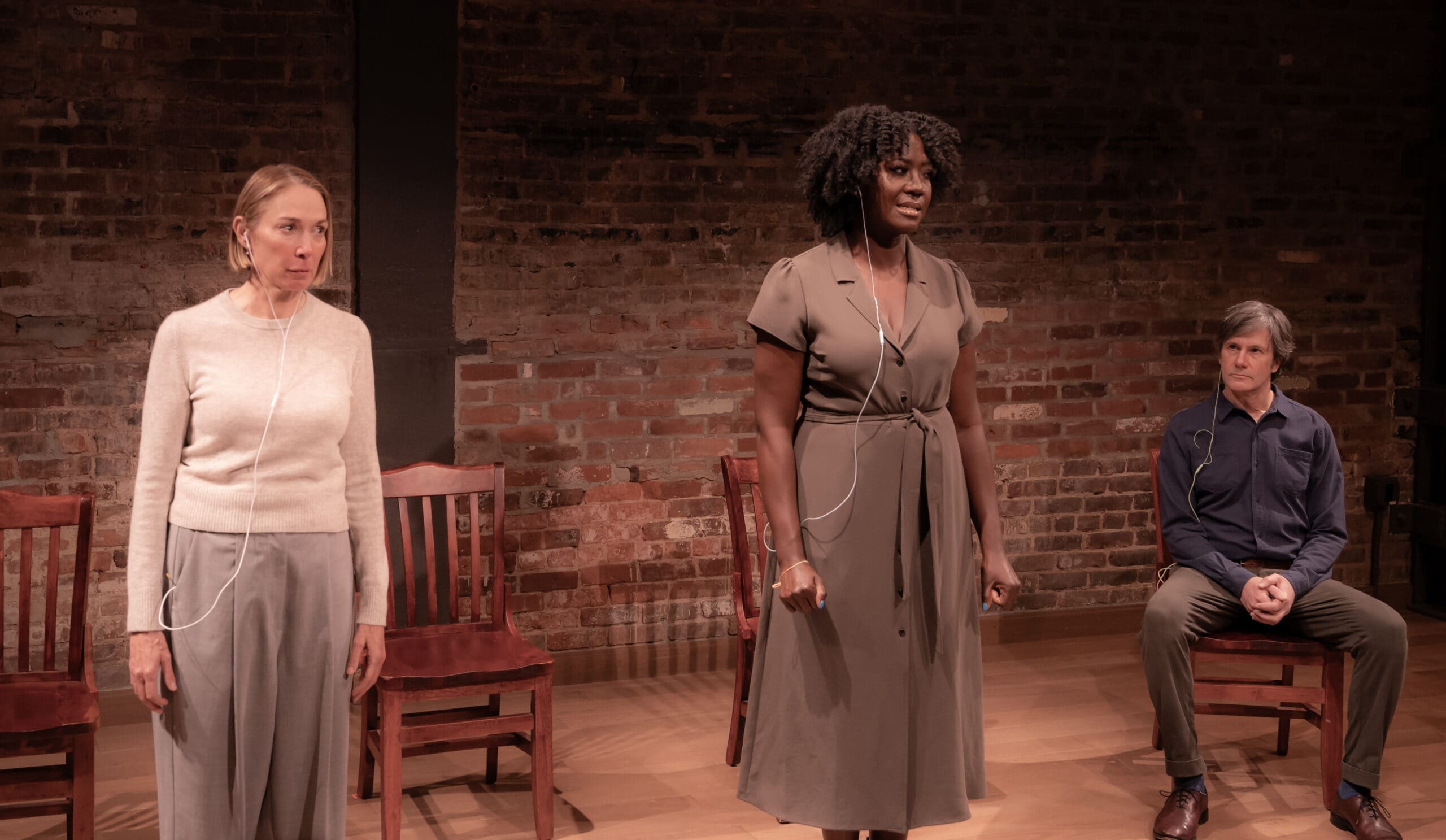
Elizabeth Marvel, Amber Iman, and Josh Hamilton in The Ford/Hill Project. Photo: Marina Levitskaya
I am going to go ahead and out myself as old enough to remember both Anita Hill’s testimony at the Supreme Court confirmation hearing for Clarence Thomas in 1991 and, almost thirty years later, Christine Blasey Ford’s at Brett Kavanaugh’s hearing in 2018. Both were indelible enough political events that I know exactly where I was when both votes happened (highly relevantly, at What the Constitution Means to Me on the day Kavanaugh was confirmed). So I didn’t really expect surprises in The Ford/Hill Project, a piece of verbatim theater (created by actor Elizabeth Marvel and director Lee Sunday Evans for Waterwell, now presented at LaMaMa as part of the Under the Radar Festival) drawing from transcripts of the hearings I’d already seen on TV. And of course, we know how these hearings end before the show begins: we know Kavanaugh and Thomas as Supreme Court justices, we know how much power they wield, and we know how they wield it.
The show does seem to presume the audience will bring that knowledge: while lobby displays and the production’s website fill in backstory, and an array of resources presented in the program and through post-show discussions add dimensions of advocacy and support for sexual assault survivors, the piece itself, with its brusquely bureaucratic title, sticks strictly to the testimony, dropping you into the middle without building any sort of expositional framework, or ever identifying any of the questioners. (I can imagine it being enormously effective embedded in an explicit curriculum.) The one piece of explanatory business it does do is open with a bit of audio from the actual hearings and then show the actors putting in earbuds: they’re serving as literal mouthpieces, funneling the words of history right to us. The transmission is not unmediated, of course–Marvel and Evans have both selected the sections to include in the play and interwoven the two events skilfully–but it is faithful, down to “um”s and “er”s and misspeakings. (The script goes so far as to color-code utterances that can be heard on the audio but do not appear in the official transcripts.)
But I did find myself surprised by the punch The Ford/Hill Project packs, for many reasons, including how starkly these charged one-on-one exchanges of testimony between the senators and the witnesses or the senators and the judges limn the mechanisms of sexual assault. Evans and Marvel have distilled what must be hundreds if not thousands of pages of transcripts and audio recordings into a taut hour that nonetheless gives both women’s stories full weight and highlights both the telling details of the events and the way both women continue to be affected by these experiences and memories. The portions of testimony depicted here are the familiar highlights for the most part. (I was a little puzzled by one fairly lengthy digression into the introduction of Hill’s family that does establish her backstory but muddies the opening moments by giving us a lot of names of people who are either never mentioned again or who are reintroduced in Hill’s opening statement.) But the way Marvel and Evans have intercut them to show both the parallels and the contrasts between the two women’s stories is effective: on the one hand, the contrast between pervasive workplace harassment and an individual instance of personal assault, or between a victim who’s an accomplished professional and one who’s a high-school girl; on the other, a shared sense of determination in the face of fear, and a shared sense of deep, weary accommodation to trauma. (The costumes, credited to coordinator Amanda Roberge lightly reflect the distinction between settings, with Hill and Thomas in business attire, Ford and Kavanaugh in more casual clothes, all in careful neutrals and pale blues.)
I was also struck to realize that while the two hearings were almost thirty years apart, the events to which Hill and Ford testify all took place in the summer of 1982, when Ford was a high school student and Hill, ten years older, was a recently qualified lawyer–and yet whether ten years in the past or thirty-plus, Hill’s and Ford’s recollections are crystal-clear.
But where the piece becomes more than a talking-heads documentary is in director Lee Sunday Evans’s work with a gifted ensemble, creating performances whose voices never stray beyond the range of emotions shown in the real events—most of them carefully calibrated for the public appearances they are, with the few emotional slips of control telling—but that still reveal much more. Most of the time, Hill is played by Amber Iman and Ford by Elizabeth Marvel, both of whose faces betray the reactions their voices seek to control as they speak: a barely perceptible ripple of revulsion across Iman’s whole face as she maintains a placid express by sheer force of will; the way Marvel seems to disappear inside herself for one flinching second. Likewise, most of the time Thomas is played by Jon Michael Hill and Kavanaugh by Josh Hamilton (this particular resemblance in performance is almost uncomfortably uncanny), and if Iman and Marvel’s faces reveal reactions of pain and fear that they’re trying to control, Hamilton and Hill’s reveal barely controlled impatience, self-righteousness, and disdain. (One could almost believe, listening to Hill deliver Thomas’s testimony with ringing clarity, that he truly thinks himself blameless; one cannot say the same for Hamilton’s Kavanaugh and his petulance.) And while the senators are never identified, all four actors ably acquire their vocal tics and habits to make it clear when a questioner shifts, and what that questioner’s attitude is toward the proceedings.
In one key section, the roles are flipped, with Hamilton and Jon Michael Hill taking on the roles of Ford and Anita Hill as the senators probe into some of the specific details of the women’s testimony. Hamilton and Hill are in no way imitating Marvel and Iman, but we see their puffed-up postures deflate, shift from a barely considered default of taking up space to a conscious, willed commitment to resist the impulse to curve inward in self-protection. We hear the shift from confident arrogance to willed clarity. Those small distinctions have a lot to say about the performance of gender in the world, even beyond the specific context of bearing witness to sexual and gender harassment.
We don’t see the end of the hearings: the confirmation votes. Instead, we see the men put on their robes, facing away from the audience, and then take a “victory lap” of procession around the space, while the women’s stricken, still faces retain the emotion of their testimony and a song with the lyric “make it right, make it right, make it right” plays. It’s a chilling moment–and the fact that these two events are twinned means that thirty years wasn’t enough to begin making it right.