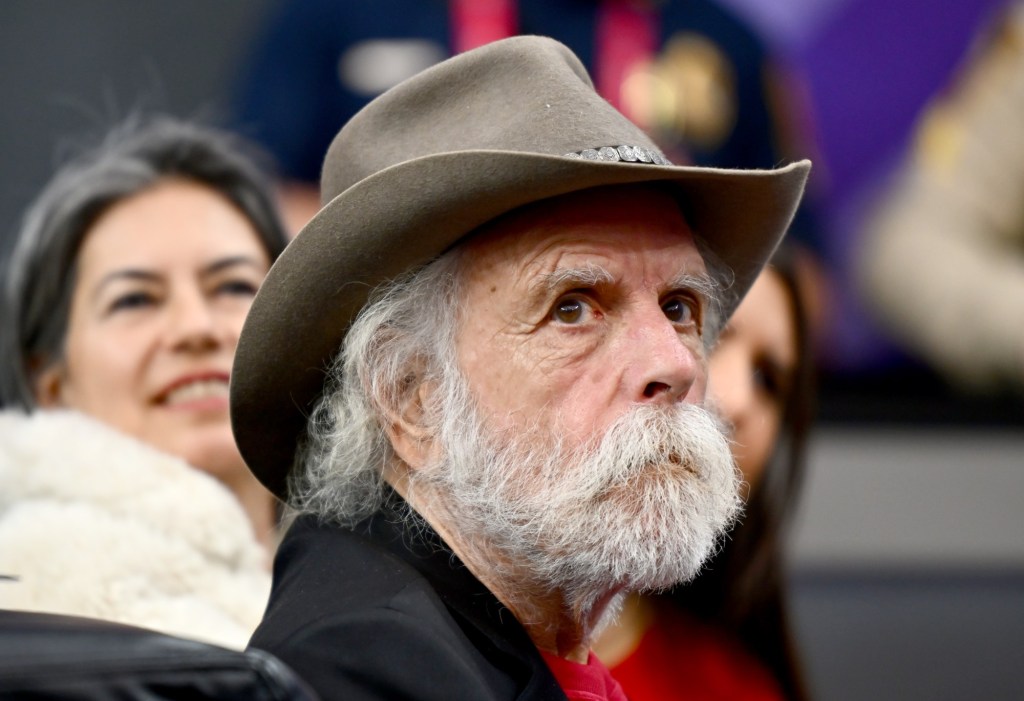
Bobby Weir, a founding member of the Grateful Dead and one of the true pillars of the psychedelic rock/jam-band community, died on Jan. 10.
The Bay Area rock legend was 78.
News of his passing was made public via social media, which included a post from Weir’s daughter — Chloe Weir — on the vocalist-guitarist’s Facebook page.
“It is with profound sadness that we share the passing of Bobby Weir. He transitioned peacefully, surrounded by loved ones, after courageously beating cancer as only Bobby could,” the post reads. “Unfortunately, he succumbed to underlying lung issues.
Weir will be remembered as one of the original members of one of the most important rock bands of all time — and certainly one of the greatest American rock bands ever to take the stage — which changed the face of the concert business and formed a bond with its fans (aka, the Deadheads) that was truly second to none.
Forming in the Palo Alto in 1965, Weir and his compatriots in the Dead — including fellow original members vocalist-guitarist Jerry Garcia, bassist Phil Lesh, drummer Bill Kreutzmann and keyboardist Ron “Pigpen” McKernan — created a sound that was no other.
They were, above all else, restless sonic travelers and they weren’t content to stay in just one chapter of the music history book. Instead they borrowed from everything from country, folk and blues, to jazz, ’50s rock and Motown to forge a freewheeling, fun-loving sound that felt so distinctly — and authentically — American.
It was too wild — arguably, too real — for mainstream radio to embrace it when the band first started making records in the late ’60s. And that trend would continue up until the late ’80s, when a brilliant fluke of a single — “Touch of Grey” — managed to break on through to the other side and ignite Grateful Dead mania with a whole new generation of fans.
For most of its career, however, the Dead had to completely count on its live show for its survival. They took to the road — and they stayed on it — foreshadowing how the concert business would continue to grow in importance to the point where its now clearly eclipsed the album charts in terms of significance, especially in the rock ‘n’ roll world.
And that seemed to sit just fine with Weir, who loved playing live shows — and continued to do that right up into 2025.
“For over sixty years, Bobby took to the road,” Chloe Weir’s Facebook post continues. “A guitarist, vocalist, storyteller, and founding member of the Grateful Dead. Bobby will forever be a guiding force whose unique artistry reshaped American music.
“His work did more than fill rooms with music; it was warm sunlight that filled the soul, building a community, a language, and a feeling of family that generations of fans carry with them. Every chord he played, every word he sang was an integral part of the stories he wove. There was an invitation: to feel, to question, to wander, and to belong.”
When Garcia — the band’s guiding force, spiritual father figure and, in many people’s eyes, a kind of a father figure to Weir — died in 1995, the Grateful Dead officially called it quits.
Well, kind of.
A better description may be that the group — which played its first show under the name Grateful Dead in December 1965 in San Jose — would decide to never perform again under its usual moniker. Instead, the remaining players (and their talented musical friends) would continue to mine the Grateful Dead’s bountiful songbook — containing such gems as “Box of Rain,” “Ripple,” “Sugar Magnolia,” “Truckin’” and “Casey Jones” — in a variety of band offshoots.
Those included Phil Lesh & Friends, The Dead, Furthur and — most recently (and lucratively — Dead & Company. That latter outfit, which featured Weir, Hart, pop-rock star John Mayer and others, served to pass on the Dead bug to, in all likelihood, hundreds of thousands of listeners as it became a massive stadium attraction in its own right.
Fittingly, Dead & Company’s final performances occurred right where the famed “long, strange trip” originally began — the Bay Area — as the band took to Golden Gate Park for three sold-out Grateful Dead 60th anniversary concerts in August.
And Weir was still performing at an incredibly high level at those shows.
“Bobby’s final months reflected the same spirit that defined his life,” the post reads. Diagnosed in July, he began treatment only weeks before returning to his hometown stage for a three-night celebration of 60 years of music at Golden Gate Park. Those performances, emotional, soulful, and full of light, were not farewells, but gifts. Another act of resilience. An artist choosing, even then, to keep going by his own design.”
The Bay Area music scene certainly won’t be the same without Weir, who was born Oct. 16, 1947 in San Francisco and lived pretty much all of his life in the Bay Area. He was an original — one of a kind — and fans will be enjoying his music for decades, if not centuries to come.
“As we remember Bobby, it’s hard not to feel the echo of the way he lived,” the post reads. “A man driftin’ and dreamin’, never worrying if the road would lead him home. A child of countless trees. A child of boundless seas.
“There is no final curtain here, not really. Only the sense of someone setting off again. He often spoke of a three-hundred-year legacy, determined to ensure the songbook would endure long after him. May that dream live on through future generations of Dead Heads. And so we send him off the way he sent so many of us on our way: with a farewell that isn’t an ending, but a blessing. A reward for a life worth livin’.
“His loving family, Natascha, Monet, and Chloe, request privacy during this difficult time and offer their gratitude for the outpouring of love, support, and remembrance. May we honor him not only in sorrow, but in how bravely we continue with open hearts, steady steps, and the music leading us home. Hang it up and see what tomorrow brings.”