Seeking to provide more affordable care for pet owners in the region, the San Diego Humane Society plans to expand a 500-square-foot clinic at its Morena campus into an $11 million full-service animal hospital, envisioning a summer or fall 2027 opening.
Officials say the project, to be funded entirely by donors, will include space for a high-volume spay/neuter clinic and an area to house dogs that have been surrendered or picked up by humane officers. It will be inside a Gaines Street building that the nonprofit acquired in 2020 along with five other buildings it had previously leased.
The Humane Society plans to triple its vet staffing for the hospital, which will provide dental care, surgeries and emergency services, as well as routine care. The goal is to expand affordable care options in the region, recognizing that some people surrender their pets, or even euthanize them, because they can’t afford veterinary care.
The University of California Davis is also building a new animal hospital in San Diego, expected to open later this year.
The additions come amid a persistent shortage of veterinarians in California and beyond.
Dr. Gary Weitzman, president and CEO of the San Diego Humane Society, said officials have discussed building the Community Veterinary Hospital for years. About $3 million has been raised for the project so far.
Several factors are making veterinary care unattainable for some, including a shortage of veterinarians and the high cost of services. Vet offices that do exist may not be able to schedule appointments quickly, while some pet owners live in “veterinary deserts” with no clinics or hospitals nearby, Weizman said.
“Access to care is becoming more and more challenging for most people with their animals,” Weitzman said. “That’s the opposite of what we want to see.”
Emergency hospitals can help fill the gap, he said, but often are too expensive for pet owners.
On its website, the Humane Society describes its community veterinary program as low-cost care that is accessible to pet families who need it most. “By providing affordable, compassionate and exceptional veterinary care to San Diego community members, we help keep pets out of shelters and with the people who love and need them,” the site says. In recent years, the nonprofit has grappled with record numbers of dogs in its shelters.
Weitzman said building the community veterinary hospital will require extensive fundraising, not only for the construction but to pay for staffing.
Officials expect it will cost about $5 million a year to run the hospital and will look at creating endowments to pay for positions. “This will definitely be a financially involved program,” he said. “But I think it’s really game-changing for the Humane Society and for the region.”
Those interested in contributing can email donate@sdhumane.org.
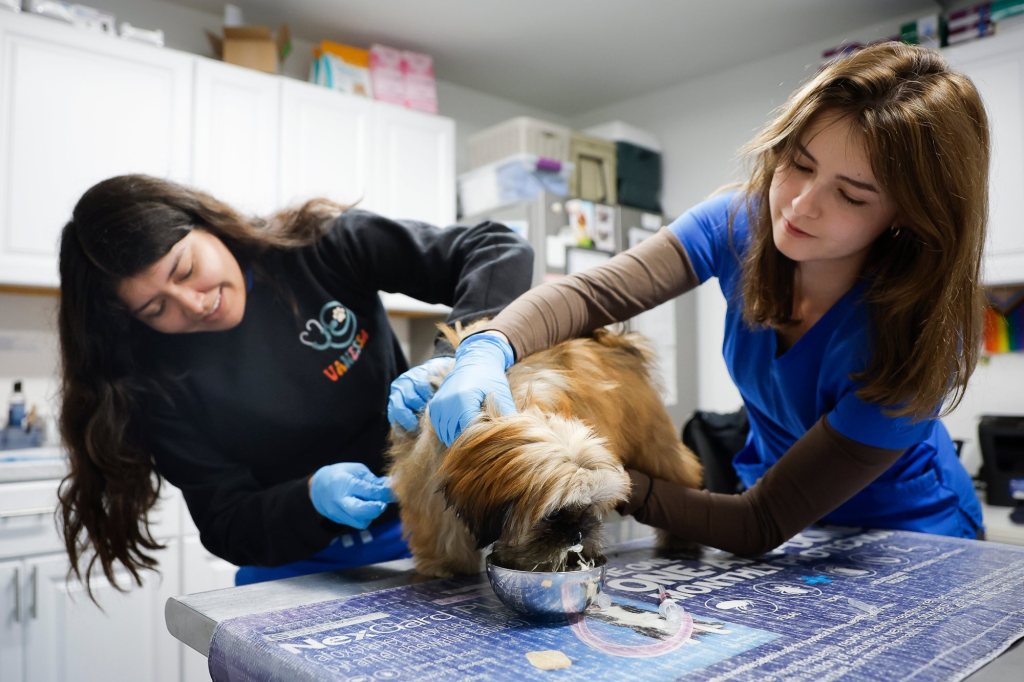
 Dr. Andrea Brkic examines Cali at the San Diego Humane Society Community Veterinary Clinic on Thursday. (Meg McLaughlin / The San Diego Union-Tribune)
A decade ago, Weitzman said he would have expected private vet practices to oppose the project. Instead, he said, those providers are increasingly sending animals needing care to the Humane Society because their owners cannot pay clinic fees.
“Ten years ago, there definitely would have been concern among my private practice colleagues,” he said. “As of COVID times, there has been no concern whatsoever. As a matter of fact, the opposite — we get referrals from private practices because they don’t want to have to resort to ‘economic euthanasia.’”
The Humane Society is able to charge lower fees because its work is supported by philanthropic gifts, he said.
“What we want to do is provide urgent care that (allows) people to come in and not have to get a second mortgage to get care for their animal,” he said.
The Humane Society began its community veterinary program in 2022, with services initially provided from a mobile clinic. In the summer of 2023, the clinic moved into the Gaines Street space, although mobile clinics are still used on a scaled-back basis, spokesperson Nina Thompson said.
The Humane Society’s website says those eligible for services at the clinic include pet owners with an annual household income under $70,000 or people enrolled in federal or state assistance programs or receiving unemployment benefits. However, clinic staff do not ask for documentation when people show up for appointments.
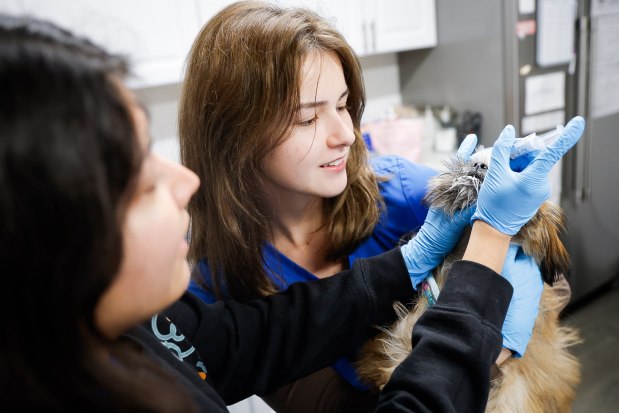 Veterinary assistants Vanessa Meza and Madeleine Inoue treat Mochi at the San Diego Humane Society Community Veterinary Clinic on Thursday. (Meg McLaughlin / The San Diego Union-Tribune)
“If you have a vet that you’re going to now, and you can afford those fees, please stay with your private practice. We’re here for people who can’t get in, and that’s really the purpose of the program,” said Weitzman, a veterinarian who works at the clinic one day a week. “We really just want to be there to solve a problem.”
Beyond the animal hospital project, the Humane Society has worked with a coalition of animal groups to seek legislative changes designed to expand veterinary care options. One new law now in effect allows registered veterinary technicians and veterinary assistants to perform any medical task not expressly prohibited by law. A second bill allows registered veterinary technicians to give vaccines and parasite control measures in shelters without requiring a supervising veterinarian to be on site.
There are other steps being taken to expand veterinary care in San Diego County.
UC Davis is building a state-of-the-art medical center in University City that will offer specialty care, create veterinary teaching and training opportunities, and facilitate clinical research studies.
According to its website, the Janice K. Hobbs UC Davis Veterinary Medical Center Southern California will feature “a pharmacy and dedicated suites for radiography, cardiology, surgery, medical oncology, 24/7 emergency and critical care (ER/ICU) and nephrology/urology.” It is expected to open later this year in a business park on Shoreham Place.
The new facility will take the place of a 3,000-square-foot medical center run by the university in Sorrento Valley in operation for more than 20 years. The new hospital will be eight times the size of the current facility.
UC Davis is also working to expand the number of veterinarians in its training pipeline. It has pledged to expand the number of doctor of veterinary medicine students enrolled from 600 to 800, adding 50 additional students per class beginning in 2029. The university also plans to build a new veterinary education pavilion on campus.
“We are the premier veterinary school in the country and California is facing a veterinary shortage, so with public and donor support we are committed to meeting the needs of the state’s pet parents, agricultural producers, animal shelters and other care providers,” Tom Hinds, a UC Davis School of Veterinary Medicine spokesperson, said in a statement.