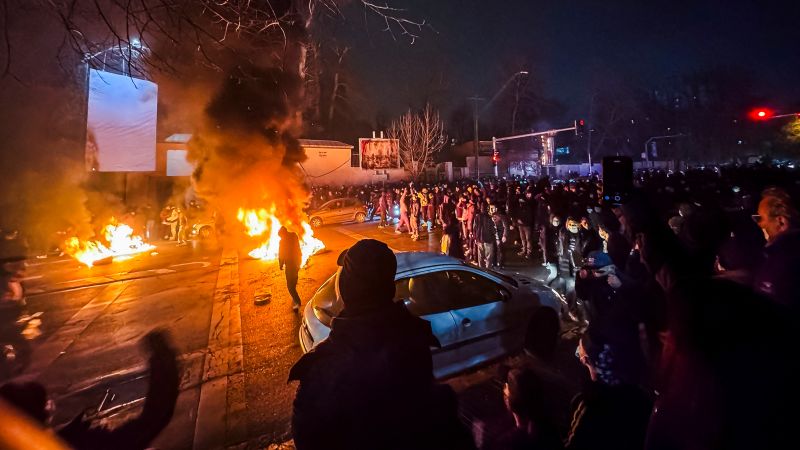

Members of Iran’s parliament have appealed to the Minister of Intelligence to resume Basij patrols as security forces launch a violent crackdown on the anti-government protests sweeping the country.
More than 544 people have been killed over the past 15 days during anti-government demonstrations, including eight children, according to the Human Rights Activist New Agency (HRANA).
But what is the Basij, the shadowy Iranian paramilitary force that has long been used by the state to quell protests and popular unrest?
Who are the Basij? Meaning “mobilization” in Farsi, the Basij is a volunteer paramilitary group that is an auxiliary arm of the Islamic Revolutionary Guard Corps (IRGC), the powerful and elite wing of the Iranian military. It was formed shortly after the 1979 Islamic revolution by Ayatollah Ruhollah Khomeini, who famously declared that Iran could never be destroyed with a 20-million-man militia.
Who makes up its ranks? The nationwide militia is known to recruit members from rural and urban areas and to organize mainly at mosques around Tehran and other major cities, and its members often come from poorer, more conservative, backgrounds. The group is under the command of the IRGC, which is under the direct control of Iran’s supreme leader.
What does it do? The Basij are an internal security force formed to prop up Iran’s theocracy and state ideology, and enforce Islamic morality among the public. The group has taken on a leading role in violently quashing waves dissent for decades.
A growing role: They were famed for conducting “human wave” attacks during the 1980-1988 Iran-Iraq war that reportedly cleared out minefields for the professional military. But the Basij has had a growing role since 2003, when it was beefed up as a first line of defense amid suspicions of a possible US-led invasion, experts said. The militia have since emerged during the initial moments of uprisings and unrest.
US sanctions: The Basij force and certain commanders have been sanctioned multiple times by the US government, including for human rights violations, suppressing student protests and allegedly using child soldiers.
Suppressing unrest: Basij enforcers have played a crucial role each time popular protest sweeps Iran. In 2009, the Basij noticeably took the lead in crowd control when tens of thousands of Iranian demonstrators took to the streets of Tehran to protest the presidential election, and in 2022 during the suppression of mass protests following the death of 22-year-old Mahsa Amini while in custody of the religious police.
Current protests: The Basij are among the security forces deployed to crack down on the protests sweeping Iran for the past 15 days. Iranian state media has reported casualties within its security forces, including the Basij. The Basij may also be involved in monitoring online activity during the protests. In a post on Telegram Sunday, the Basij News Agency, the official news channel of the Basij forces, reported that a bloggers website and social channels had been shut down, saying “the arrest of bloggers supporting riot continues.”