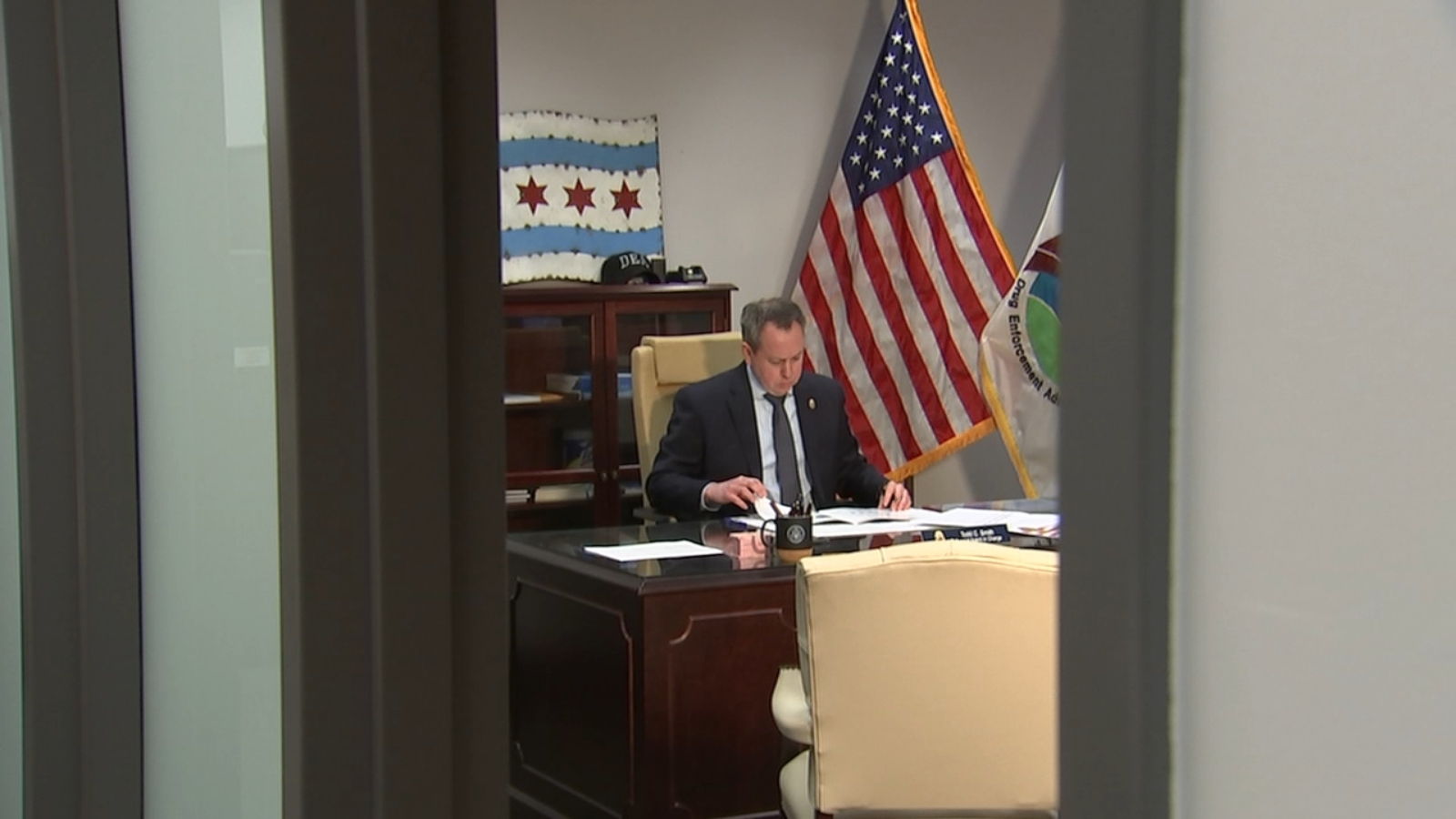
CHICAGO (WLS) — The new top enforcer for the Drug Enforcement Administration’s Chicago Field Division spent more than 20 years on the front lines in the city battling cartel influence in the dangerous drug trafficking trade.
Todd Smith, 46, originally worked narcotics cases on the street and has seen the drug landscape change during his two decades of service including the transforming connections between Chicago gangs and Mexican cartels.
ABC7 Chicago is now streaming 24/7. Click here to watch
In a wide-ranging exclusive TV interview with the ABC7 I-Team, Smith revealed his priorities as the new leader of DEA Chicago.
Since 2018, there have been five different leaders of the DEA Chicago Field Division. Smith was appointed earlier this month as the new special agent in charge and says he is walking into the job with a wealth of Chicago experience.
“I rose through the ranks. People know who I am and what I’m about. We’ve had special agent charges come from outside of the area into Chicago and have to learn on the job relationships both with the U.S. Attorney’s Office or the State’s Attorney’s Office or the Chicago Police Department. I’ve been here for 20 years, working with those people. I understand Chicago. I understand the drug trafficking threat here, and it’s our goal, working through our partners, to reduce that,” he said.
Smith started his career carrying out investigations targeting Chicago gangs and cartel influence on the streets. Now, he’s overseeing the work he once conducted and says he knows how the landscape has changed on the street.
“Really, it’s block-by-block work. DEA has to go block-by-block with the Chicago Police Department and hold those people accountable that are dealing drugs and causing violence within our communities,” Smith said.
He says when he began his career two decades ago, there was a defined leadership of a gang in the city of Chicago.
“Over the years, we’ve seen that leadership really flatten and there’s less hierarchical structure over a gang,” Smith said.
He says that makes drug distribution in the city more fluid than ever before.
“With less of that structure, a gang could bounce between cartels, meaning they could be selling Sinaloa cartel fentanyl today, and in a week, they could be selling CJ and G cartel fentanyl. Historically, that didn’t happen. But today, there’s less allegiance to a cartel, less allegiance to a gang, and it’s just about making money,” Smith said.
The drugs themselves are changing. too, with the introduction of deadly fentanyl and even more potent carfentanyl, tranquilizer mixes, the rise of methamphetamine use and more.
Smith confirmed to the I-Team as fentanyl deaths continue a downward trend, so does its purity in recent DEA lab testing.
“Roughly 29% of all pills that are analyzed contain a lethal amount of fentanyl. Just a few years ago, it was as high as 70%,” he explained.
President Donald Trump has made clear he wants to take on Mexican cartels peddling fentanyl to Chicago streets, branding them terrorist organizations, even proposing military action to disrupt and dismantle them.
“Arrests of cartel leaders, whether it’s Chapo Guzman or Ovidio Guzman, have impact on the cartel. We want to keep that momentum up, and if we can disrupt and really our goal is, dismantle the cartels, we have to take out their leadership. And by taking out their leadership, I mean bringing them to justice and holding them accountable in the United States,” Smith said.
And as DEA agents are tasked with enforcing Trump’s immigration policy, Smith says their core mission work on drugs speaks for itself.
“Overdoses, record lows, seizures, record highs. Poisonings in America are down,” Smith said.
Smith says his goal is improve relationships with local law enforcement, saying while the office is in good shape, he hopes to make it even better.
“It’s nice to be able to stay home and be able to be promoted within the Chicago field division and lead the men and women as we bear down on the enforcement of these deadly drugs,” he said.
That work at home is vital. With Chicago as such a nexus of transportation with rail, road, and plane, it is a drug distribution hub for the Midwest and the country.
Smith also told the I-Team he is looking forward to partnering with the new U.S. attorney and Cook County state’s attorney to hold criminals accountable.
His predecessor, Shane Catone, is staying in Chicago as the head of a newly created regional office. He is now the associate chief of operations for the DEA Midwest Region, where he will oversee investigate operational and administrative collaborations across five DEA domestic divisions – Chicago, St. Louis, Detroit, Omaha, and Louisville.
Copyright © 2026 WLS-TV. All Rights Reserved.