Get a daily rundown of the top stories on Urban Milwaukee

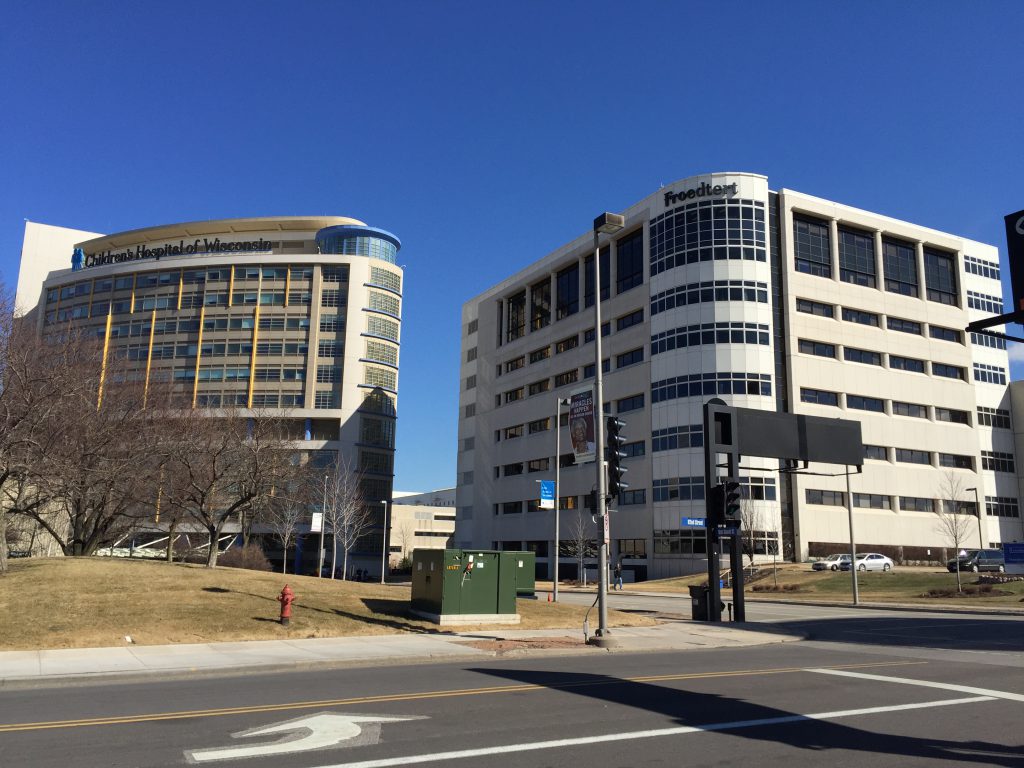
Children’s Hospital of Wisconsin and Froedtert. File photo by Aalvarez89 / (CC BY-SA)
In September Children’s Wisconsin held a new fundraising event for its two hospitals. Created to replace Al’s Run and held at State Fair Park, Rally Round Children’s Wisconsin “offers what people loved about the original event — running, walking and coming together for a great cause — plus so much more,” the promotion by Children’s promised, “featuring entertainment, activation zones and delicious food.”
Some 6,000 people showed up to support Children’s.
“I have goosebumps,” Christine Baranoucky of Children’s Wisconsin Foundation told CBS 58. “I am so inspired by the community’s generosity and engagement with us.”
The event was just one of the many ways Children’s solicits donations from the community. Its federal 990 tax forms show it raised $118 million in contributions and grants in 2024. These donations, Children’s assures the community, will “fund critical treatments, health care services, pediatric medical equipment and charitable care.”
In fact, like most children’s hospitals in America, the Milwaukee organization provides little charitable care and has a tremendous stockpile of investments. A 2011 story by Kaiser Health News found that “in 2009, the elite children’s hospitals reported $1.5 billion in profits – what nonprofits call surpluses,” and “had accumulated $21 billion in stocks, bonds, real estate and other investments as of 2010 – more than enough to provide an entire year’s worth of medical care for free. They had net assets – the equivalent of net worth for nonprofits – of $23 billion.”
Back then Children’s Wisconsin was already on the road to acquiring such wealth. Its 2010 federal tax form showed it had net assets of $1.2 billion and $673 million in publicly traded securities. That was more than enough to pay for a year’s worth of medical care — its total budget was $623 million that year — for free.
Get a daily rundown of the Milwaukee stories
But its stockpile of money has grown tremendously since then. It has three different entities — Children’s Hospital of Wisconsin, Children’s Hospital and Health System and Children’s Hospital of Wisconsin Foundation — which makes it harder to track its financials. Together they show the organization had by 2024 more than tripled its net assets, to $3.8 billion, and more than doubled its stock of publicly traded securities, to $1.74 billion, more than enough to pay for its total budget of $1.27 billion.
Children’s had a net income of $146.8 million, giving the nonprofit an 11.6% profit margin for the year, which would be the envy of many for-profit corporations. And just like the children’s hospitals Kaiser reported on, much of its soaring budget goes for big pay to executives.
The list of its executive leadership is a long one with 20 people, led by its CEO Gil Peri, who took over in midyear the position that pays nearly $2.7 million in compensation. Below him is one executive paid more than $2 million, two getting more than $1 million, two awarded more than $900,000, five at more than $600,000, three at more than $500,000 and 12 getting more than $400,000.
Children’s did not respond to requests for comment by publication, but its federal tax form says the organization uses an “independent” compensation consultant and a compensation survey or study to determine salaries. Given the skyrocketing salaries of other children’s hospital executives Kaiser documented, that survey would likely justify generous pay.
None of this is disclosed when Children’s holds fundraisers or seeks donations. The organization does not provide any link to its federally required annual tax form on its website, nor does it disclose any salaries. And its split into three different entities with separate tax forms makes that information even less transparent.
Rather, its sales pitch is always about raising “critical funds that support the kids and families of Wisconsin.” And it has many community partners who help raise the money. There’s the WKLH Miracle Marathon Benefiting Children’s Wisconsin which raised more than $1 million in 2025. And there are two different golf courses who’ve worked with Children’s. The Children’s Wisconsin Open at Buttes des Morts Country Club in Appleton has raised millions. “The Baths of Blackwolf Run!” golf event raises funds for “the life-saving work at Children’s Hospital.”
Since 2019, the Do Good With Food fundraiser has generated more than $130,000 for Children’s Wisconsin. More than 40 restaurants participated in 2024, donating a portion of their sales to Children’s. And the “Gather for Good” auction with dinner and cocktails in De Pere has raised $2.1 million over the last 30 years.
For 45 years Children’s promoted Al’s Run to raise money, but ended that in 2023 because it wasn’t worth the effort for the $120,000 in net revenue, as Urban Milwaukee reported. That amounted to a rounding error for an organization pulling in $118 million per year in contributions and grants. Children’s pays three different philanthropic consultants: Schultz & Williams (based in Philadelphia), Bentz Whaley Flessner (Minneapolis) and Community Counseling Service LLC (also in Philadelphia).
With their help Children’s doesn’t seem to miss a trick with its fundraising. It offers a long list of possible fundraising events for individuals and businesses, including a bake sale, benefit concert, bike-a-thon, bowling event, car wash, lemonade stand and yard sale. It encourages donations by mail, online, by “Stock Transfer” or that you “Fundraise on Facebook.”
This is a corporate-like entity with $3.8 billion in net assets asking kids to sell lemonade or do car washes to give it more money. It earned far more in income from its massive stash of investments — a $117.6 million spin-off in 2024 — than the $26.4 million it got in donations. In the last two years its net income far exceeded total fundraising, meaning it would have still had a healthy profit without any donations.
As for the idea these donations will be used for charitable care, Children’s gives little free care. The most recent report by the Wisconsin Hospital Association showed Children’s Hospital in Milwaukee devoted 0.5% of its revenue to charity care in 2024, 0.3% in 2023, and 0.2% in both 2022 and 2021. In all four years this well below the average for all Wisconsin hospitals, the reports show.
The hospital has in the past defended itself, saying children rarely need charity care because “the vast majority” in the state have some kind of coverage from public or private sources. Yet in 2023 Children’s shut down a pediatric clinic on the city’s North Side, one of the poorest and least healthy neighborhoods in the nation. Children’s insisted it had not made the decision for financial reasons, noting “Well over 50 percent of our patients every year receive some form of Medicaid coverage.”
But as a study by KFF found, private insurers pay way more than Medicaid, nearly double the rate for all hospital services. By closing the northside clinic, where 95% of patients are on Medicaid, Children’s could lower the number of those patients it serves.
Hospitals like Children’s are classed as tax-exempt charitable organizations, meaning they pay no federal, state and local taxes. But a Kaiser study found that hospitals nationally provided $16 billion in charity care in 2020, which was far less than the estimated $28 billion value of their tax exemptions. The difference would be even bigger for Children’s, given how little charity care it provides.
“As nonprofits, children’s hospitals enjoy an array of tax breaks covering real estate, earnings and investment gains,” Kaiser reported, which “helps them boost their reserves and grow the business.” Children’s Wisconsin has a $34.9 million investment in the Central American and Caribbean countries of Antigua, Barbuda, Aruba and the Bahamas, its tax form shows.
Children’s Wisconsin has a 27-member board of directors, led by co-chairman Patrick Hammes, managing principal with Hammes Partners, a company that invests in health care real estate. Fourteen of the board members are current or retired executives with corporations and four are executives at Children’s. No working nurse or doctor serves on the board.
Correction: The original version of this story reported that Children’s devoted 0.0% of its gross patient revenue to charity care in 2023; the correct figure was 0.3%.