
Each season at The Athletic, reporters Scott Wheeler and Harman Dayal publish a quarterly Calder Trophy list ranking the top rookies in the NHL.
After submitting top-10 ballots at the quarter mark, they narrowed down their ballots to five players (the same number as the PHWA awards ballot) and a couple of honorable mentions at the halfway mark. New York Islanders rookie defenseman Matthew Schaefer remains the clear favorite, but a consensus top four has also now developed.
Here are their top five rookies, plus a couple of honorable mentions, at the midway point of the 2025-26 season.
1. Matthew Schaefer — LHD, 18, New York Islanders
Stats: 45 GP, 12 G, 17 A, 29 PTS, 23:58 ATOI, +9
Wheeler’s ballot: No. 1
Dayal’s ballot: No. 1
It’s almost unheard-of to see an 18-year-old immediately become a bona fide No. 1 defenseman, and yet that’s exactly what Schaefer has accomplished.
Schaefer is tied for fourth among all NHL defensemen with 12 goals in 45 games, and ranks in the top 20 among all defenders in points. He’s on pace to score 53 points, which would be the second-highest mark from an 18-year-old defender in NHL history behind only Phil Housley’s 66 points in 1983. He should comfortably clear Rasmus Dahlin (44 points) and Bobby Orr (41 points), who are the only other 18-year-old defenders to hit the 40-point mark. Watching Schaefer play, his exceptional lateral mobility, creativity and ankle-breaking moves at the offensive point are reminiscent of Cale Makar and Quinn Hughes.
One of the impressive aspects of Schaefer’s rise is that his historic offensive production has never come at the expense of his defensive play, nor has it been juiced by a sheltered role. Schaefer’s average ice time of 23:58 ranks in the top 20 among all NHL players. He’s been tasked with the challenging defensive matchups you’d expect from a top-pair defender, and he’s winning those minutes, as the Isles have a plus-13 goal differential with him on the ice at five-on-five.
Schaefer is an elite puck-mover, which has been essential to New York’s fast, rush-based team identity. His defensive play is quite advanced and mature for a rookie, as he quickly closes gaps and leverages his long reach to break up plays.
2. Ivan Demidov — RW, 19, Montreal Canadiens
Stats: 46 GP, 10 G, 29 A, 39 PTS, 15:15 ATOI, +9
Wheeler’s ballot: No. 2
Dayal’s ballot: No. 2
The barometer as a forward for Calder Trophy consideration is typically the 50-60 point range, and Demidov is playing at a 69-point pace. That’s more productive than recent rookies Matty Beniers (first in 2023 Calder voting), Trevor Zegras (second in 2022) and Matvei Michkov (fourth in 2025), and more total points than Connor Bedard and Macklin Celebrini scored, though they didn’t play a full season.
Demidov has made his linemates better all year and is emerging as one of the game’s brightest young stars. It feels inevitable that he becomes one of the league’s top wingers.
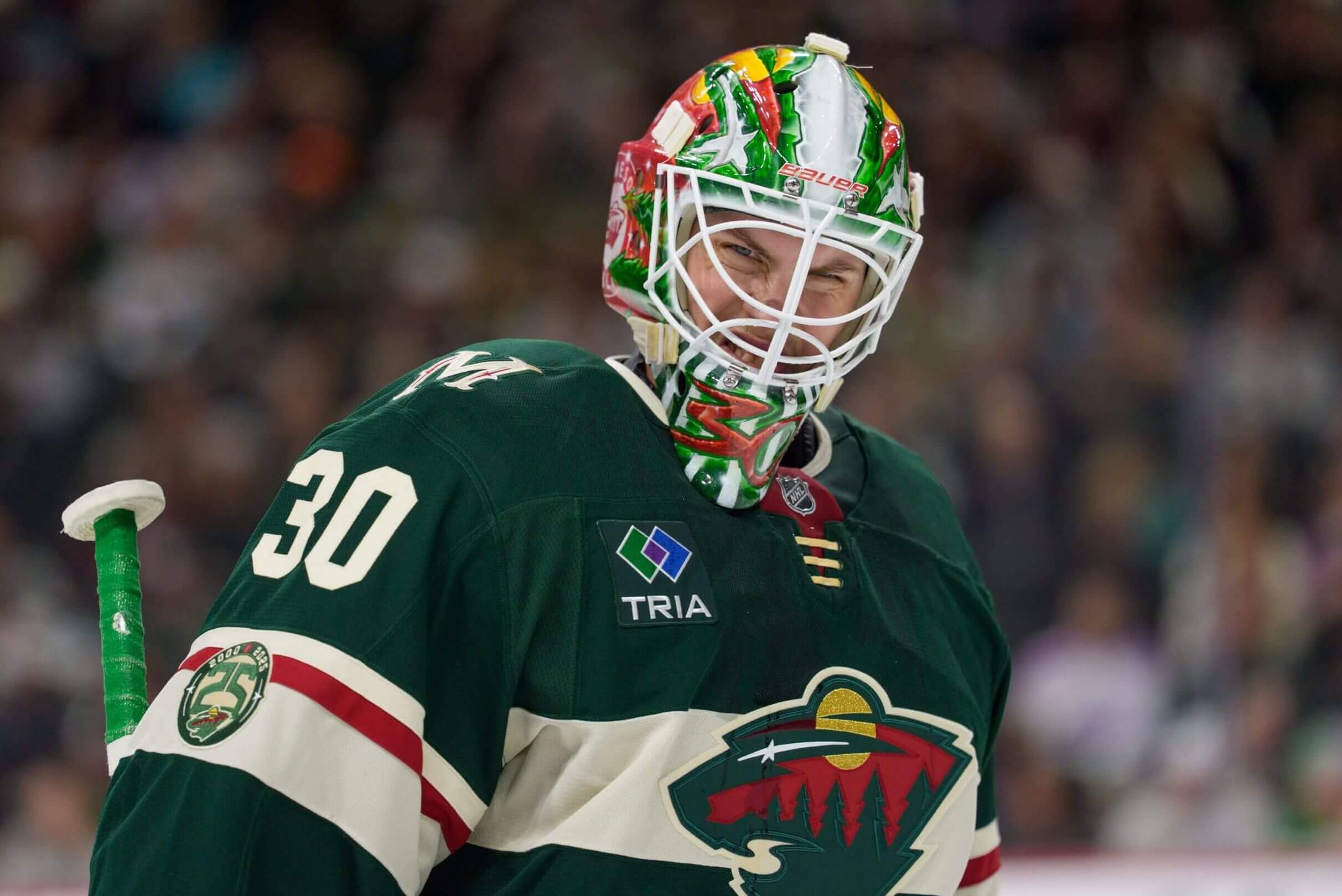
Wild goalie Jesper Wallstedt is tied for the NHL lead in shutouts this season with four. (Matt Blewett / Imagn Images)
3. Jesper Wallstedt — G, 23, Minnesota Wild
Stats: 19 GP, 12-3-4, .923 SV%, 4 SO
Wheeler’s ballot: No. 3
Dayal’s ballot: No. 3
Wallstedt’s performance has been so excellent that we both briefly considered ranking him second. However, he’s played only 19 of Minnesota’s 47 games, which isn’t quite a large enough sample yet to justify moving him ahead of Demidov. That absolutely could change, though, if he sustains this performance and finishes the season with 40ish games played.
The Wall of St. Paul owns a .923 save percentage and four shutouts (tied with Ilya Sorokin) this season. Prior to Monday’s 5-2 loss to the Devils, he had saved 14.2 goals above expected, which ranked 18th among all netminders. GSAx is an accumulation-based stat, so it’s impressive that he ranks that high despite playing fewer than 20 games.
Wallstedt’s sensational arrival was key to turning Minnesota’s season around in November. Stylistically, he’s such a treat to watch — Wallstedt’s technical mastery and positioning are pristine. He’s exceptionally calm, poised, and in control in his crease, which allows him to make spectacular saves look easy at times. The 23-year-old Swede never overcommits to a singular play because of how well he controls his edges, which ensures that he stays in excellent position to stop second- and third-chance opportunities.
4. Beckett Sennecke — RW, 19, Anaheim Ducks
Stats: 45 GP, 14 G, 20 A, 34 PTS, 16:55 ATOI, -6
Wheeler’s ballot: No. 4
Dayal’s ballot: No. 4
When we did our last Calder list at the quarter mark, Sennecke was averaging 16 and a half minutes and playing at a 56-point pace. Both of those are very impressive for a teenage forward. Now he’s playing at a 62-point pace and averaging 17 minutes per game. Where some rookies hit a wall at this stage in a season, Sennecke’s production and role are actually expanding — even as his team has hit a bit of a rut. That’s a testament to his talent. He belongs in the Calder conversation.
T5. Ryan Leonard — RW, 20, Washington Capitals
Stats: 39 GP, 9 G, 19 A, 28 PTS, 14:06 ATOI, +11
Wheeler’s ballot: HM
Dayal’s ballot: No. 5
Leonard looks like a game-breaker. The 20-year-old right winger is a top-notch puck transporter, capable of driving dynamic entries and rush chances with ease. He’s shown tremendous growth in his playmaking, as his knack for finding dangerous east-west seams and setting up teammates for Grade-A scoring chances has been prolific. Leonard’s precocious impact as a solo driver of play and offensive chances — which you have to see on a shift-by-shift basis to truly appreciate — makes him a slam-dunk future star.
Leonard would be on pace for 58 points if he hadn’t missed seven games with injury. That production is particularly strong because he’s averaged just 14:06 per game due to how stacked the Capitals’ forward group is. On a per-minute basis, Leonard’s 2.62 points per 60 leads rookies and ranks 22nd among all NHL players.
T5. Alexander Nikishin — LHD, 24, Carolina Hurricanes
Stats: 45 GP, 5 G, 13 A, 18 PTS, 18:49 ATOI, +11
Wheeler’s ballot: No. 5
Dayal’s ballot: HM
Nikishin’s production (a 32-point pace) isn’t as glossy as his peers’ in this rookie class, but he’s playing almost 19 minutes per game on the best team in the Eastern Conference. He has quickly established his physical presence in the league (his 85 hits lead the Hurricanes and are just outside the league’s top 10 D), he has a 55.4 percent expected goals share at five-on-five and the Canes have outscored the opposition 32-25 (56.1 percent) with him out there. Nikishin would have needed more power-play usage earlier in the year to amass the point totals that are typically required to become a contender for the award, but he deserves consideration down ballots.
HM. Artyom Levshunov — RHD, 20, Chicago Blackhawks
Stats: 44 GP, 2 G, 19 A, 21 PTS, 18:54 ATOI, -16
Levshunov’s game comes with some ups and downs, and so has his season, but he’s still playing at a 40-point pace, he has run the Blackhawks’ power play for most of the season and he’s now playing 23-24 minutes per game and starting to put it all together. On his best shifts, he can take over and run wild around the ice. If he continues to get the minutes he has played over the last couple of months, a step in the second half and down-ballot votes are entirely possible.
HM. Oliver Kapanen — C, 22, Montreal Canadiens
Stats: 46 GP, 16 G, 11 A, 27 PTS, 14:52 ATOI, +5
The hype around Demidov shouldn’t make us overlook how enormously valuable Kapanen’s rookie contributions have been. The 22-year-old Finnish forward has filled in admirably as the Canadiens’ second-line center this season, a high-leverage role that the club would have otherwise struggled to adequately patch over.
Kapanen leads all rookies with 16 goals. He isn’t the main driver of Montreal’s second line — Demidov and Juraj Slafkovský have done a lot of the heavy lifting — but he’s been an excellent complementary fit, and has been especially productive lately, with nine goals in his last 21 games.
Kapanen’s underlying metrics are a bit soft (he earned 43 percent of shot attempts and 42 percent of expected goals before Monday’s win over Vancouver), but the eye test shows that his positioning, reads and defensive play are polished for such a young center. Stylistically, that responsible approach has been a nice fit with Demidov’s flashier, more dynamic skill set. Kapanen is fast enough to keep up with Demidov as a supporting offensive threat off the rush and can handle some of the dirty work to win battles and regain puck possession.
Lately, his usage has increased significantly as well; Kapanen has averaged close to 18 minutes in his last 21 games, compared to just over 13 in his first 25.