
A rare meteorite recovered from Alaska is prompting scientists to rethink how Earth got its water. New findings suggest our planet may have had the hydrogen needed to form water on its own, without relying on asteroid impacts, contradicting a theory long held in planetary science.
This surprising insight comes from research conducted by scientists at the University of Oxford, who analyzed an enstatite chondrite meteorite known as LAR 12252. The meteorite’s composition, which mirrors that of Earth from 4.55 billion years ago, revealed substantial amounts of hydrogen previously undetected. This latest study calls that idea into question by presenting direct evidence of native hydrogen in a rock chemically similar to early Earth.
Matrix Reveals Hidden Hydrogen Source
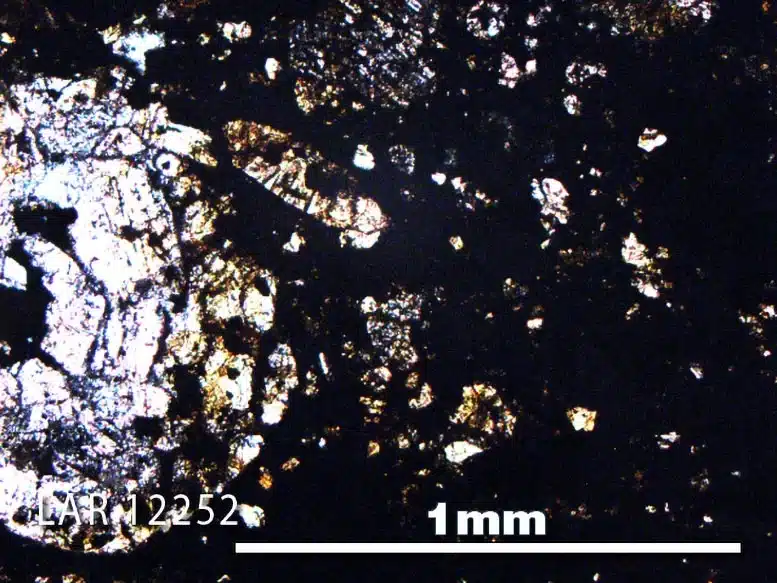
While earlier studies had identified small traces of hydrogen in LAR 12252, researchers noted the possibility that these traces came from contamination after the meteorite landed on Earth. To avoid this uncertainty, the new team focused on a different area of the rock: the matrix, the material surrounding its chondrules.
 A fragment of the LAR 12252 meteorite. Credit: NASA
According to Thomas Barrett | Department of Earth Sciences, lead author of the study and a researcher at Oxford’s Department of Earth Sciences:
“We were incredibly excited when the analysis told us the sample contained hydrogen sulfide—just not where we expected,” he stated in a University of Oxford press release. “Because the likelihood of this hydrogen sulfide originating from terrestrial contamination is very low, this research provides vital evidence to support the theory that water on Earth is native—that it is a natural outcome of what our planet is made of.”
A Planetary Building Block Under Review
The significance of LAR 12252 lies in its classification as an enstatite chondrite, a rare group of meteorites that closely match the isotopic composition of early Earth. As mentioned by James Bryson, co-author of the study available on Icarus, these meteorites serve as “snapshots” of the material that formed our planet.
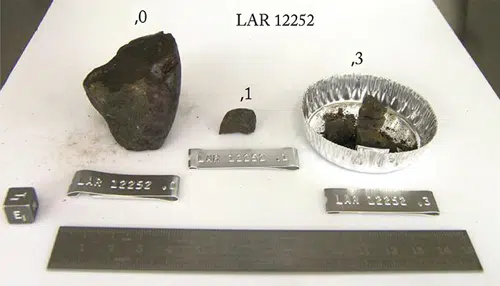 Close-up of meteorite LAR 12252 taken in the lab. Credit: NASA
Previous assumptions held that Earth was relatively dry during its formation and only acquired water through later bombardment by wet asteroids. This new evidence contradicts that view by showing that the planet’s own ingredients may have been hydrogen-rich enough to form water internally.
The idea that Earth was capable of producing water without external delivery changes the way researchers understand the chemical evolution of our planet. As stated in the Oxford study, it supports the notion that water formation was a natural consequence of the planet’s formation materials, not a rare stroke of cosmic luck.
The “Standard” Origin Theory Is No Longer So Certain
The theory that water came to Earth via asteroid collisions has been widely accepted in planetary science, supported by findings of hydrated minerals in meteorites and lunar samples. But this theory hinges on the assumption that early Earth was too dry to produce water independently.
Findings from the LAR 12252 meteorite offer a serious counterpoint. According to the research, the presence of native hydrogen in a meteorite chemically aligned with Earth’s earliest makeup strongly suggests that water could have formed here naturally.