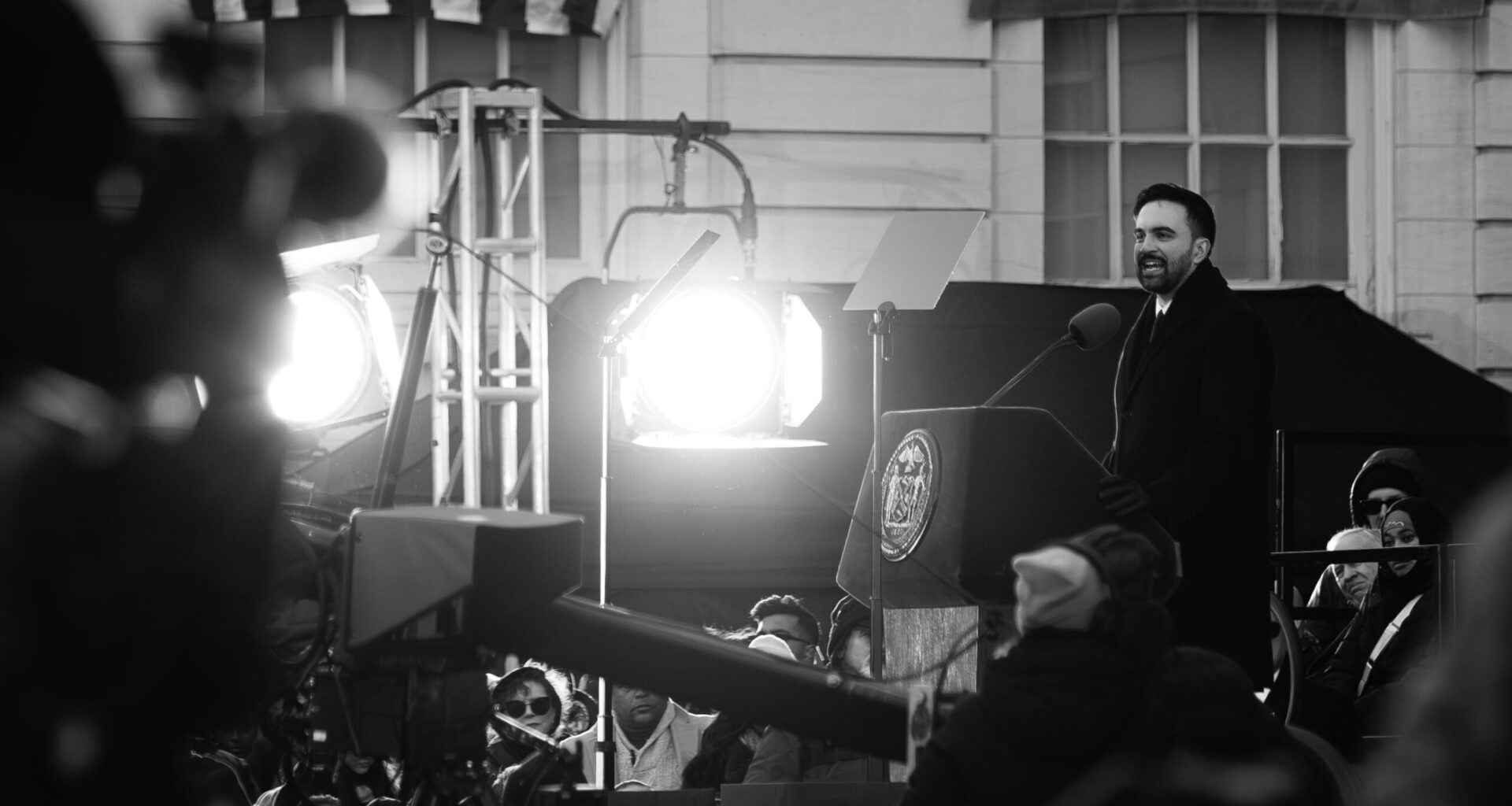
New York City’s new mayor, Zhoran Mamdani, has gained power in a city facing a myriad of problems that include housing affordability, crime (despite falling homicide rates), homelessness, poverty, and U.S. Immigration and Customs Enforcement (ICE) raids. There will also likely be budgetary, management, and bureaucratic troubles inside City Hall; unforeseen natural disasters and racial and ethnic conflict in the city; and, of course, Trump himself, who may use the city and Mamdani as scapegoats whenever politically necessary. As president, Trump will always be able to spew venomous attacks at the city as both a home for illegal immigrants—whom he stereotypically views as mainly thieves, addicts, and welfare recipients—and as a place rife with uncontrolled crime and violence. These crimes—real and imagined—are fodder for sensational headlines seen daily in Murdoch’s Trump-loving media like Fox News and The New York Post, headlines that make the city seem like an abattoir to outsiders.
Mamdani will also be reminded by many critics that the city is too large, complex, chaotic, and faction-ridden to be governable, especially by an idealistic socialist who presumably doesn’t know much about the machinery of governing.
But somehow, Mamdani does not look like a man who will throw up his hands and hide or flee from the difficulties that will inevitably confront him. He may be as committed to the left as any mayor in city history and has probably risen faster with less experience than any previous mayor. Still, I have a feeling that he will be both sufficiently pragmatic and savvy to eschew ideological purity for what is politically feasible (e.g., his meeting with Trump). He has already relieved a few of the fears of the city’s political establishment by asking billionaire and current City Police Commissioner Jessica Tisch to stay on for his term in office.
One of the more volatile problems he will have to face is education. He has hired Kamar Samuels as schools chancellor, who brings over 20 years of experience as a teacher, principal, and superintendent. (In the last four years, from late 2021 to late 2025, the city has had three schools chancellors.) That decision should help inform us how Mamdani intends to shape the system for the next four years.
According to Chalkbeat New York, the educational system faces many difficulties, including absenteeism (approximately 40 percent of students (over 300,000) are chronically absent) and declining K-12 enrollment, which has fallen by over 95,000 students (9.2 percent) between 2019 and 2023, with projections suggesting it could drop below 750,000 by 2030.
Systemic inequities like segregation are a constant, with New York City remaining one of the most segregated school systems in the nation. One result is that low-income families—Hispanic and Black—are less likely to graduate or enroll in college than their Asian and white peers. Many schools in majority Black and Hispanic neighborhoods are struggling.
In addition, the city’s specialized high schools—Bronx Science (which Mamdani attended), Stuyvesant, Brooklyn Tech, and others—have a 54 percent Asian and 26 percent white population of students receiving offers. Meanwhile, Black and Latino students, who make up nearly two-thirds of New York City public schools enrollment, received only about three percent and seven percent of the offers, respectively. The disparity is based on the results of exams. These numbers are disturbing, but the opposition to changing the basis for entry has been vocal and adamant. For many low-income and immigrant Asian students, these schools are the gateway to elite colleges. And they are unwilling to have their interests sacrificed for more racially balanced schools. There are no easy answers in this situation. Eliminating the exam would probably begin to undermine one of the New York City education system’s few bright spots and see some of its best students depart for the suburbs.
Other problems the system faces include the city failing to provide mandated instruction time or qualified teachers to nearly half of students learning English.
New York City spends nearly $35,000 per student—the highest in the nation—yet student achievement in math and reading remains in the middle compared to other states.
The city failed to collect $42.6 million in penalties from underperforming bus vendors in 2024–25.
The schools also confront significant overcrowding and delays in necessary construction, such as accessibility ramps and elevators, often due to cost overruns at the School Construction Authority. Finally, smaller class sizes have been mandated by 2028. It would require the city to hire 4,000 new teachers, which would be a serious budgetary challenge.
Mamdani has plans (co-governance) to revise the governance of the school system. However, the plans are not yet finalized or fully defined.
What Mamdani is looking at is to redistribute power away from the mayor’s office to the appointed schools chancellor, the city council, and New Yorkers who are most involved—teachers, parents, and students.
Nobody would disagree with Mamdani’s assertion that the city (and education system) needs to be transformed, that “[i]n this moment of political darkness, New York will be the light,” as he asserted in his victory speech. Fine words, but how to succeed bringing this about remains an open question. Still, if nothing else, Mamdani offers hope in thinking about the city’s renewal in a unique and more equitable way. Watching his inauguration moved me and reinforced my qualified sense of hope: Mamdani promising to govern “audaciously” for he views the city as “belonging to all who live in it.”