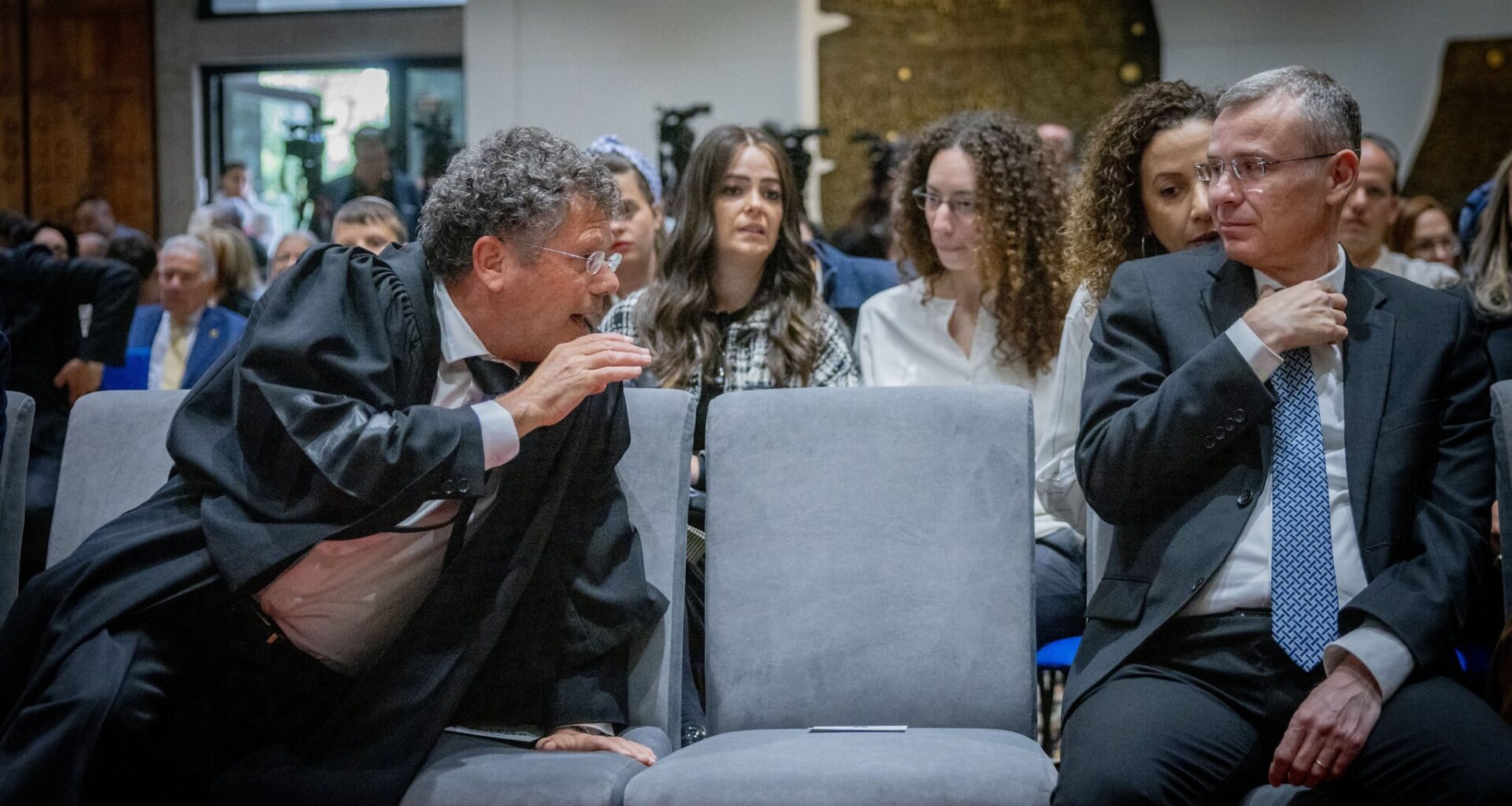
Recent weeks and months have seen senior cabinet ministers launch a series of vitriolic attacks on the Supreme Court and its judges over a string of decisions that have not gone the government’s way.
Finance Minister Bezalel Smotrich has said the government will “trample” the Supreme Court President Isaac Amit. Justice Minister Yariv Levin has described the Supreme Court justices as “extremists,” whose decisions are all “political.” Diaspora Affairs Minister Amichai Chikli called the court a “circus” and the president “a clown” — just three examples from the past four weeks.
And Levin, Chikli and Communications Minister Shlomo Karhi have explicitly and publicly called on the government not to abide by specific court orders and decisions on several occasions.
Although the current government has long railed against the Supreme Court — and indeed worked assiduously to pass legislation to weaken its authority — the recent verbal assaults have now reached levels of incendiary ferocity previously unheard of in Israeli discourse, which experts say appear to be a calculated assault on the legitimacy and power of the courts.
Delegitimization of institutions
Speaking to The Times of Israel, Yaniv Roznai, a professor of constitutional law at Reichman University, said that the inflammatory rhetoric against the court, and Israel’s system of legal checks and balances in general, is designed to delegitimize these institutions to make them less effective as brakes on executive power.
Get The Times of Israel’s Daily Edition
by email and never miss our top stories
By signing up, you agree to the terms
He noted that the government had initially gone about trying to “capture” several of these institutions, but having initially or temporarily failed in that mission, it is now seeking to delegitimize them as well.
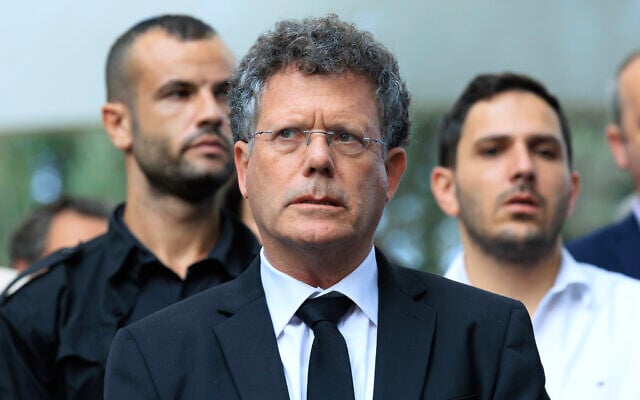
Supreme Court President Isaac Amit, November 3, 2025. (Moshe Shai/FLASH90)
These efforts included legislation that narrowly failed to pass and would have handed the government full control over all judicial appointments, Levin’s push to install his preferred candidate as Supreme Court president, and the government’s attempt to fire the attorney general.
“They have tried to capture institutions, and when that fails they weaken and delegitimize that institution so that it is no longer effective as a check on government power,” said Rozani.
Indeed, the government and some cabinet ministers already appear to be disobeying some High Court’s orders amid the ongoing campaign to deprive it of its legitimacy.
On Monday, Attorney General Gali Baharav-Miara said the government was violating the High Court’s order of November 19, instructing it to draw up concrete policies for enforcing the military draft on ultra-Orthodox men within 45 days.
She said that the government had “not even taken the first step” to begin drawing up such policies and was therefore violating the court order, and doing severe damage to the very principle of judicial review and “creating a dangerous opening for the rule of unchecked power.”
And National Security Minister Itamar Gen Gvir has already been found by the High Court to have violated one of its interim orders instructing him not to give operational orders to the police regarding the policing of demonstrations.
The attorney general has more broadly asserted that Ben Gvir has unlawfully intervened over operational conduct of the police in almost every other aspect of its work, including specific arrests, promotions, dismissals of police officers, demolition orders and other matters.
And there are some key High Court orders and decisions for which the government is preparing the ground to disobey or ignore.

Justice Minister Yariv Levin speaks at the Knesset, Jerusalem, January 7, 2026. (Yonatan Sindel/Flash90)
The High Court will hear on Thursday petitions asking the High Court to order the prime minister to remove Ben Gvir from office for violating the High Court orders barring him from issuing operational orders to the police, as well as for violating the terms of a court ruling enabling him to take up his post in the first place.
The court will ultimately have to decide whether or not to order Prime Minister Benjamin Netanyahu to dismiss Ben Gvir from office.
On Tuesday, senior coalition leaders — including Smotrich, Foreign Minister Gideon Sa’ar and Ben Gvir himself — wrote in a letter to Netanyahu claiming that the High Court had no legal authority to order Ben Gvir to be removed from office for violating court orders, and that “we will not allow it.”
Targeted attacks on the Supreme Court president
A key feature of the recent attacks on the Supreme Court has been the specific targeting of Supreme Court President Isaac Amit, who has been singled out for particular opprobrium by the government, not to mention Levin’s boycott.
This includes Smotrich’s attack on him as a “violent, aggressive megalomaniac who has stolen Israeli democracy”; deputy minister Almog Cohen’s remarks that Amit “appointed himself” Supreme Court president and “turned the High Court into a political tool that serves the dying elites”; and Chikli’s comments about Amit being “a clown.”
עבריין הבנייה יצחק עמית אשר מינה את עצמו לנשיא בית המשפט העליון, ממשיך דרכו של אביו הרוחני, הנפוטיסט אהרון ברק, הפך את בג״צ לכלי פוליטי גרידא שמשרת את האליטות הגוססות.
השינוי במערכת המשפט, אשר ישפיע לדורות על אזרחי מדינת ישראל, חייב להיות כזה שינקה את המערכת המסואבת, הרקובה…— אלמוג כהן Almog cohen (@almog_cohen08) December 4, 2025
Amir Fuchs, a senior researcher at the Israel Democracy Institute, said that the attacks on Amit were not only part of the broader effort to delegitimize the court, but also designed to discredit the Supreme Court president as a way to justify the government’s refusal to establish a state commission of inquiry into the October 7 disaster.
Once the government authorizes the creation of such inquiries, it is the Supreme Court president who appoints its members, so the government has sought to delegitimize Amit in the eyes of the public as a fair-minded judge to vindicate its refusal to create a state commission of inquiry, said Fuchs.
There are also petitions before the court asking it to order the government to establish a state commission, and Justice David Mintz indicated in October last year that the court believes an independent, investigative body is needed to examine the October 7 failings.

Hamas terrorists are seen near the Gama Junction in southern Israel, close to Re’im and Kissufim, amid the October 7, 2023, onslaught. (South First Responders)
So the attacks on Amit as head of the Supreme Court may also be designed, in part, to lay the groundwork for disobeying a court decision ordering the government to establish a state commission.
New lines of attack
In a further step to undermine the High Court’s authority, the coalition is set to bring a motion to the agenda in the Knesset on Wednesday, declaring that any court orders against legislative amendments to quasi-constitutional Basic Laws are void.
The motion targets petitions currently before the High Court, calling on it to annul the government’s flagship judicial overhaul legislation greatly increases political influence over the appointment of judges.
The law is the centerpiece, so far, of Levin’s judicial overhaul agenda and will enable him, and the opposition, to handpick judges for the High Court.
Although the motion would not have the force of law, it would symbolically pit the Knesset, as the elected representatives of the people, against the court in a further effort to undermine the court’s authority.
Roznai said that the recent, furious verbal assaults by coalition Knesset committee chairmen on legal advisers to their committees, as well as the recent phenomenon of verbal outbursts in courtrooms against judges and the legal system during key hearings, are yet another method of undermining the status and public standing of the judiciary.
“The governments have sought to delegitimize the High Court for years, they want to justify their laws, taking power away from it, and their [new] ability to appoint judges,” said Fuchs.
“To do this, they need to show how the court is the ‘enemy of people’.”
Checking the brakes
Roznai insisted that the fierce rhetorical attacks on the Supreme Court are a calculated part of the government’s broader assault at present on the checks on executive power which exist in Israel’s system of government.
He cited legislation currently being advanced that would remove all effective authority from the attorney general role, as a key component of the renewed judicial overhaul drive designed to weaken legal restraints on government power.
“The goal is to have a yes-man lawyer to allow the government to do anything it wants, and this is against the background of our very slim system of checks and balances, which is basically just the court and the attorney general,” said Roznai.
“We still have a strong Supreme Court, a strong attorney general and a strong civil society, but all the government’s moves are designed to weaken and undermine these lonely islands of the rule of law and democracy which can still check political power.”