Alones Creative/Getty Images
The new race to the moon is on, and China seems to be in the lead. China has already successfully tested a lunar lander, while SpaceX Starships keep blowing up and NASA flounders despite meaningless executive orders. Now, Chinese researchers have developed a lunar timekeeping system that will keep clocks accurate during long-duration lunar missions, reports Gizmodo.
Researchers from China’s Purple Mountain Observatory have published a paper in Astronomy and Astrophysics containing the details of LTE440, their software for tracking lunar time and adjusting it to remain in sync with Earth time. This software has been released to the public on Github, with a user manual available on Harvard University’s Astrophysics Data System, among other places.
Although NASA is already working on its Coordinated Lunar Time standard, the Chinese system is the first one to be released. The researchers who developed it say it is so accurate, it will remain within just a few tens of nanoseconds over the next 1,000 years, according to the South China Morning Post. However, NASA will likely continue developing its own system, especially considering that the U.S. has already banned Chinese cars, hardware, and software used for communications or autonomous driving.
Moon time
Bettmann/Getty Images
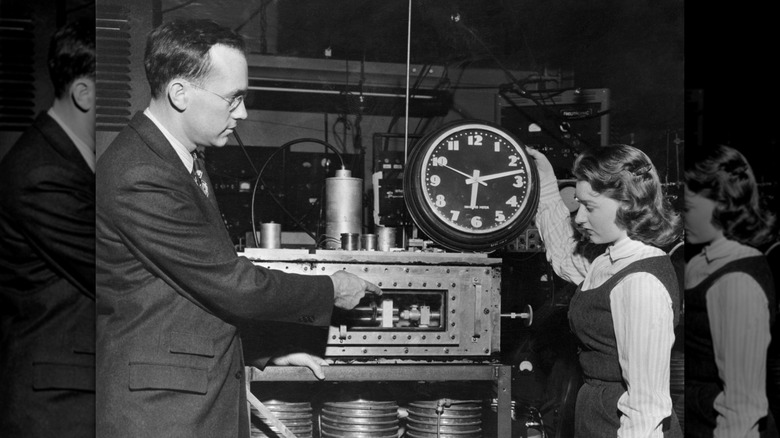
Why is a special lunar timekeeping system important? Time runs slightly faster on the moon than on Earth due to its lower gravity. Einstein’s theory of general relativity may still be just a theory, but it explains why a clock on the surface of the moon ends up about 58 microseconds faster than the same clock on Earth during an Earth-based 24-hour day. This isn’t a huge difference, and it didn’t have a significant effect on the Apollo missions, the longest of which, Apollo 17, was still less than two weeks.
However, those occurred before GPS-based navigation, which uses precise atomic clocks to help identify your location. The moon currently has no GPS, but a similar system will be necessary in the future for precision landings and navigation across the lunar surface. This time correction will also be needed for long-term lunar missions to keep everyone using the same time instead of falling out of sync during months and years on the lunar surface.
It will be interesting to see what NASA comes up with to establish Coordinated Lunar Time. If the Chinese have figured out a highly accurate system, the mathematics involved are valid regardless of who writes the software that runs it. Will NASA come up with an even better way to do it, or copy the Purple Mountain Observatory’s public notes?