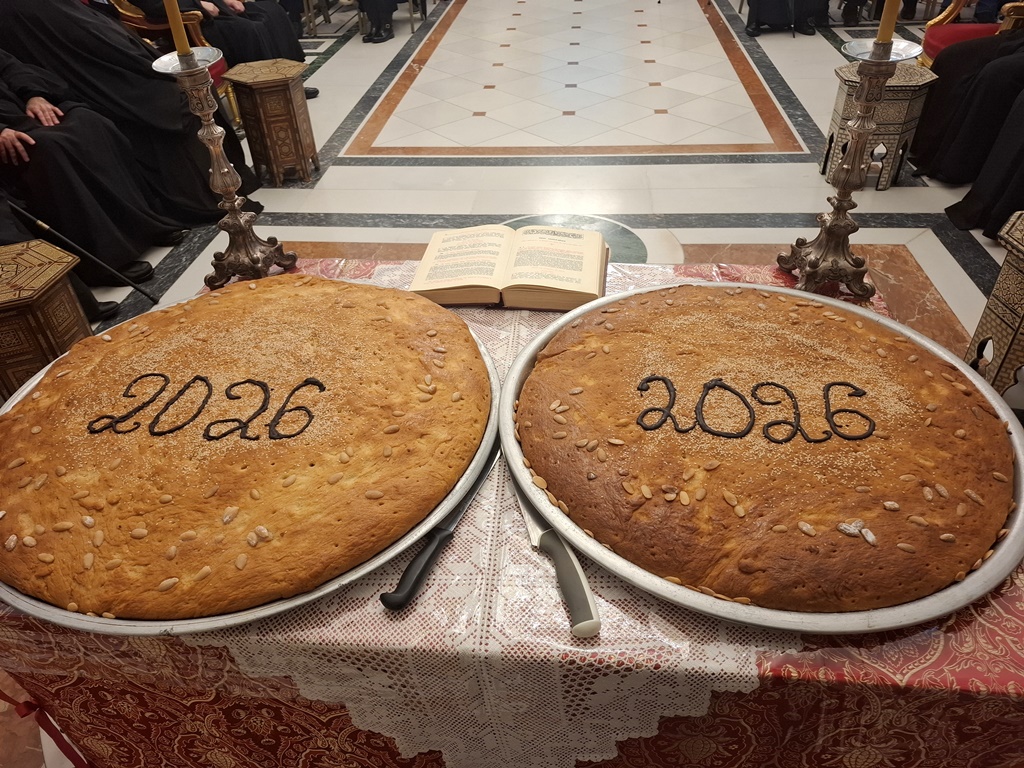
On the Eve of the New Year, 31 December 2025 / 13 January 2026, the ceremony of the cutting of the Vasilopita took place in the hall of the Patriarchate.
During this ceremony, His Beatitude, our Father and Patriarch of Jerusalem Theophilos addressed those present with the following address:
“And if a man desire much experience, [wisdom] knoweth things of old, and conjectureth aright what is to come: she knoweth the subtilties of speeches, and can expound dark sentences; she foreseeth signs and wonders, and the events of seasons and times” (Wisdom of Solomon 8:8). Thus speaks the wisdom of Solomon.
Your Excellency General Consul of Greece, Mr Dimitrios Angelosopoulos,
Venerable Holy Fathers and Brethren,
Beloved brethren in Christ,
The grace of the Holy Spirit, which overshadowed the Virgin Mary, from whom the God-Word was incarnate and became man—our Lord Jesus Christ—has gathered us all together in this sacred place of our venerable Patriarchate of Jerusalem, that we might offer glory and thanksgiving unto the Creator of the whole world for the turning of the year of the Lord’s goodness (cf. Luke 4:19 / Isaiah 60:2).
Moreover, Christ, who was quickened by the Spirit (cf. 1 Peter 3:18), has gathered us together for the venerable commemoration of His circumcision according to the flesh, as also for the observance jointly celebrated of our Father among the Saints, Basil the Great, Archbishop of Caesarea in Cappadocia, and for the ceremony held in his honour of the cutting of the Vasilopita that bears his name.
The succession of our historical time into past, present, and future—into outgoing and incoming, Old and New—as well as its determination by the philosophising human intellect, remains incomplete, if not altogether impossible. “It is not for you to know the times or the seasons, which the Father hath put in his own power,” the Lord says to His disciples (cf. Acts 1:7).
According to Solomon, however, the wisdom of God is that which can know the constitution of the world and the operation of the elements: “For he gave me certain knowledge of the things that are, namely, to know how the world was made, and the operation of the elements: the beginning, ending, and midst of the times: the alterations of the turning of the sun, and the change of seasons: the circuits of years, and the positions of stars” (Wisdom of Solomon 7:17).
In his discourse On Time, the philosopher and martyr Justin says: “That time is neither motion nor without motion is evident. But that time is created and not eternal, having a beginning and not without beginning, finite and not infinite—this too is evident.”
Saint Basil the Great, in his discourse Against Eunomios, says: “days and hours and months and years are measures of time and not parts of it. Time is an interval which extends together with the world from the creation; within this interval every movement is measured, whether of the stars, of living beings, or of any other moving creature, and based on this measurement we say that one moves faster or slower than another.”
In other words, the succession of time is a fact that marks the passing interval of man’s cosmic history, and all the more so of sacred history, which reaches its culmination in the mystery of the Divine Providence, that is, in the Incarnation and the becoming man of the God-Word, our Saviour Christ.
For this reason, our Holy Church, heeding the scriptural words of the Lord—“The Spirit of the Lord is upon me, because he hath anointed me to preach the gospel to the poor; he hath sent me to heal the broken-hearted … to set at liberty them that are bruised, to preach the acceptable year of the Lord” (Isaiah 61:1–2 / Luke 4:18–19)—not only celebrates this event, but also invokes the blessing from God the Father of the “year of the Lord,” saying: “O Word without beginning and Son, united with the Holy Spirit, Maker and Co-Creator of all things visible and invisible, bless the crown of the year” (cf. 2 Corinthians 6:2).
According to the observation of Melito of Sardis, “Time is the interval during which something is done, while season is the opportune time for the work.” Wherefore Saint John Chrysostom, interpreting the aforementioned words of Paul, “Behold, now is the accepted time; behold, now is the day of salvation,” says: “Paul also recalls the prophecies, urging them on and pressing them to bestir themselves toward the appropriation of their own salvation.”
To this very end the divine Paul urges and presses us on: that we should bestir ourselves toward the appropriation of our own salvation. This, indeed, is accomplished within the liturgical life of the Church, that is to say, in the mystery of the Divine Eucharist, where time becomes season.
The Apostle Peter, responding to the conceptual understanding of time among the Greeks—that is, the pagan philosophers—says: “For we have not followed cunningly devised fables, when we made known unto you the power and coming of our Lord Jesus Christ, but were eyewitnesses of his majesty” (2 Peter 1:16). These words of the inspired Peter once again indicate that time, which has become season in the Body of Christ, that is, in the Church, has been given unto us, that we also, through faith and the illuminating power of the Holy Spirit, might become “eyewitnesses of his majesty,” that is to say, beholders of the glory of God.
This confession of the Apostle Peter, which refers to our Lord and God Jesus Christ, the Creator of Time, who hath called us out of darkness into his marvellous light (cf. 1 Peter 2:9), the true Light (John 1:9), at this present season of the turning of time, calls us to sobriety according to the psalmic word: “Our soul is escaped as a bird out of the snare of the fowlers: the snare is broken, and we are escaped” (Psalm 124:7).
In other words, the present season of the succession of scriptural time is the pre-eminently fitting season for us to reflect, according to the Evangelist Luke, upon “repentance toward God, and faith toward our Lord Jesus Christ” (Acts 20:21). And this, because we live in perilous times—times in which sin, that is to say, apostasy, lawlessness, and the power of darkness (Luke 22:53), are falsely regarded as freedom, and thus lie in wait, perverting and undermining “our liberty which we have in Christ Jesus” (Galatians 2:4). Humanity, moreover, is being tried by wars, conflicts, and “every evil work” (James 3:16), according to the Apostle James, the Brother of the Lord.
As we celebrate the Nativity according to the flesh of our Lord and God and Saviour Jesus Christ, and likewise the dawning of the New Year, let us entreat the great Hierarch of Cappadocia, Saint Basil the Heaven-manifest, that together with the Theotokos and Ever-Virgin Mary he may intercede for our souls and for the peace of the whole world—especially for the sorely tried and uncertain as to the course to be taken Gaza Strip, and the wider region of the Middle East—and also for the cessation of divisions that ought not to be, and for the healing of the fractured unity of the One, Holy, Catholic, and Apostolic Orthodox Church.
And together with the hymnographer let us say: “O Word of the Father, pre-eternal, who by thy almighty word hast established the whole creation, bless the crown of the year of thy goodness, bestowing peace [and unity] upon thy Churches. Preserve the holy city of Jerusalem, our pious Christian flock, our venerable Hagiotaphite Brotherhood, and the pious race and nation of the Orthodox Romans. Amen. A blessed and peaceful New Year 2026. Many happy returns!”
Thereafter, the Apolytikion of the Feast of the Circumcision of Christ was chanted, “Thou didst take upon thyself the form of man without change…”, as well as that of Saint Basil the Great, “Their sound hath gone forth into all the earth”; and subsequently His Beatitude cut the Vasilopita, saying: “A prosperous, blessed, and peaceful New Year 2026,” and distributed it to those honouring the ceremony: the General Consul of Greece in Jerusalem, Mr Dimitrios Angelosopoulos; the Consul, Ms Anna Mantika; the Holy Sepulchre Hierarchs, Archimandrites, Priests, Deacons, and monks; the nuns; and all those present.
While His Beatitude was distributing the Vasilopita, the Holy Sepulchre novices of the Patriarchal School of Zion chanted, “We are the new generation of the All-Holy Sepulchre…”, together with the New Year carols. After the ceremony concluded, accompanied by the Headmaster, the monk Basil, they visited His Beatitude and the members of the Holy Sepulchre Brotherhood, chanting carols in their homes.
From the Chief Secretariat