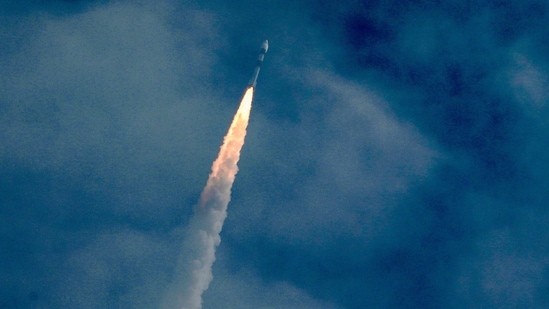
A ‘KID’ – against all odds – managed to separate from the 15 other satellites that got lost in space while being carried by Indian Research Space Organisation’s (ISRO) PSLV C62 as part of a mission – called ‘EOS N1’ – that took off from Andhra Pradesh’s Sriharikota on Monday.
 ISRO’s PSLV-C62 carrying the EOS-N1 lifts off from the Satish Dhawan Space Centre in Sriharikota, Andhra Pradesh, Monday, (PTI)
The 44.4 metre tall four-stage rocket lifted off as scheduled at 10.18 am on Monday from the spaceport in Sriharikota.
The mission was to deploy a primary Earth Observation satellite and multiple co-passenger satellites into a 512 km Sun-Synchronous Orbit, after a flight of about 17 minutes.
Watch the launch
The automatic launch sequence took place following approval from the mission director. ISRO scientists shared real-time updates as the vehicle ascended, with the initial phases of the flight proceeding as intended.
Things changed at the Mission Control Centre after the announcement that the “third stage ignited”.
15 satellites lost, but a KID made its way
In the second consecutive setback for ISRO’s PSLV, 15 of the 16 satellites, including a foreign Earth Observation payload, could not be placed in the intended orbit after the carrier rocket encountered an “anomaly” in the critical third stage of the launch on Monday.
“Disturbances in the rocket and later deviation from the flight path were observed when strap-on motors were providing thrust during the flight’s third stage to propel the vehicle to the intended altitude”, ISRO chairman V Narayanan said, adding a detailed analysis has been initiated to identify the cause.
While ISRO sources, cited by PTI news agency said all 16 satellites were lost, KID or Kestrel Initial Technology Demonstrator – from a Spanish startup that was a small-scale prototype of a re-entry vehicle – apparently fought against odds.
“Our KID capsule, against all odds, separated from PSLV C62, switched on, and transmitted data. We’re reconstructing trajectory. Full report will come,” said the Spanish startup Orbital Paradigm on X.
Which were the other satellites
Among the satellites lost were DRDO’s Anvesha, a strategic super-eye to unmask military camouflage from nearly 500 km, AayulSAT, India’s first in-orbit fuelling satellite, and CGUSAT, a small, student-developed Low Earth Orbit (LEO) satellite designed primarily for emergency communication and disaster management. The Earth Observation satellite was built jointly by Thailand and the UK.
A similar, previous attempt in May 2025 (PSLV-C61-EOS-09) also did not succeed due to a “motor pressure issue,” and there was a fall in the chamber pressure of the motor case.
A former top ISRO scientist said it would take some time for the space agency to gather data, analyse, understand what happened, and make necessary corrections. It is expected that ISRO will officially release the findings in the days to come, he was quoted as saying by PTI, on condition of anonymity.
“It is a setback as the satellites did not reach the intended orbit and all satellites lost in space maybe drifting as space debris,” he added.
What ISRO said
Confirming the mission’s failure on its ‘X’ handle, ISRO said, “The PSLV-C62 mission encountered an anomaly during the end of PS3 (third stage) of the vehicle. A detailed analysis has been initiated.”
The space agency did not provide more details and didn’t categorically describe the mission as a failure.
In a brief press conference later, ISRO chief Narayanan, who is also the secretary of the Department of Space, said, “As all of you are aware, today we attempted PSLV-C62/EOS-N1 mission… the mission could not proceed in the expected (flight) path. That is the information right now available.”
“We are going through the data and with the data collected from all the ground stations, and once the data analysis is completed, we shall come back to you,” he was quoted as saying.