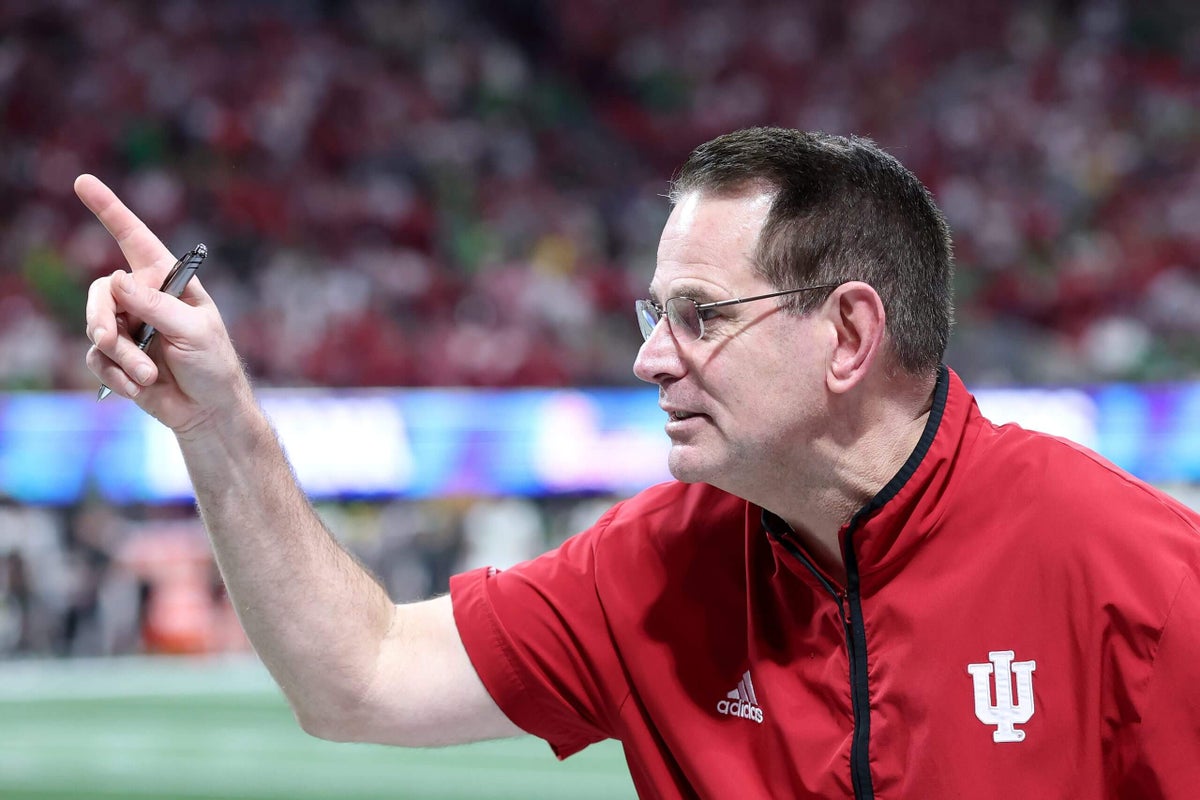
Rather than waiting a week for everybody to throw something back in my face, I’m going to own up to one of my dumbest takes of all time.
It started in my Sept. 24 Mailbag about Curt Cignetti and the coaching carousel, in which I wrote: “Even the cocksure Cignetti surely realizes you can’t win a national championship at Indiana.”
Indiana fans immediately took umbrage in the comments, but I did not change my tune the following week. “Perhaps Indiana will get there one day, but right now, it’s only five games into the second year of its hike.”
Finally, two weeks later, after the Hoosiers’ eye-opening 30-20 win at No. 3 Oregon, someone followed up with, “Do you still believe Indiana can’t win a national championship?” And I freaking tripled down.
“Winning three straight games in January against top-10 teams requires a level of depth that teams like Ohio State and Alabama almost always have, and where teams like Indiana are at a perpetual disadvantage.”
Self-destruction. Got me again.
But hey, I did say at the time, “I’d be thrilled to be proven wrong.” As it turns out, win or lose against Miami, I absolutely was.
What have we learned from Cig’s evaluation of talent and roster construction? That evaluating high school talent is more of a crapshoot than we thought, and that the subsequent star ratings should be taken with more of a grain of salt? What are the implications for the college football industry? — Kevin K.
Curt Cignetti has broken the entire recruiting evaluation industry. Or at least exposed how outdated it is, given all the recent changes.
It’s not that the recruiting analysts have gotten worse at assigning star ratings; it’s that those ratings should really come with an expiration date at this point. Once a guy goes in the portal after his first two years, what does it matter whether he was a three-star or a five-star coming out of high school? Everyone now has new, fresher data.
Take Indiana’s undersized cornerback D’Angelo Ponds, who, as Bruce Feldman wrote Tuesday, only had one P5 offer, from Syracuse, at the time he committed to Cignetti at James Madison. He immediately “proved the doubters wrong” his first year at JMU, earning Freshman All-America honors while ranking 11th nationally with 15 passes defended.
And yet, when he went in the portal, he was still ranked behind 83 other cornerbacks, well behind guys such as Denver Harris, a former five-star who was suspended for parts of his first two seasons at Texas A&M and LSU and played sparingly for them. Perhaps that should have been a red flag, because Harris has since bounced to UTSA, where he made three starts, and UNLV, where he barely played. But the people who do those transfer rankings still tend to default to potential over production.
But not Cignetti. His lineup is full of guys who had proven themselves at mid-level P4 schools (Cal’s Fernando Mendoza, Maryland’s Roman Hemby) or G5 schools (JMU’s Ponds and Elijah Sarratt, Kent State’s Stephen Daley) by the time they got to Indiana, yet they still get counted simplistically as “not four stars.”
It may be that 10 years from now, we look back and realize that Cignetti/Indiana and future national championship participants will still primarily be the schools that hoard all the five-stars. But no doubt, other coaches and programs will try to emulate his model. The recruiting rankings system will need to adjust as well.
Miami returning to the mountaintop after almost 25 years in the wilderness would be the story in college football if it weren’t for Indiana. Win or lose, for Miami to be back in the conversation is a remarkable achievement for a coach and a program who have had their share of doubters. What are your thoughts on Miami’s rise again, and do you think they can remain a title contender in the future? — Brian R.
If Miami wins a national championship Monday, it ought to give a ring to Kirk Herbstreit. The ESPN analyst inadvertently touched off this renaissance in 2021 with a scathing “College GameDay” rant about the program’s demise in which he called out then-president Julio Frenk (now at UCLA) and athletic director Blake James (now at Boston College) for a lack of commitment to football.
In short order, these things then happened:
Frenk publicly pledged to become more involved in athletics and ousted James, soon replacing him with Clemson’s Dan Radakovich.
With the university’s coffers humming thanks to its highly profitable UHealth system, the administration began throwing money at the problem in the form of facilities upgrades and staff salaries, including …
Frenk and a couple of his lieutenants (one of whom, Joe Echevarria, succeeded Frenk as president) went hard after Mario Cristobal at Oregon, despite not yet having fired Manny Diaz. They convinced him to come home with a 10-year, $80 million contract.
Wealthy Miami boosters (remember the since-shelved John Ruiz) embraced NIL in a big way. Cam Ward and Carson Beck put off the NFL to collect big checks at Miami, and the Tuscaloosa News reported this week they tried to convince Ty Simpson to do the same with an unprecedented $6.5 million offer. Beck is reportedly making between $3-4 million.
All of which is to say, it’s a different world now than it was back when Howard Schnellenberger and the coaches who followed him were dominating recruiting in the “state of Miami.” South Florida high school kids still play key roles in Cristobal’s program — see Rueben Bain, Mark Fletcher, Malachi Toney and many others – but he’s been given the resources to go find the best players wherever they may be.
As long as that continues, I see no reason why Miami can’t keep this going. It’s not like Florida State or Clemson are going to get in the Canes way anytime soon.
Stew — Is the Demond Williams saga evidence that schools have figured out how to lock players into their NIL deals, or was there something else that happened behind the scenes? And if so, what comes next? Are multi-year contracts a possibility? — Isaac O
It’s definitely an example of the post-House settlement “system” working.
All along, schools have been hoping their rev-share contracts would prove more stabilizing than outsourcing roster retention to a third-party NIL collective. And the Big Ten was particularly proactive about it. It came up with the template language that Washington and most of the conference’s other programs use, which includes a liquidated damages (buyout) clause. It certainly deterred Williams in this case, given the university was threatening to demand the full reported $4 million value of the deal.
Whether his situation becomes a precedent for other schools remains to be seen. This was an extreme case, given how much money was at stake. It would have been extremely risky for Williams to leave for LSU or Miami without knowing whether he’d be able to get out of paying such a huge amount. We also don’t know whether Washington would have been as strident if this were a lesser player who tried to break, say, a $100,000 deal within days of signing it.
I’m all for a model with more stability/less chaos, but we’re a long way from knowing whether the current version will hold up in court. A Big Ten rev-share agreement I viewed last year stated that “the Athlete is not, and shall not claim to be, an employee of the Institution,” and that the compensation is “not provided in exchange for the Athlete’s commitment to attend the Institution or participate in the Institution’s Program (i.e., not ‘Pay-for-Play’).”
Schools like Wisconsin (with Xavier Lucas) and Washington claim these contracts are nothing more than agreements to license the athlete’s NIL rights, while also claiming they legally bind the athlete to play football for their school. Kind of like an employee who is compensated to attend their Institution and participate in the Institution’s program.
While Washington and Williams avoided a legal clash, Georgia and former defensive end Damon Wilson II remain in the early stages of litigation over a similar situation. If it makes it to court, a judge will determine whether the school is justified in claiming Wilson caused $390,000 in damages when he broke his contract last year, less than a month after signing it. There will likely be other challenges like it very soon.
By the way, multi-year contracts are already here, though mostly for quarterbacks and other high-end players. Schools still want the flexibility to cut other guys loose.
The Jan. 23 deadline for CFP expansion is fast approaching, and you are the expert with your finger on the pulse of this sport. If you were an oddsmaker, how would you set the odds on how many teams will be in the CFP next year: 12? 16? 24? — John H.
Staying at 12 for at least another year remains the heavy favorite, higher than even Indiana -8.5, even though nearly all the conferences are ready to expand. The Big Ten and SEC hold sole decision-making power over the next deal, and their commissioners remain diametrically opposed in their visions of how a bigger Playoff should look, and it seems unlikely that’s going to change in less than two weeks.
SEC commissioner Greg Sankey would sign up for a 16-team field with five AQs and 11 at-large berths tomorrow, but remains adamantly opposed to more than five automatic berths. Big Ten commissioner Tony Petitti, realizing his polarizing 4-4-2-2-1 plan is DOA, has already moved on to trying to sell the group on going straight to 24 teams. In that model, either all the conferences would have the same number of AQs, or there would be no AQs at all.
As crazy as it sounds, there’s more support for that model within the SEC and other conferences than you might imagine, and we’re probably headed in that direction at some point. But the idea that they could scrap conference championship games, add play-in games, figure out the logistics and bid out the extra inventory to the TV networks, all by next fall, seems implausible. From what I’m told, the commissioners haven’t yet discussed any of that. They’re still stuck on the number of teams.
The one wrinkle that could open the door to some expansion in 2026-27 would be if Petitti temporarily cedes to a 5+11 field in the short-term with the understanding they’d start trying to implement 24 for a year or two down the road. Which seems impractical.
The commissioners will hold their first formal CFP meeting in months on Saturday in Miami. I expect we’ll finally hear some details about next year at that time. But it will blow my mind if those details include a 180 on format from either Petitti or Sankey.
Stewart, would you consider the optics of mixing the pinnacle of the season, critical CFP semifinal and national championship games, with the chaos of the portal and some of the stories coming out as less than ideal for the marketing of the sport? Would the NFL ever deliberately put themselves in a situation where the Super Bowl was overshadowed by complete ridiculousness off the field? — Brian S.
“Less than ideal” would be a good way to put it. But I’m not sure it affects the buildup to the title game at all.
The universe of diehards who follow the day-to-day machinations of this sport — like those of you reading this column — comprises a small percentage of the 20 million or so folks who will tune in for the national championship game. In fact, how many of those 20 million would you guess even know who Demond Williams is, much less that he tried to get out of a $4 million contract at Washington? Ten percent? Five percent? Less?
The much bigger problem for the marketing of the CFP is how late they’re playing these last two rounds of games.
To use your NFL analogy, can you imagine fewer people watching the NFL playoffs as the Super Bowl approached? Because that’s exactly what’s happened with the 12-team CFP. The quarterfinals, played on Dec. 31/Jan. 1, averaged 19.3 million viewers. A week later, viewership dropped to 18 million for Indiana-Oregon and 15.8 million for Miami-Ole Miss. Some of that was likely due to the absence of big brands, but even the Notre Dame-Penn State and Ohio State-Texas pairings last year, which played in the same Thursday/Friday time slots, were down 17 percent from the Jan. 1 semis the year before.
And it was even more telling that the Jan. 20 Ohio State-Notre Dame title game, which you would think to be a TV exec’s dream title matchup, was 12 percent lower (22.1 million) than Michigan-Washington the year before, when it was two weeks earlier.
Rather than focusing on portal and recruiting windows, the P4 commissioners need to place more urgency on shifting the regular season earlier so they can move the CFP earlier, when it’s not on random weeknights wedged between rounds of the NFL playoffs. The semis should be on Jan. 1, the title game a week later. In which case, the portal-CFP overlap will at least be reduced to a few days, and you might be able to avoid situations like Oregon’s Spinal Tap running back shortage.
As an Oregon fan, how should I feel about Oregon’s Playoff appearances under Dan Lanning? Last year we got blown off the field by Ohio State, 41-21 (34-8 at the half), and this year we lost 56-22 to Indiana in a game that was 35-7 at the half. Do we have a young coach who’s still growing in his role, or do we have the coach who can’t win “the big one”? — Trevor K, Portland, Ore.
I think you have a coach who is really, really good at his job, who has built Oregon into one of the top 5-10 programs in the country, but not quite at a national championship level yet. Who has, unfortunately, drawn an inordinate number of games against teams that proved to be at that level.
Here’s a crazy stat: Lanning is 48-8 at Oregon, and six of the eight losses were to teams that reached/won the national championship (2022 Georgia, 2023 Washington twice, 2024 Ohio State and 2025 Indiana twice). If that’s the threshold for “big one,” then no, he has not won the big one. But I’d hardly say this is a James Franklin situation. The guy is 6-0 against other Top 10 teams, including a 23-0 shutout of No. 4 Texas Tech just a week before the Indiana game.
I realize the past two CFP blowouts will inevitably be grouped together, but I view them as two distinct circumstances. Last year’s Rose Bowl dud was inexplicable. A 13-0 team that beat Ohio State earlier in the season should not be falling behind 34-8 to that same opponent in the Playoff. Whereas the Indiana game … you could kind of see it coming. Mass injuries/attrition at running back. An offensive line that struggled in pass protection in their first meeting and again in the Texas Tech game. Back-to-back cross-country flights in a five-day span.
And then the game started.
I hope Ducks fans will give Lanning a pass for this one. No one is immune to a Curt Cignetti butt kicking.
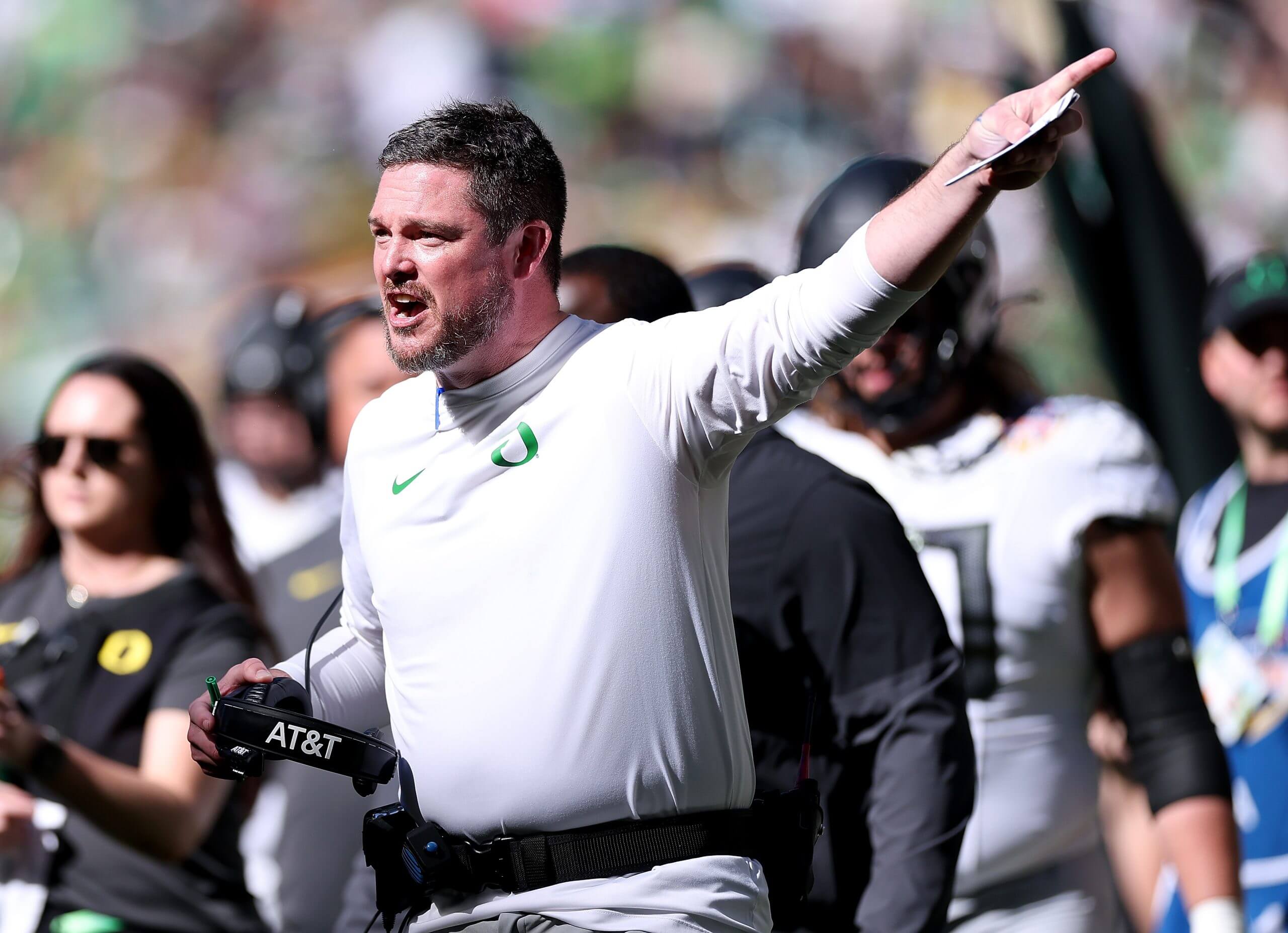
The Ducks have lost a majority of their games under Dan Lanning to teams that reached the national championship. (Kevin C. Cox / Getty Images)
Will Curt Cignetti crack a smile if his team wins on Monday? — Martin D.
If Indiana wins Monday, I predict we’ll see a completely unfiltered version of Cignetti. Maybe he cracks open a better one on stage during the trophy presentation.
Lastly, thanks to reader Eric Hazard for digging up a Mailbag from 2011, the zenith of the BCS era, where someone asked me to describe a “hypothetical 16-team Playoff” from the future. Which I wanted nothing to do with. So I wrote a satirical game story about a 2024 Texas vs. Stony Brook national championship game.
It’s the last question, if you want to get a kick seeing what I was dead wrong about (declining attendance, bowls going out of business, Major Applewhite becoming Texas’s head coach) and what proved to be prescient (mass coach firings, calls for an even bigger playoff, Applewhite becoming someone’s head coach).
One loyal reader even had a question published in both that 2011 column and this 2026 column.