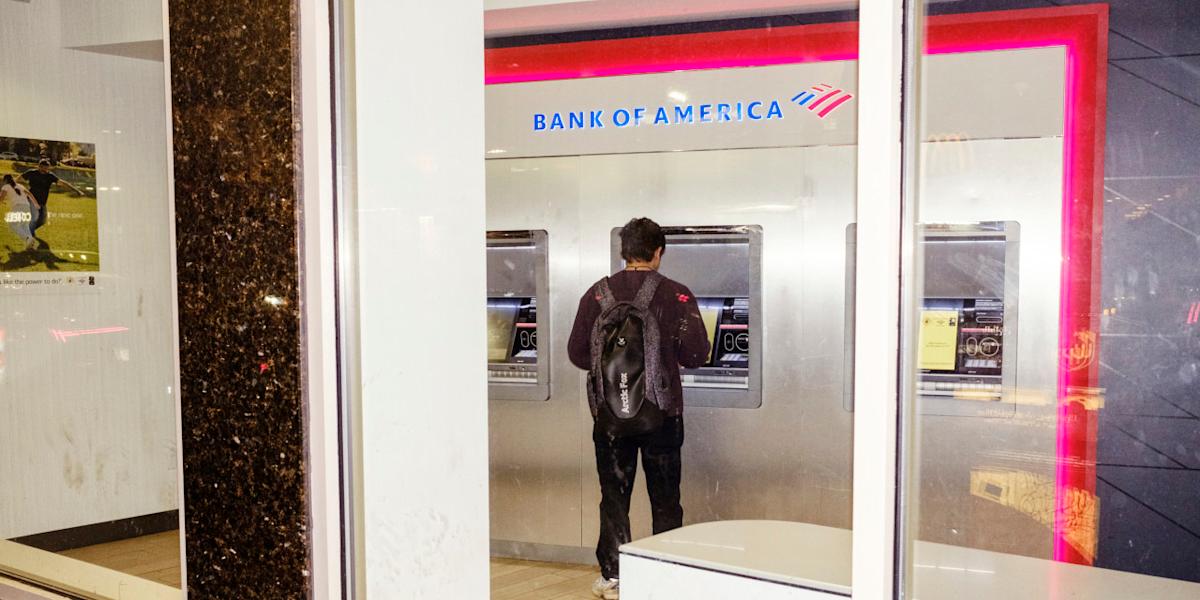
 Bank of America expects further economic growth this year. – Michael Bucher/WSJ
American consumers continued to spend and borrow at a healthy clip at the end of 2025, despite a year marked by uncertainty around job security, tariffs and stubborn inflation.
JPMorgan Chase, Bank of America, Citigroup and Wells Fargo this week collectively reported $28.5 billion in profits for the fourth quarter. That amounted to $123.2 billion for the full year, up nearly 5% from 2024.
“All of the metrics that we can see tell us the consumer remains resilient and in great shape,” Bank of America Chief Financial Officer Alastair Borthwick said on a call with reporters.
Borthwick said the bank isn’t seeing signs people are borrowing significantly more, or saving less. Citigroup’s CFO said he isn’t seeing a lot of disparity across income brackets on credit-card delinquencies.
As Americans continue to contend with elevated interest rates and prices, the Trump administration kicked off 2026 with a supercharged push to reach voters on affordability ahead of midterms. Over the weekend, President Trump rattled the financial industry with a call to limit credit-card rates to 10% for one year, though it isn’t clear how he would put such a policy in place.
Banks expressed support for the Trump administration’s affordability efforts, but warned that such a cap would make it harder for consumers to access credit, especially those with lower incomes and credit scores.
“An interest-rate cap is not something that we would or could support,” said Mark Mason, Citigroup’s chief financial officer, on a call with reporters. He said it would “restrict access to credit to those who need it the most, and frankly, would have a deleterious impact on the economy.”
Wells Fargo CFO Mike Santomassimo said it would “have a negative impact on economic growth.” On Tuesday, JPMorgan’s Jamie Dimon said “if it happened the way it was described, it would be dramatic.”
JPMorgan, Bank of America and Citigroup said spending on cards rose in the fourth quarter, while delinquencies on credit cards edged lower. Bank stocks were down Wednesday, falling more than the broader market, with Bank of America, Citigroup and Wells Fargo all sliding more than 4% in afternoon trading.
The Trump administration has focused much of its recent campaign on home affordability, increasingly a political flashpoint.
In the fourth quarter, mortgage originations jumped by nearly a third at JPMorgan and more than 28% at Bank of America, compared with a year earlier. Originations at both banks were still down sharply from 2021 levels.
The Trump administration recently warned home builders to build more and lower prices rather than focus on stock buybacks. It also moved to ban “large institutional investors” from single-family home purchases and directed the government-backed mortgage-finance giants Fannie Mae and Freddie Mac to buy $200 billion in mortgage bonds.
“I did actually hear that it was a pretty busy day in the home lending business on the back of what happened in the mortgage market, so maybe we’ll actually start to see some pick-up there,” JPMorgan CFO Jeremy Barnum said on a Tuesday call with analysts. “But obviously, there are still some larger dynamics in the housing market that will be a challenge there.”
The monthly cost to own a home has dramatically risen in recent years. Mortgage rates have eased some in recent days but remain roughly double what they were several years ago. Homeowners who locked in lower-rate mortgages before that have been reluctant to move, which has weighed on supply and kept prices elevated.
Write to Gina Heeb at gina.heeb@wsj.com and Alexander Saeedy at alexander.saeedy@wsj.com