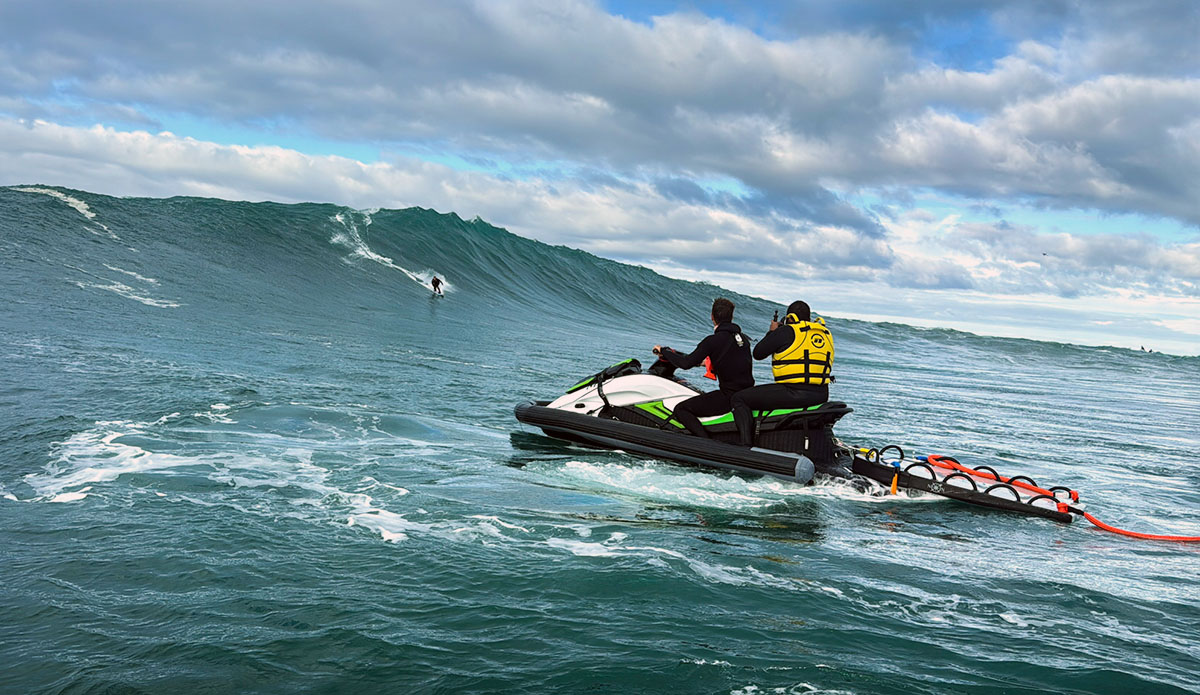
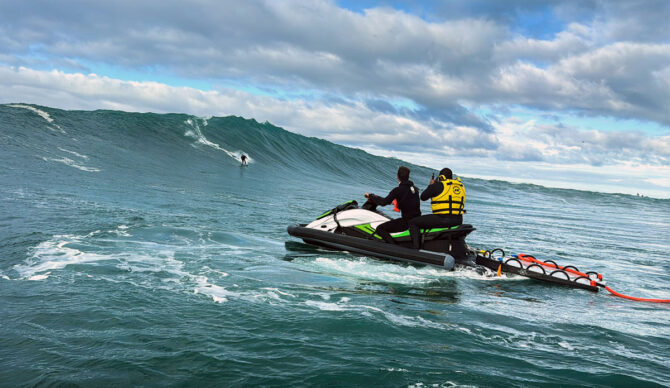
Big wave photography: it’s a team effort. Photo: Jackie Connor

Big wave surfing – the phrase comes with a heavy reputation of intense training regimes, sheer dedication and just plain guts. And then there’s the actual situation, being in the presence of unthinkable amounts of water moving at unfathomable speeds, only to detonate like a monster from the deep. Somewhere in us all, we desire to observe these beasts. Some might ride them, and a select few want to capture the magic of a full-throttle big wave lineup for the world to see. Yes, big wave photography is its own animal.
That was me, amidst the chaos and the sounds of the full send at Nazaré, trying to capture all the glory on film. But what was I doing there?
We can thank Maria Fernanda Bastidas for that.
For more than a decade, Bastidas has been shooting big waves in and out of the water all over the world. A competitive swimmer, Bastidas’ passion for big wave photography started with a dream in Mexico City. She sold her car and bought a camera, water housing and booked a ticket to Hawaii, where she trained with a core group of bodyboarders on Kauai’s North Shore. Bastidas made significant strides after a three-day, 18-mile swim along the Nā Pali coast with Bethany Hamilton.
“I grew up in the city, but I just liked the water and the ocean, and suddenly I got to practice with the best,” said Bastidas. “When I’m in the ocean, I’m completely focused.”
Bastidas hosted her annual Big Wave Photography Workshop in Nazaré and, having dreams of my own, I couldn’t resist.
Let’s get one thing straight – I’m a writer, any semblance of photography talent is because I point, shoot. Nature and the surfer typically does the rest. I take no credit for having technical skills that lend to the craft. Photography has always inspired and intimidated me because there are so many factors, so much to learn and consider. My surf ADD ends up taking over, and I’ve put down the camera and grabbed my board. Writing has its complexities, too, but the factors involved in writing are typically based on personal experience or observation. So when I decided to take Bastidas’ workshop, it was completely out of my comfort zone on all fronts: surf, technical photography skills, swimming and rescue.
Everything is different. Nothing is without risks.
“If you’re not 100 percent ready, don’t go,” said Bastidas. “You have to be as trained as possible. The ocean is powerful. Being physically and mentally ready is a must.”
For three days, I got a crash course on what that meant at the OHAI Resort alongside three other talented photographers. Though I came down with a stomach bug right before day one, which counted me out for the apnea training and an in-water photo session, on the second day, all four of us jumped aboard Jet Skis with Anthony Cardoso and Ivo Cação of Nazaré Nexus.
A Nazaré local, lifelong surfer and founder of Nazaré Nexus, Cardoso has spent decades in these waters paddling, surfing and now operating one of the most trusted Jet Ski and safety operations in town. As big wave surfing in Nazaré evolved, Cardoso evolved with it, building a team, investing in equipment and setting a standard that prioritizes local knowledge and safety above all else.
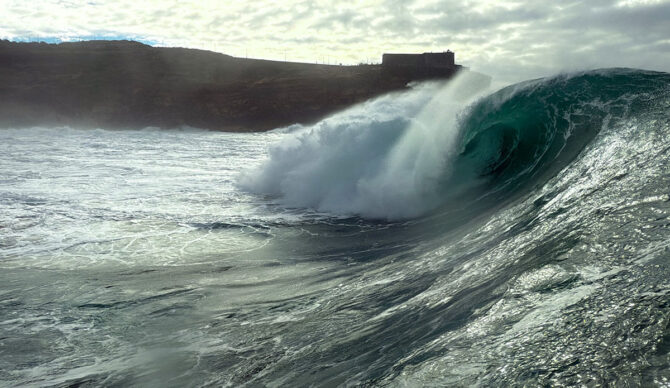
The belly of the beast and one of the best classrooms in the world. Photo: Jackie Connor
“Safety is everything. I built my team from the ground up and passed on my knowledge so everyone understands the standards I expect,” said Cardoso. “The team is doing a great job, and our clients are happy because they feel safe. I have this company because everything comes from my experience — paddling and surfing this beach since I was 12 years old. That local knowledge made me who I am today, and now I can offer it to others in a safe way around big-wave surfing.”
Rain was off and on during the trip, but the sun poked through, the wind calmed and we were met with 15-20-foot faces –plenty of swell to go around the seemingly crowded lineup. Jet Skis, tow surfers, paddle surfers buzzed everywhere. The air felt electric with energy and then the horizon would get dark.
So you want to be a big wave photographer?
You have to be a swimmer, not just a surfer. Bastidas grew up landlocked, but she still managed to be a champion swimmer.
“For me, the best training is just being in the ocean swimming,” said Bastidas. “It teaches you how the ocean moves, its force and power, everything you need for shooting later with a camera in your hand.”
And you have to hold your breath. Bastidas’ workshop included apnea coach Pedro “Jojo” Barbudo, of Wave Crushers Training Systems, who trained with underwater breath holds, weights and running underwater and has trained surfers. He recommends playing underwater hockey.
“A lot of what we do actually comes from underwater hockey,” he explained. “That sport taught us how to stay longer underwater and get comfortable there – and that’s where this whole training approach was built.”
In the most dire of situations, you also become a first responder and need to know CPR and first aid. Consider the Big Wave Risk Assessment Group (BWRAG) training, specifically designed to teach surfers unique rescue skills, first aid and CPR.
One thing you really need, and something I’ve had to learn is that you must possess a healthy amount of fear, but never panic.
“Fear isn’t going to kill you, in fact, it is how we survive, but panic will,” said Bastidas. “It takes more energy to panic, so the key is maintaining focus and mental clarity.”
On the water, Cardoso echoed the same mindset.
“To shoot big waves safely, you need a team,” he said. “ The Jet Ski is one element, the pilot is another, the photographer is another, and we also have a spotter on the cliff watching everything. If conditions aren’t safe, we don’t go. If the equipment isn’t perfect, we don’t go.”
But most of all, you need to be stoked. The ocean has a way of reflecting our energy 10-fold. While out on the ski at Nazaré, all I could see were smiles for miles. Everyone works together as a team to keep the lineup safe and stoked. No local vibes or arguments felt that day – just smiles. Nazaré seemed to have a tight vibe that felt contagious – even the grumpiest local would have no choice but to crack a few hoots for those sending it.
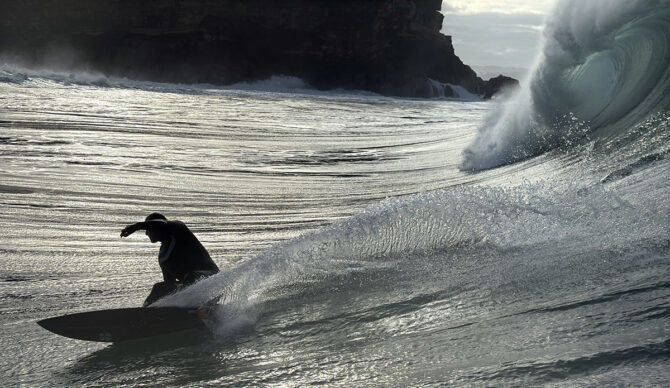
Rodrigo Koxa, making Nazare his play land. Photo: Jackie Connor
Lifeguards, Jet Ski operators, spotters, photographers – these are the folks behind the scenes making sure surfers are safe. I’ve never experienced a big wave lineup until now and while watching from the safety of a Jet Ski, it felt as though I was watching gladiators take on mythical monsters, minus most of the blood. When big wave surfer Clément Roseyro, winner of the Nazaré Big Wave Challenge’s Best Male Performer award, took a hit in the impact zone, Cardoso didn’t hesitate. Roseyro’s nose was bloody but a giant smile crossed his face. He maneuvered the ski in cleanly and pulled Roseyro to safety. Blood ran down Roseyro’s face, but a massive smile spread across his mug.
“That’s why we’re here,” said Cardoso. “Everyone goes home safe.”
I caught a couple of shots of Rodrigo Koxa, Brazilian big wave surfer from the Go Bigger team, catching bombs, carving the huge, clean faces as though the waves were half the size.
“Big waves, for me, let me be in the present,” Koxa told me later. “People live too much in the future or the past, but here you are just all instinct. You’re putting your life and your friends’ lives in each other’s hands. Everybody needs to have the same energy together. Without love, you cannot be here.”
And to be honest, that sums up the work and training of big wave photographers. You simply can’t do it out here alone.
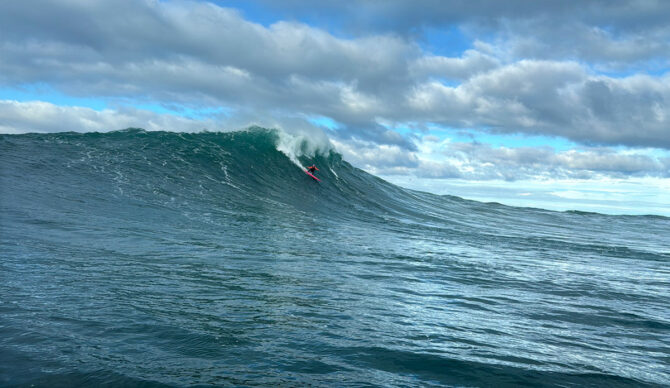
Photo: Jackie Connor