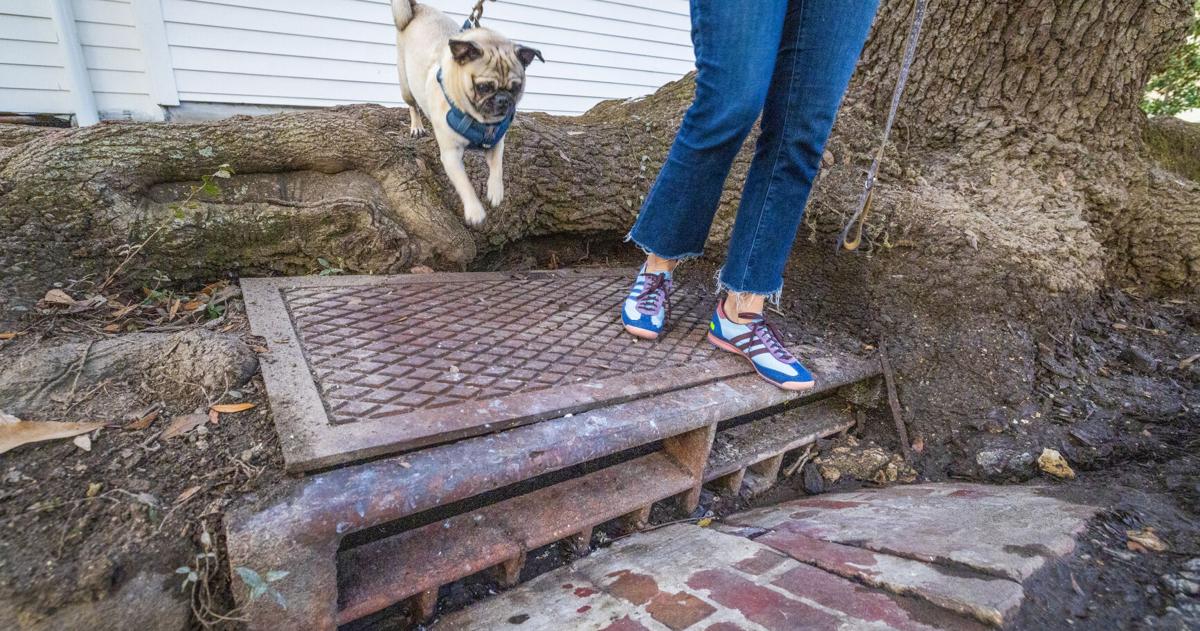
When the New Orleans Sewerage and Water Board took responsibility for the city’s “minor drainage” system one year ago, utility officials said $25 million was needed to properly maintain the catch basins, lateral drainage lines and small pipes that capture stormwater from the streets.
City Hall, which had neglected the minor drainage system for three decades before transferring it to the S&WB, committed $19 million. Less than half that amount was actually received, and the S&WB fell far short of its goal of cleaning 20% of the system, which officials say is the industry standard per year.
Now, with Mayor Helena Moreno’s newly installed administration demanding money from the S&WB to balance the city budget, it’s not clear how much funding for minor drainage will be available this year and beyond. The S&WB has frozen a contract for the work until reliable funding is in place, although some in-house personnel are still available.

Trash, leaves, and weeds cover the front of a catch basin in New Orleans on Monday, January 5, 2026. (Photo by Chris Granger, The Times-Picayune)
PHOTO BY CHRIS GRANGER
“We have a great program in place to establish what we need to meet the industry standard. We’re there. We just need the money,” said David Cappel, the S&WB drainage director, speaking at a board committee meeting on Wednesday.
The limited funding was still enough to make some headway. S&WB says it cleaned more than 9,000 catch basins and 94 miles of drainage lines last year, removing more than 5,000 tons of debris. But that translated to just 12% of the catch basins and 6% of the drainage lines, well below the 20% standard.
Cappel said he saved $1.7 million by eliminating unnecessary construction managers on contract crews that worked on minor drainage under Cantrell’s public works department.
The S&WB eventually wants to phase contractors out of minor drainage altogether, but that will require new specialized trucks needed to do the work. Only five of the nine trucks the S&WB received from Public Works were functional, Cappel said.
Shifting to in-house labor will also require more equipment operators. Cappel said he’s spoken with potential recruits currently working for engineering firms, but there’s no money to pay them.
Repairs are another matter. While the full extent of damage is not yet clear, an S&WB study of Treme found 15% of the minor system in that neighborhood needs repairs. If that figure holds up citywide, the S&WB estimates repairs will cost $240 million.
A piece of broken cement covers half of a catch basin in New Orleans on Monday, January 5, 2026. (Photo by Chris Granger, The Times-Picayune)
PHOTO BY CHRIS GRANGER
“That’s a tremendous bargain for spending zero dollars for 30 years,” S&WB board member Tyler Antrup said at the committee meeting, referring to City Hall’s management.
Moreno’s press office did not respond to questions about the administration’s plans for minor drainage funding.
Moreno’s infrastructure chief and public works director, Steve Nelson, repeatedly called attention to the minor drainage funding shortfall in his previous role as S&WB general superintendent. He reiterated the need in a recent interview, speaking in his new City Hall role.
“If the (minor) drainage system is not maintained, that’s going to have an adverse impact on our constituents,” Nelson said. “The funding has to happen.”
Nelson was circumspect on how the funding will be obtained, however, saying “we are continuing to work through it.”
“There is a reality to it. You can’t squeeze blood out of a turnip,” he said.
A history of neglect
The city’s Public Works department took control of the minor drainage system in 1992, after voters declined to renew an S&WB drainage millage. The city notoriously failed to keep the system free of debris and in good condition over generations of leadership. No one disputes that neglect has been a major contributor to chronic street flooding.
Officials long ago recognized the need to reunify the entire drainage system back within the S&WB’s portfolio, which still includes the “major” system of large pipes, canals and pump stations that ferries stormwater from the minor system into Lake Pontchartrain and the Intracoastal Waterway. Several attempts to negotiate the consolidation have broken down in recent years, including one Moreno helped lead as a council member in 2022. Funding was always the key sticking point.
State lawmakers finally forced the issue in 2024 with a law requiring the S&WB to take over all New Orleans drainage operations, but it was an unfunded mandate.
A new catch basin and sidewalk being built near Orleans Avenue in New Orleans on Monday, January 5, 2026. (Photo by Chris Granger, The Times-Picayune)
PHOTO BY CHRIS GRANGER
Former Mayor LaToya Cantrell’s administration and the City Council – led by former Councilmember Joe Giarrusso, who is now Moreno’s chief administrative officer – cobbled together a mix of one-time and recurring revenue totaling $19 million.
That was a bit shy of what the S&WB sought, and it didn’t answer the question of how minor drainage would be funded beyond 2025. Still, it was generally considered a workable amount for the S&WB to get started on a regular maintenance program that City Hall never got around to.
But the city fell far short of its commitment: The S&WB received just $8.5 million for minor drainage last year. Traffic camera revenue dedicated to drainage was put in escrow and never released. The Cantrell administration crawfished on a $5 million annual allocation of tourism revenue that it previously agreed to.
A missing cover on a catch basin on Orleans Avenue in New Orleans on Monday, January 5, 2026. (Photo by Chris Granger, The Times-Picayune)
PHOTO BY CHRIS GRANGER
“It would be useful to understand what did happen to that money and why we did not receive it,” Antrup said at the committee meeting.
Roughly $7 million from the city’s infrastructure maintenance fund is left as the only recurring revenue source for minor drainage. That’s enough to maintain about 8% of the system, with little or nothing left over for repairs, according to the S&WB.
Moreno, meanwhile, is calling in S&WB debts owed to City Hall to balance the city’s $800 million operating budget, primarily for road projects the city fronted on the S&WB’s behalf. The S&WB has agreed to fork over $29.5 million by the end of the year.
Officials have said talks are underway on a larger financial agreement, which could include minor drainage. The status of those talks is unclear.