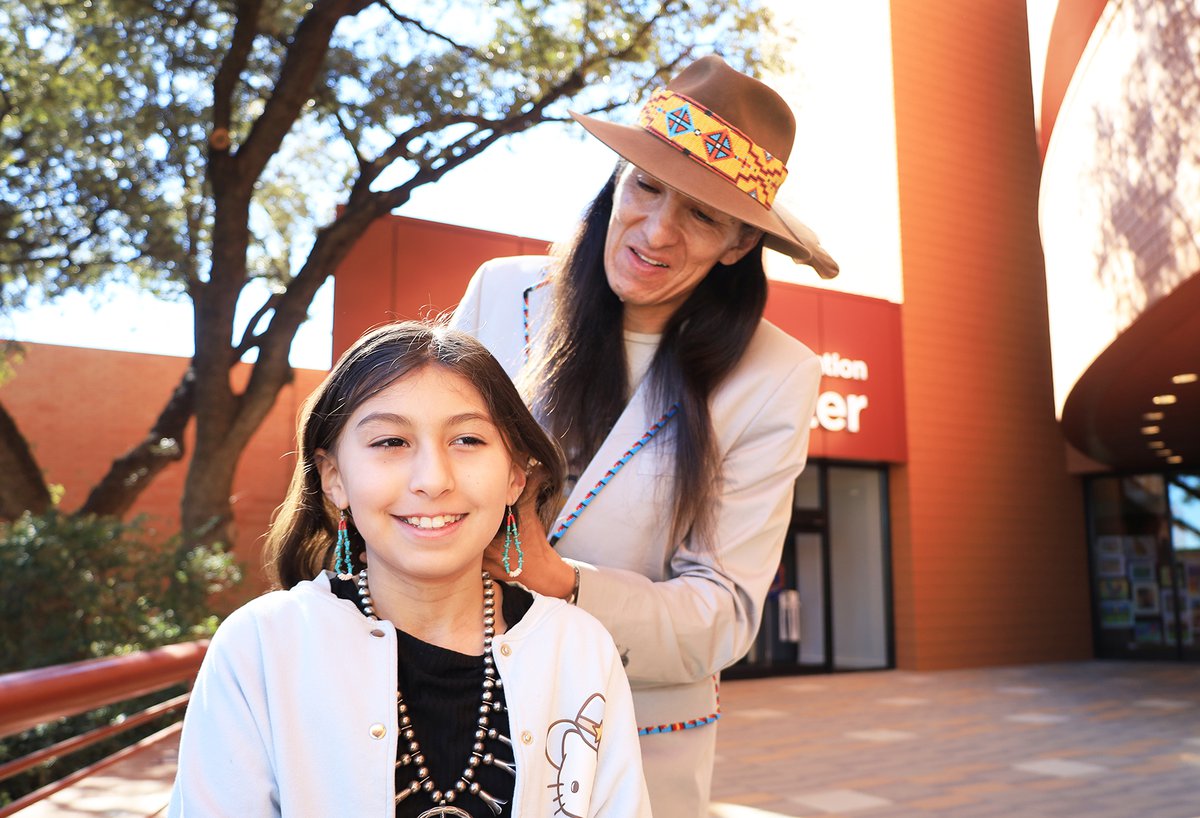
In the wide, sunbaked stretches of Northern Arizona, Clayson Benally learned early that the back of a horse is more than just a seat — it’s a place of freedom, connection, and understanding. No saddle, no reins, just a belt and a willingness to move with the rhythm of the animal beneath him. For Benally, an internationally recognized Diné (Navajo) artist, performer, and cultural practitioner, horses are not just creatures to ride — they are teachers, companions, and carriers of stories older than memory.
That sense of timeless connection lies at the heart of “Horse Power,” a Giant Screen documentary exploring humanity’s enduring bond with horses across continents and cultures. Premiering Jan. 16 at the Fort Worth Museum of Science and History inside the newly revamped Jane & John Justin Foundation Omni Theater, the film arrives as a fitting opening note for the first day of the Fort Worth Stock Show Rodeo.
Benally, along with his youngest daughter, Zonnie, and his mother, recently traveled to Fort Worth to help promote the film, which arrives at a moment when global attention seems uniquely attuned to the animal.
According to Scott Wilson, Director of Awareness and Advocacy with the American Wild Horse Conservation, the timing is no coincidence. “2026 is the Year of the Fire Horse in the Chinese calendar,” Wilson explains, “an event that only comes around once every sixty years. There’s a lot of attention globally on horses right now.” That convergence helped spark the creation of the film, produced by Plimsoll Productions, the UK-based studio widely regarded as one of the world’s leading nature documentary filmmakers.
“Horse Power” unfolds in chapters that span the globe. Viewers encounter equine therapy programs in the United Kingdom, Arabian horses celebrated for speed and endurance, and rewilding efforts in Mongolia. “But we also had to ensure there was an appropriate celebration of the wild horses we have in America,” Wilson says.
America’s role in the story, he notes, runs deeper than modern myth. “America, after all, was the birthplace of all the world’s horses. They started here prehistorically. Horses evolved across the Bering land bridge to Asia and Europe, and then back to America again. There’s always been this incredible love affair with horses here.” Benally’s presence in the film, Wilson adds, brings an essential dimension to that history — one rooted in Indigenous knowledge and lived tradition.
“I come from the Bitter Water Clan,” Benally says, introducing himself with the formal respect of his culture. “We’re from the Black Mesa region, in the heart of the Navajo Nation. My father is a traditional practitioner, but we grew up ranching — sheep, cattle, and horses. For me, it was a blessing to witness the ecosystem and our culture intact, with large herds, self-sustaining, and balanced.”
As a child, walking into a wild horse herd to find his own mount was simply part of daily life. He learned to ride without tools, guiding a horse with intuition rather than force. That closeness to land and animal now shapes his work — leading horse-connection workshops, teaching youth programs, and traveling internationally to share Diné culture through music, storytelling, and horsemanship.
Benally is more than a horse trainer — he’s a horse listener. His approach draws on centuries of Navajo tradition, in which horses are sacred and woven into ceremony and song. “The horse has been with us since the beginning of time,” he says. “They carry our burdens, our lessons, and our connection to the land.”
The film also situates Benally’s story within a broader conversation about wild horses today. Only about 55,000 wild horses remain roaming across ten Western states, Wilson notes — a surprisingly small number in a nation of millions of domesticated horses. “We’re a massive horse-loving country, but awareness of wild horses is incredibly low,” he says. “This film gives us an opportunity to tap into that love and remind people that wild horses are still running free in very remote parts of the West.”
In “Horse Power,” audiences meet Jetta, a mare rescued during a severe drought. Benally took her in as a newborn after her mother could no longer nurse, guiding her recovery and eventual reintegration into a herd. Her story becomes a quiet meditation on resilience — echoed by sweeping footage of wild herds traveling miles to water, their family bonds and hierarchies visible without a word spoken.
Benally’s perspective challenges the language often used around these animals. “People talk about feral versus wild,” he says. “To us, these horses have always been here. They are family groups, integral to the land and our culture.” Oral histories, he notes, remember horses long before written records, and genetic research on Navajo lands points to a deep and diverse equine lineage.
Riding, for Benally, is ultimately an exercise in empathy. A horse mirrors the rider’s state of mind, responding to intention rather than command. “If you want a horse to run free, you have to free yourself,” he says. The same philosophy shapes his music — as a drummer and performer, he draws on the rhythms of hooves, blending traditional Navajo songs with contemporary sounds.
Now 48, Benally sees his life as a bridge between past and present, humans and animals, and cultures. Bringing Zonnie along on that journey is part of the responsibility — a way to ensure the teachings endure. As “Horse Power” premieres in Fort Worth, fittingly during the city’s storied stock show season, the film offers more than spectacle.
“Sometimes,” Benally says, “it takes a horse to carry us through to a deeper understanding of what it means to be human.”