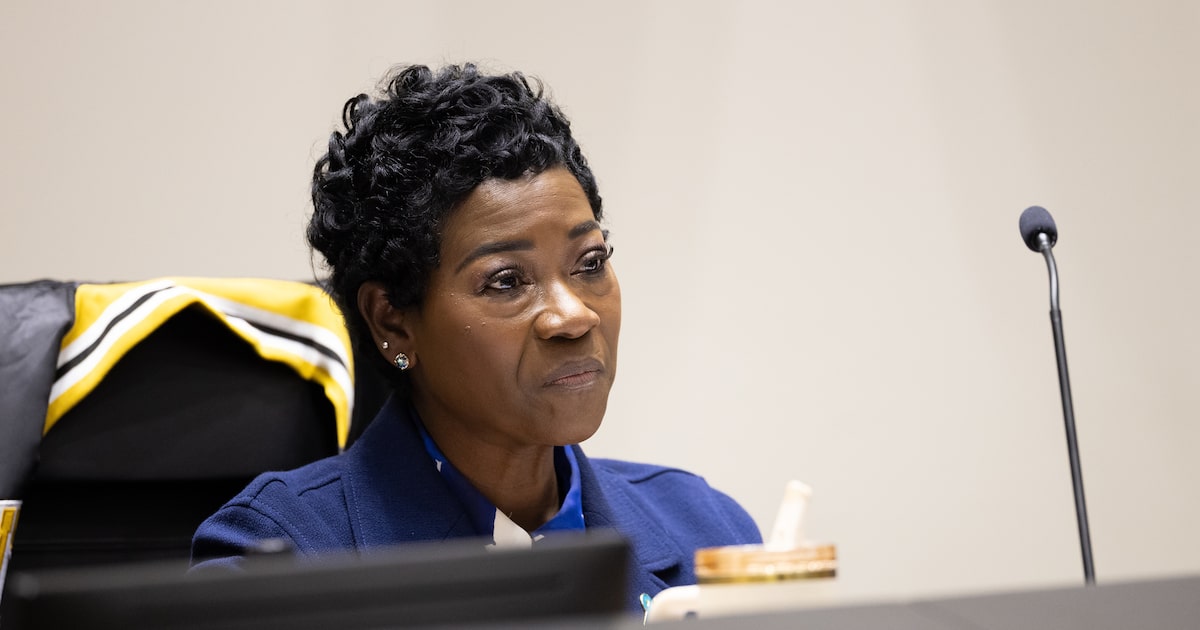
As Kimberly Bizor Tolbert reaches her one-year mark as Dallas city manager, she faces a looming test: a stay-or-go decision on City Hall that could define her legacy and reshape downtown for years to come.
She stepped into the job last January with a firm City Council mandate: steady the city government, improve services, tighten fiscal oversight and restore trust in how Dallas runs itself.
Now, comes a reckoning over the iconic I.M. Pei-designed City Hall, long admired and increasingly costly to maintain.
Repairs to make up for decades of deferred maintenance could cost hundreds of millions. Prominent business interests support relocation, seeing a chance to jump-start redevelopment downtown. Preservationists fear abandonment of history and the city’s resolve to fix what it owns.
Breaking News
How that choice unfolds runs through Tolbert as she deals with clashing expectations inside City Hall and beyond on that and other matters. She has acknowledged the high stakes.
“Our momentum is great, but we must keep running up the score to make sure that Dallas is at the top of the leaderboard, which is where we belong,” Tolbert said the day she became the first Black woman to lead the country’s ninth-largest city.
She brought the City Hall issue to the council after outlining the city’s record of underinvesting in maintenance and repairs. She pressed for a structured review, with the council directing the Economic Development Corp., a nonprofit advisory group, to produce a report laying out costs and options, due Monday.
No matter what the City Council ultimately votes to do, the burden of execution will fall on Tolbert.
The debate has accelerated against a fragile backdrop. Downtown is struggling with older buildings, fewer daily workers and concerns over public safety and homelessness.
AT&T’s announcement last week that it’s moving to Plano sharpened worries that the heart of the city is losing out as development picks up elsewhere, from Uptown’s rising skyline to Victory Park’s coming Goldman Sachs campus.
Deputy Mayor Pro Tem Gay Donnell Willis said Tolbert already has shown she has what it takes to keep downtown vibrant. “I have faith in her,” she said.
Building coalitions
Tolbert’s work as Dallas’ administrative CEO started after former City Manager T.C. Broadnax left for Austin, at a time of leadership turnover and friction between Mayor Eric Johnson and some council members over direction and governance.
She had been serving as interim city manager since May 2024, after years in senior roles, including deputy city manager and chief of staff, before the council appointed her to the top spot.
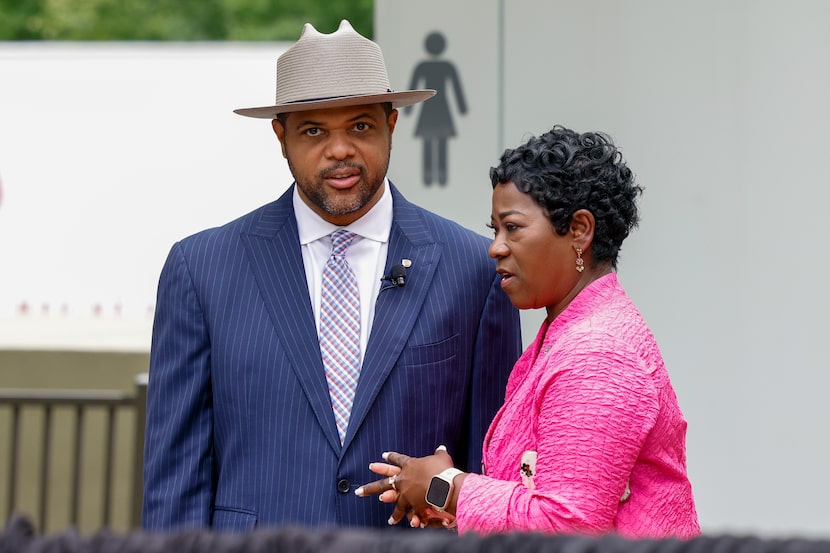
Dallas Mayor Eric Johnson speaks with interim city manager Kimberly Bizor Tolbert at Klyde Warren Park, Thursday, May 9, 2024, in Dallas.
Elías Valverde II / Staff Photographer
From the outset, Tolbert, 57, who lives downtown near the Farmer’s Market, has moved to pull city power brokers into a common conversation.
In her early months on the job, she convened some of Dallas’ most influential business and development leaders – executives who help determine what rises and falls downtown – and challenged them to engage directly on what’s needed to unlock action.
“Dallas is open for business,” developer Ray Washburne recalled her telling the group. “Bring me what you think we need to do, and let’s talk about it and do it.”
Park Board President Arun Agarwal, who attended some of those meetings, said she paired that invitation with a pointed question: “What can you do for the city? And what does the city need to do to get you to act?”
That outreach reflects how the city manager’s role has shifted in Dallas. Traditionally, the job has been to carry out policy crafted by elected officials, not to publicly steer major civic debates.
With the future of City Hall tied to downtown’s fate, conflicts have broken out among council members and outside interests over cost, identity and timing. That is pushing Tolbert into a more public role in which delay itself carries risk.
Former Dallas City Manager Ted Benevides said the evolution is not unique to Tolbert, but it has become unavoidable in large cities wrestling with complex, generational decisions.
It is especially tricky in Dallas, where a powerful business community aims to influence big projects, and the mayor and 14 council members bring competing priorities, alliances and political pressures.
City managers, Benevides said, can no longer operate strictly behind the scenes if they want policy to translate into action. Instead, they must blend management with negotiation.
“They’re not elected, so they don’t get the vote,” Benevides said. “But they have to be politically savvy — more engaged in helping elected officials create policy that actually moves the city in the right direction.”
Early test, early praise
The day Tolbert landed the job permanently, the mayor – who had clashed with her predecessor – praised Tolbert as a leader who would listen to the council, put the city first and work relentlessly.
Weeks in, word spread that Neiman Marcus was closing its flagship store downtown.
Tolbert quickly banded with Jennifer Scripps, leader of Downtown Dallas Inc., Linda McMahon, the chair of the city’s Economic Development Corp., and developer Shawn Todd, rallying support for the store.
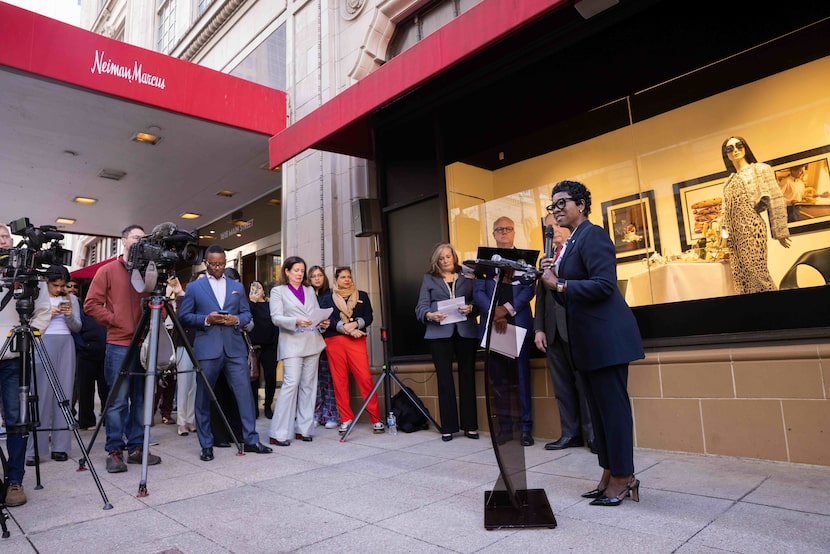
Dallas City Manager Kimberly Bizor Tolbert speaks during a Downtown Dallas Inc. press conference at the downtown Dallas Neiman Marcus on Tuesday, Feb. 25, 2025. A group of officials, including those in the city, economic development and real estate, are sending a letter to Saks Global and other key parties to work on a solution to keep the store open.
Juan Figueroa / Staff Photographer
Tolbert called it a pillar of the city’s identity and “a catalyst for ongoing growth.” Keeping the store open, she said, mattered not just symbolically but economically.
Neiman Marcus did not shutter its doors, easing fears about downtown’s direction.
“She’s found her own voice,” council member Paula Blackmon said. “When you work for somebody above you, you need to toe the line. When you’re your own boss, you get to draw the line.”
Tolbert motto: ‘Service Now!’
One year in — working out of a fourth-floor office with signage that says “Service Now!” — Tolbert has touted a string of changes that touch daily life: more streets paved, use of AI on sanitation trucks to monitor code compliance in neighborhoods and attracting sports teams, such as the WNBA’s Dallas Wings, to play in Dallas.
Tolbert oversees a workforce larger than many corporations and manages a $5 billion budget. She’s reorganized departments, reset metrics and tied budgets more tightly to performance. Multiple large capital projects place a premium on financial stewardship.
She’s also put her reputation on the line in the city’s scramble to try to keep the Dallas Stars hockey team and Dallas Mavericks basketball team from bolting.
Those who have worked closely with her describe her leadership as quick and demanding, focused on policy execution, with a visible public hand. She is selective in giving interviews – and declined a request to speak for this story.
City Hall may dominate attention, but Tolbert also is grappling with police staffing shortfalls, aging infrastructure, uneven services and neighborhood inequities.
For decades, city leaders have struggled to knit together the urban core, betting success in one district would lift the rest. Instead, gaps remain, from safety concerns in the West End to uneven foot traffic in Victory Park, where new development has yet to produce steady daily activity.
Still, her second year will be judged by what Dallas does next with City Hall.
Some council members have questioned whether Tolbert is making decisions independently of the council.
“Nobody understands why it’s so urgent, but the city manager is pushing this,” council member Paul Ridley told The Dallas Morning News in November.
The pace has been fast. Her team briefed the council in late October on the building’s condition and scale of overdue repairs. By November, members approved a dual-track review, reassessing City Hall’s lifespan while exploring relocation options.
At the time, council member Cara Mendelsohn questioned the speed of the process, saying it felt like an emergency item. Tolbert responded that the timeline was ultimately the council’s call.
Willis pushed back on the notion Tolbert has overstepped. “She has had to take on issues that have languished for years,” she said.
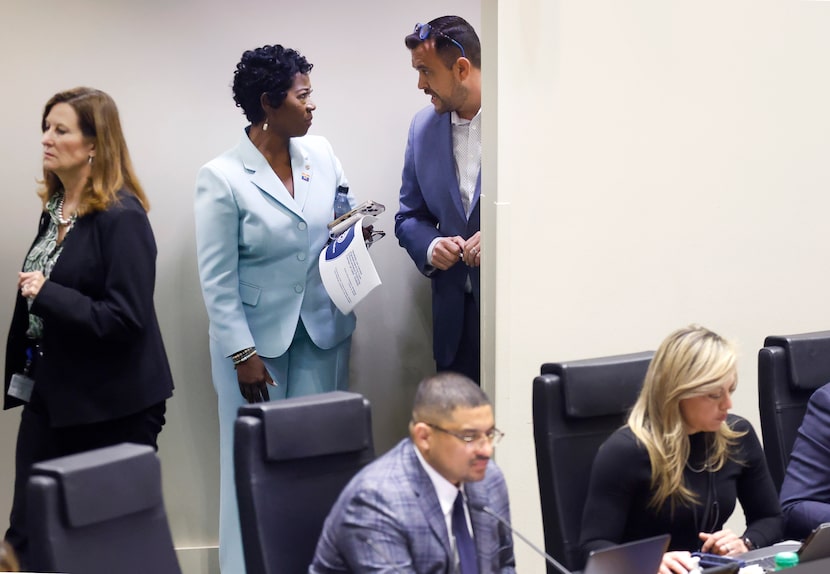
Dallas City Manager Kimberly Bizor Tolbert (standing, center) visits with Deputy Mayor Pro Tem Adam Bazaldua behind the council dias during public session at Dallas City Hall, June 4, 2025.
Tom Fox / Staff Photographer
The Mavericks search for sites for a new arena has added urgency to the tussle over City Hall.
Prominent Dallas architects say the nearly 50-year-old City Hall remains sound and adaptable, and underused sites elsewhere would better suit a sports arena or major redevelopment without abandoning the civic core.
Supporters of relocation counter that the City Hall property is one of downtown’s most valuable parcels, and moving government offices could unlock new development and momentum in a part of the city that has struggled to regain its footing.
Council member Kathy Stewart, who chaired the ad hoc pension committee, said Tolbert has the skills to carry downtown revitalization forward, crediting her for resolving the long-running police and fire pension dispute.
After years of stalled talks and a legal setback for the city, negotiations culminated last fall in a deal, a turnaround Stewart said was driven by Tolbert’s persistence and her ability to bring the right people together and privately work through the details alongside the mayor.
“I had honestly almost given up” on a solution, Stewart said.
The task before Tolbert is whether she can apply the same coalition-building and follow-through to the City Hall tradeoffs now playing out in public. For Tolbert, the work is rooted in place.
“This is my home,” she said. “I am a champion for this city.”
At one year, Tolbert’s biggest call
- The decision: Whether Dallas repairs and recommits to its I.M. Pei–designed City Hall or relocates city government elsewhere.
- The stakes: Hundreds of millions in potential repair costs, downtown redevelopment prospects and the future identity of the civic core.
- The pressure: An undecided City Council, an assertive business community and preservation community, deferred maintenance laid bare and fresh anxiety after AT&T’s announced plan to move to Plano.
- Why it’s hers: Tolbert put the issue before the City Council and pushed for a structured review.