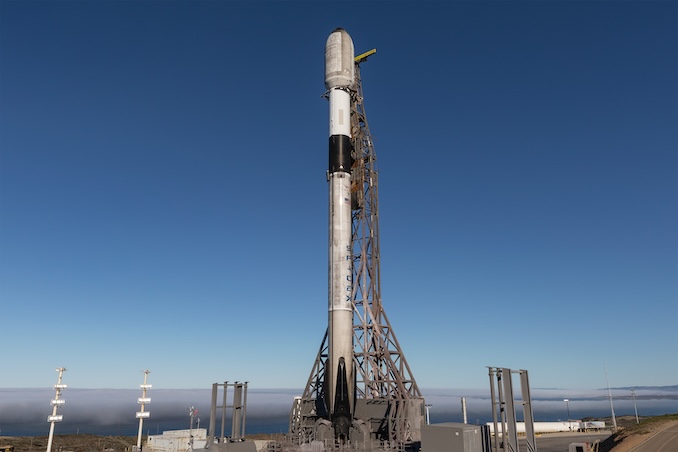
 A SpaceX Falcon 9 rocket is seen in the launch position at Space Launch Complex 4 East at Vandenberg Space Force Base on Jan. 16, 2026, ahead of the launch of the NROL-105 mission for the National Reconnaissance Office. Image: SpaceX
Update Jan. 17, 12 a.m. EST (0500 UTC): SpaceX landed its booster at Landing Zone 4.
Update Jan. 16, 9:25 p.m. EST (0225 UTC): New T-0 set.
Update Jan. 16, 5:20 p.m. EST (2220 UTC): SpaceX adjusted the T-0 liftoff time.
SpaceX executed a late night Falcon 9 launch from Vandenberg Space Force Base on Friday, which carrying an undisclosed number of intelligence-gathering satellites for the National Reconnaissance Office.
The mission, NROL-105, has a payload of satellites heading to low Earth orbit, which are believed to be Starshield, a government variant of the Starlink satellites.
Liftoff from Space Launch Complex 4 East happened at 8:39:51 p.m. PST (11:39:51 p.m. EST / 0439:51 UTC).
SpaceX launched the mission using the Falcon 9 first stage booster with the tail number 1100. This was its second flight after launching the Starlink 11-30 mission on Nov. 23, 2025.
A little more than 7.5 minutes after liftoff, B1100 touched down back at Landing Zone 4, adjacent to the launch pad. This was the 33rd landing at LZ-4 and the 560th booster landing for SpaceX to date.
The NRO began deploying its fleet of satellites in May 2024 and launched a total of 11 times on Falcon 9 rockets, procuring the launches outside of the framework of the National Security Space Launch contract.
Its stated goal is to establish “the largest government constellation in history” consisting of hundreds of satellites with launches planned through 2029. There are roughly half a dozen missions planned for 2026, including NROL-105.
“The NRO’s proliferated system will increase timeliness of access, diversify communications pathways, and enhance resilience,” the NRO said in its prelaunch press kit. “It will provide greater revisit rates and increased coverage, and eliminate single points of failure. With hundreds of small satellites on orbit, data will be delivered in minutes or even seconds. This will ensure the analysts, warfighters, and civil agencies NRO serves receive actionable information faster than ever before.”
 The mission patch symbolizing the National Reconnaissance Office’s proliferated architecture satellite constellation. Graphic: NRO