Prime Minister Mark Carney delivers remarks at dinner hosted by the Canada-China Business Council in Beijing, China on Friday.Sean Kilpatrick/The Canadian Press
Canada is planning to reserve preferential access to its domestic auto market for foreign automakers who build vehicles in this country under a new auto policy to be released in February, a senior Canadian official said Saturday.
The official also said Canada gave advance notice to the United States of its Jan. 16 decision to part with Washington and slash tariffs on Chinese-made electric vehicles that were imposed in tandem with the Americans in 2024.
The Globe and Mail is not naming the official because they were not authorized to speak publicly on the unreleased auto policy.
Canada reaches tariff deal with China on electric vehicles, canola
Under Ottawa’s new auto policy, foreign companies that make cars in Canada will have more favourable access to the Canadian market than those that choose to import cars assembled outside the country, the official said.
The Canadian government is scrambling to preserve and grow Canada’s 125,000-job auto sector as automakers adjust to the protectionist policies of U.S. President Donald Trump who has imposed tariffs on foreign-made vehicles and said the U.S. does not need cars made in Canada.
If foreign automakers refuse to build their cars in Canada, then their access to the Canadian market will come on less favourable terms, the official said. They did not detail how this would be accomplished but tariffs or restrictions are examples of such measures.
The first step in a new approach to auto policy came Friday when Prime Minister Mark Carney struck a deal with China to cut Canadian tariffs on Chinese-made electric vehicles.
The senior official said the Canadian government gave advance notice to Washington of the tariff cut, but did not say when the notice was given.
Opinion: In seeking to deepen trade with China, Canada is hedging its bets
The government, through Canada’s ambassador to the United States, informed U.S. Trade Representative Jamieson Greer ahead of Friday’s announcement in Beijing that Mr. Carney was lowering levies on Chinese EVs from 100 per cent to 6.1 per cent for the first 50,000 vehicles imported.
Mr. Carney said Canada expects the deal with China will lead within three years to Chinese investment in this country’s auto sector. Industry Minister Mélanie Joly was one of four cabinet ministers who accompanied Mr. Carney to China earlier this week and during the visit she met with Chinese EV automakers BYD and Cheri, her office said.
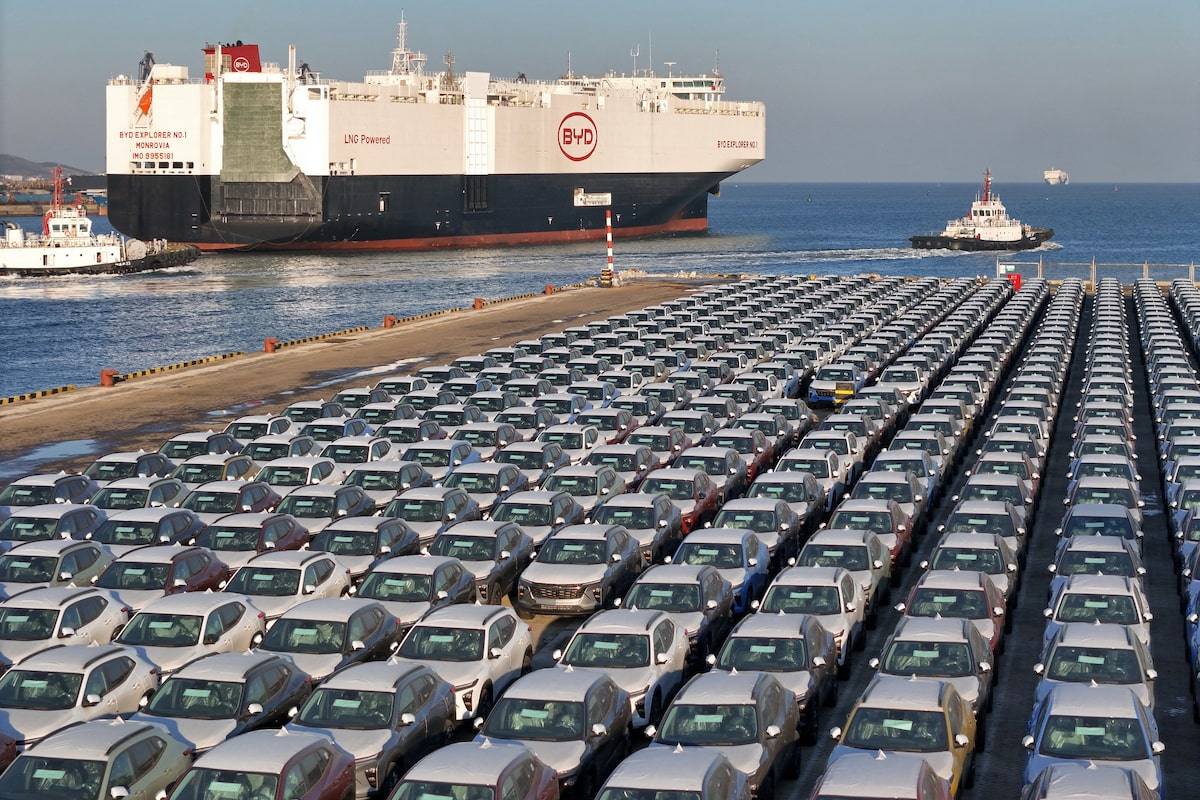
Electric cars wait to be loaded on the ‘BYD Explorer No. 1,’ a vessel intended to export Chinese automobiles, at Yantai port, in eastern China’s Shandong province, Jan. 10, 2024.-/AFP/Getty Images
Speaking to reporters as Mr. Carney flew to Qatar from Beijing Saturday, the official said in the short term it’s expected most of the Chinese-made EVs coming in under the new lower-tariff rules will be from Western-owned factories in China, including Tesla. Over time, however, they expect homegrown Chinese automakers to comprise a bigger share.
At the core of Canada’s new auto strategy will be electric vehicle production in Canada.
The official said Canada wants to entice Chinese, Korean or German automakers to commence and grow auto sector production in Canada. They said this plan is inspired by Ottawa’s success in the 1980s at attracting Japanese auto factories to Canada from companies such as Honda and Toyota. Today, 70 per cent of auto assembly in Canada is Japanese, they said.
The official acknowledged a potential shuttering of access to the U.S. auto market means that any vehicle assembly in Canada can’t rely on shipping cars south of the Canada-U.S border. They said they expect foreign auto makers would envision on assembling vehicles in Canada for other overseas markets as well, including possibly the Middle East.
However, with 1.8 million vehicles purchased each year in Canada, the market isn’t negligible, the official said. In Ottawa’s estimation Canada is among the sixth or seventh largest market in the world.
Canada’s food-safety agency signs agreement with China
Canada has the ingredients for a flourishing domestic auto assembly industry including sizeable auto-parts makers such as Magna, Linamar and Martinrea, the official said.
Concerns about possible spyware in Chinese-made EVs could be mitigated by conditions Ottawa would place before greenlighting their production in Canada, the official said.
They said Ottawa intends to enforce beneficial conditions before approving foreign auto assembly investments in Canada including commitments on size of investment, possibly the use of a unionized workforce, whether Canadians would control the intellectual property and how much domestic technology would be incorporated into plants.