At All Import Auto Parts, the company’s purpose goes beyond providing customers with discounted, used car parts.
The Fort Worth-based auto recycler has always been dedicated to mitigating North Texas’ air pollution. Since partnering with the SHiFT Vehicle Retirement Initiative early last year, the program has allowed the company to further fulfill their environmental goals.
How does the business do it?
The company buys or accepts what it calls “end-of-life” vehicles, some of which are donated through SHiFT, to recycle 90% to 95% of a car’s parts.
Eligible vehicles include cars that have been in accidents, were declared totaled by an insurance adjuster or are older models that emit more emissions.
SHiFT kicked off in early 2023 following conversations between its president and CEO Joe Hearn and automotive recyclers about how to best retire end-of-life vehicles while considering impacts on the environment.
In North Texas, cars produced more greenhouse gas emissions in 2022 than any other source, making up 41% of emissions, according to data from regional transportation planners.
The region’s declining air quality has prompted regional planners to seek federal funding to create a long-term plan aimed at reducing air pollutants, such as ozone, or ground-level smog.
As part of the SHiFT initiative, auto recyclers such as All Import Auto Parts agree to retire engines from an end-of-life vehicle. Retiring an engine, the carbon producing unit of the car, prevents it from being used or sold elsewhere, continuing to drive emissions.
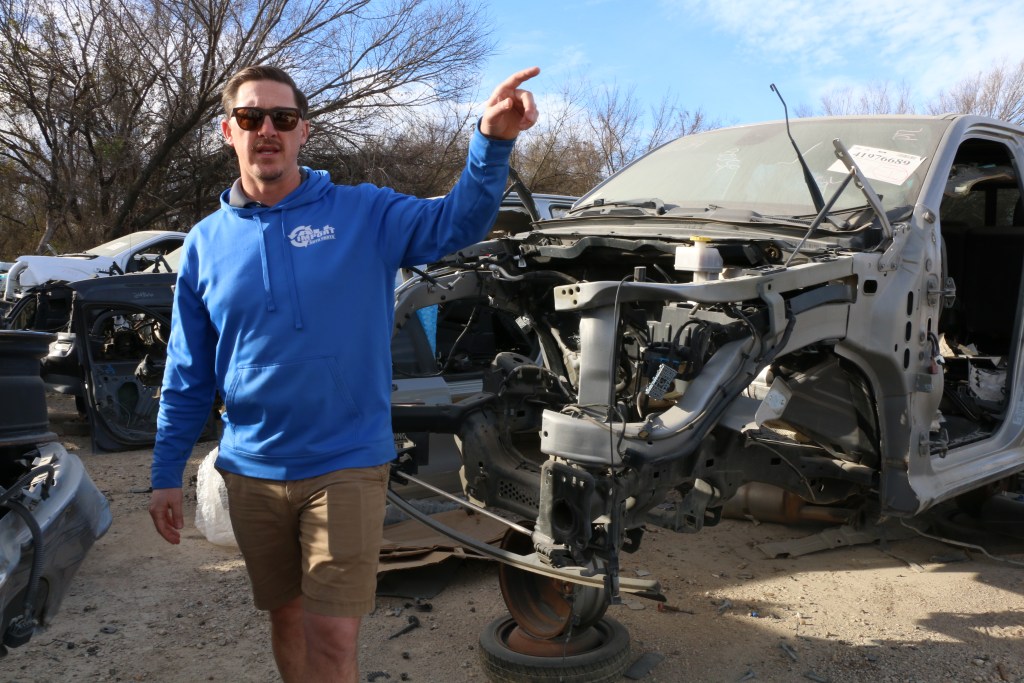 Jason Howell, pictured Jan. 6, and his employees disassemble vehicles outside of the main warehouse at All Import Auto Parts in Fort Worth. (Fort Worth Report | Nicole Lopez)
Older or faulty engines contribute to poor air quality as they tend to emit more emissions than a newer or more efficient engine, said Jason Howell, All Import Auto Parts general manager.
SHiFT exists to make sure those engines are retired in an environmentally mindful way.
“As vehicles age, they can often become less efficient,” Hearn said. “While there have been incredible gains in maintenance and management of vehicles, it is also true that older vehicles are the dirtiest on roadways.”
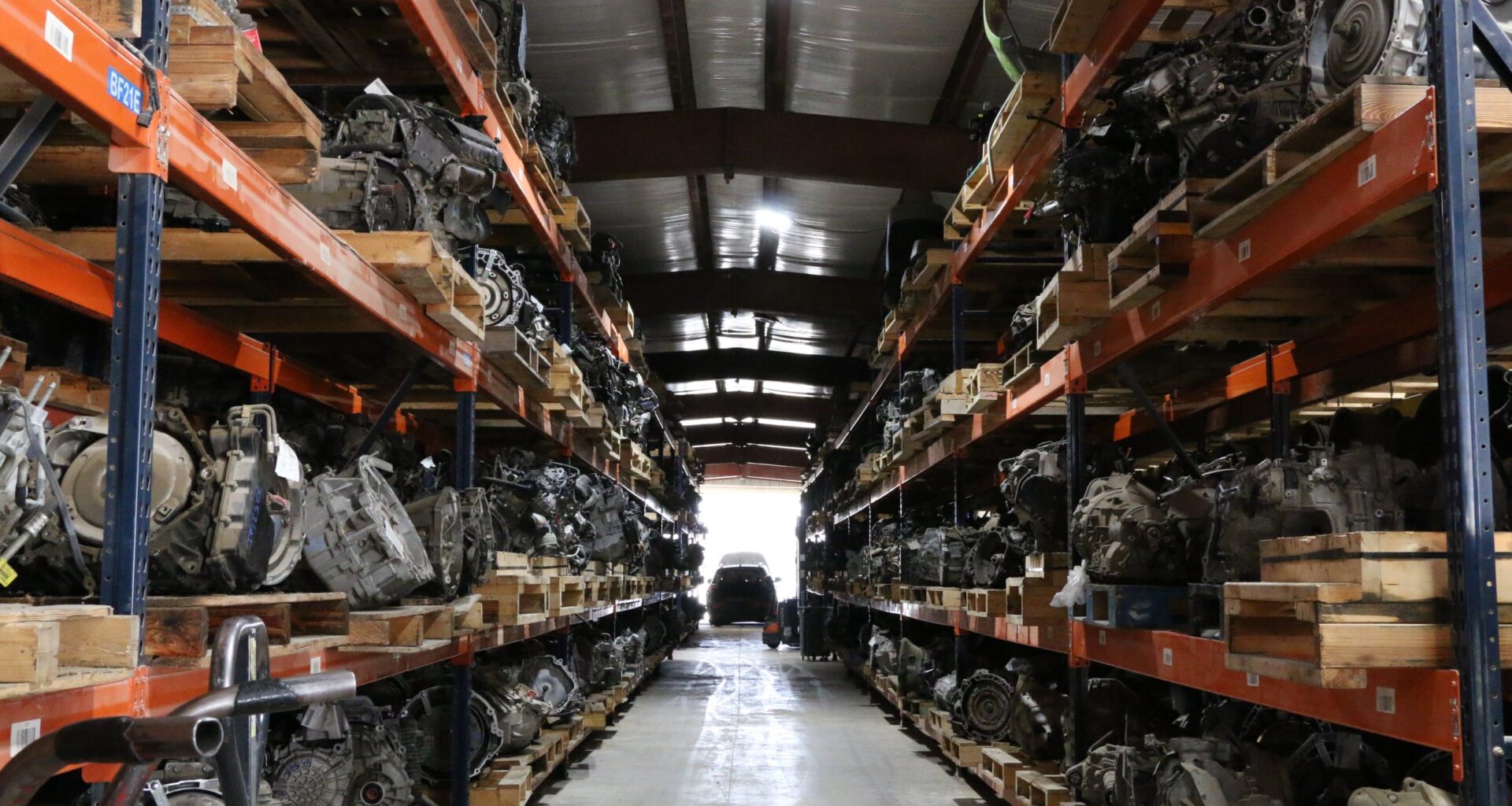
Parts from disassembled cars line the shelves at the All Import warehouse. Those parts include batteries, tires, air bags and engine control modules, among many other recyclable or resellable elements.
“What we’re really trying to do is extend the life of the car parts that are still good,” Howell said.
In addition to refurbishing parts, Howell and his team aim for their business operations to also be environmentally friendly.
Howell’s store is equipped with a water separating system, pulling oils from cars to prevent fluids from going through sewer drains. All Import staffers utilize electric-powered tools and machines, such as power washers and forklifts, to minimize the need for fuel-burning equipment.
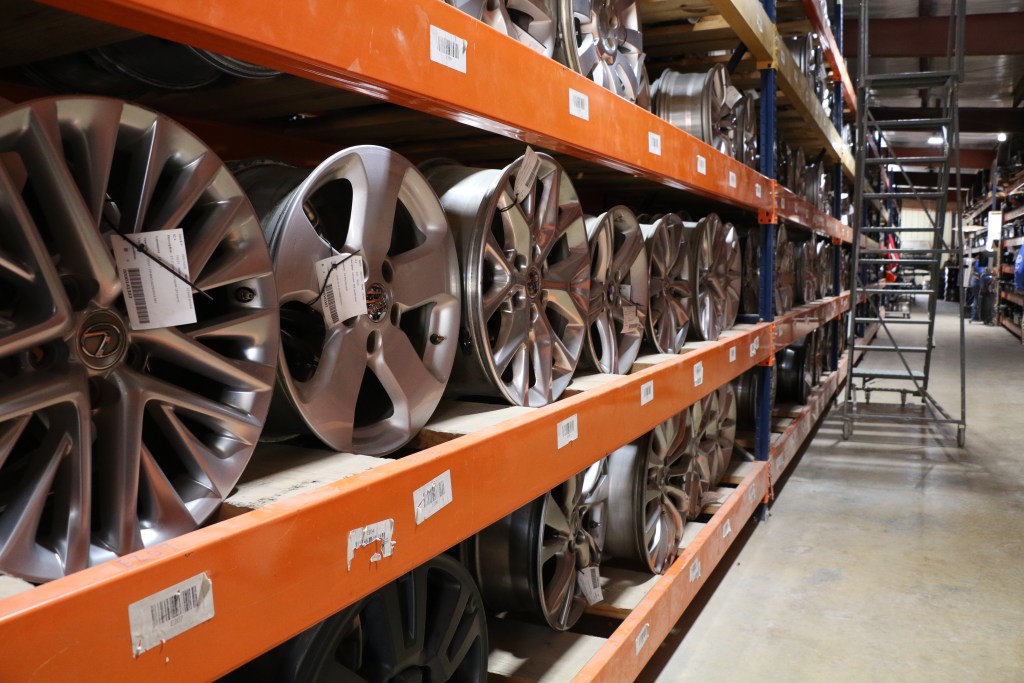 Tire rims stored at All Import Auto Parts, pictured Jan. 6, are removed from retired vehicles and sold to customers at discounted prices. (Nicole Lopez | Fort Worth Report)
“Everything we do has a positive carbon footprint here,” Howell said.
Taking a vehicle to a professional automotive recycler also prevents “gross polluting” cars — vehicles that emit significantly higher levels of harmful chemicals — whether from disintegrating in the environment or being reused, he added.
“You want to get rid of it, but you don’t want it to just go sit in the field,” Howell said. “You want to make sure it goes to the right place.”
Instead of being resold, the engines are melted to be reused as steel or aluminum metal.
The recycled metal could be reused to make a variety of other everyday items, such as kitchen appliances.
Reusing metals and other parts also helps offset the need for producing more materials, which also lessens emissions from manufacturing plants and transporting goods.
“You’re not having to go out and mine that precious metal out of the ground,” Howell said. “You’re saving emissions by just buying one used part.”
All Import is a “great organization” that represents a system of North Texas auto recyclers that are partnered with SHiFT, Hearn said.
It takes a wide network of auto recyclers to keep up with the need to find a second — or even third — life for retired cars.
“The demand for disposable transportation that starts out in the U.S. gets extended through export to other countries, but continues to pollute the environment,” Hearn said. “As an alternative, SHiFT gives you a guaranteed outcome.”
Nicole Lopez is the environment reporter for the Fort Worth Report. Contact her at nicole.lopez@fortworthreport.org.
At the Fort Worth Report, news decisions are made independently of our board members and financial supporters. Read more about our editorial independence policy here.
This <a target=”_blank” href=”https://fortworthreport.org/2026/01/17/fort-worth-car-recycler-driven-to-reduce-regional-air-pollution-with-national-programs-help/”>article</a> first appeared on <a target=”_blank” href=”https://fortworthreport.org”>Fort Worth Report</a> and is republished here under a <a target=”_blank” href=”https://creativecommons.org/licenses/by-nd/4.0/”>Creative Commons Attribution-NoDerivatives 4.0 International License</a>.<img src=”https://i0.wp.com/fortworthreport.org/wp-content/uploads/2021/04/cropped-favicon.png?resize=150%2C150&quality=80&ssl=1″ style=”width:1em;height:1em;margin-left:10px;”>
<img id=”republication-tracker-tool-source” src=”https://fortworthreport.org/?republication-pixel=true&post=369586&ga4=2820184429″ style=”width:1px;height:1px;”><script> PARSELY = { autotrack: false, onload: function() { PARSELY.beacon.trackPageView({ url: “https://fortworthreport.org/2026/01/17/fort-worth-car-recycler-driven-to-reduce-regional-air-pollution-with-national-programs-help/”, urlref: window.location.href }); } } </script> <script id=”parsely-cfg” src=”//cdn.parsely.com/keys/fortworthreport.org/p.js”></script>