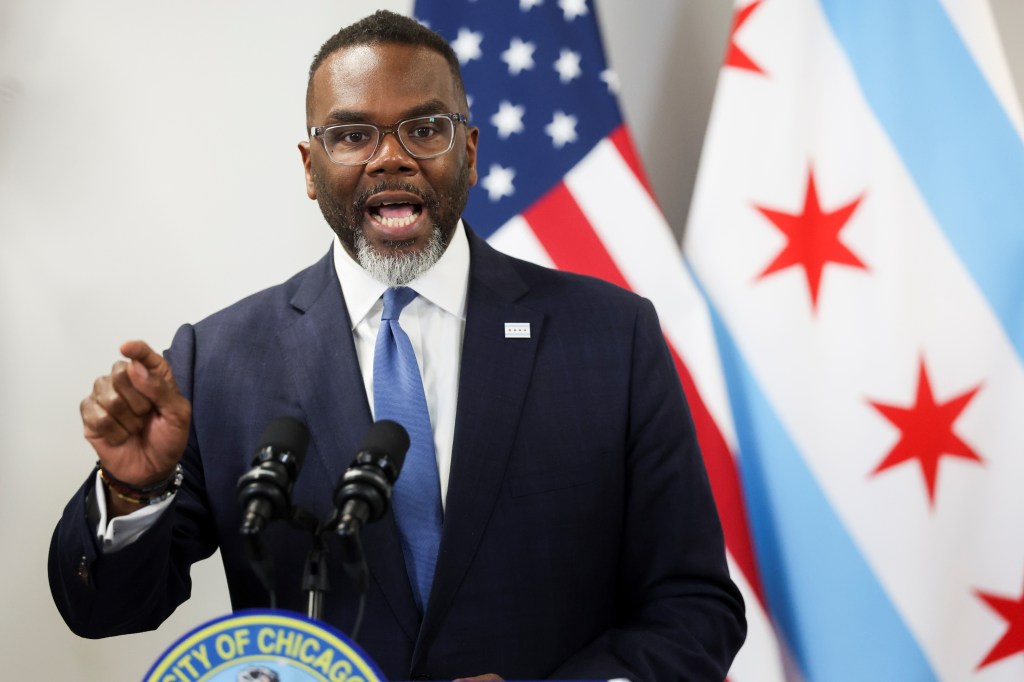
Four years ago, the first Chicago mayoral hopefuls were months away from announcing their campaigns. This time around, the line is already out the door.
A large and growing field of candidates is angling to take out Mayor Brandon Johnson, who is seen as very beatable. New campaign finance records showing a couple of likely challengers holding commanding leads in fundraising over the freshman incumbent drive home the tough battle he faces.
And as members of the crowded slate jockey for money and support, many are casting Johnson as political carrion.
“I think the public’s made up their mind about him,” said U.S. Rep. Mike Quigley, who promised to jump in the competition earlier this month. “This is a city in crisis. I think people get it.”
As of the end of 2025, Johnson had $830,000 on hand, trailing potential candidates Illinois Comptroller Susana Mendoza and Secretary of State Alexi Giannoulias, who were sitting on $1.6 million and $6.35 million, respectively.
Altogether, six politicians who have declared for the race or signaled serious interest reported raising more than Johnson’s $70,000 last quarter. They range from relative unknowns to local political mainstays.
But Johnson’s camp maintains the mayor is in no dire straits.
“When and if Brandon Johnson makes the decision to run again, we will have more than enough funds to be competitive, just like we did last time,” Johnson’s political director, Christian Perry, said. “And I got outspent three-to-one.”
Some of Johnson’s opponents are angling to spend “obscene amounts of money to push a narrative to get working-class and poor people to vote against their interest,” Perry said. He urged a conversation about campaign finance reform.
Caps on campaign contributions are already off in the race, thanks to Joe Holberg, who lent his campaign $350,000 just after Christmas.
Johnson, for his part, recently sidestepped a question about whether he will even seek a second term, saying, “What I’m committing to doing is my job.”
“Look, the people of Chicago are not thinking about mayoral elections,” Johnson said at a City Hall news conference earlier this month. “My focus right now is doing the thing that I was elected in charge to do, which was to drive violence down in the city of Chicago, to build more affordable homes, to invest in young people, to invest in good paying jobs, to invest in our education system.”
The mayor has spent part of January highlighting the steep decrease in Chicago gun violence last year to levels not seen in a decade, though he and other leaders agree there is still work to do. However, that good news comes after Johnson suffered political blows from an obstinate City Council opposition over the recent budget, on top of other losses for his progressive agenda. His opponents are making no small haste in capitalizing on what they sense as weakness.
“The city doesn’t need Humpty Dumpty, and the city doesn’t need a six-pack with no brains,” Pappas told the Tribune Thursday, in apparent references to Johnson and Giannoulias. “The city needs somebody like me who could come in there with a plan and pass the baton on.”
Chicago mayoral elections often come down to demographic splits and political ground games as much as they do to candidates’ campaign platforms, however. With the Chicago Teachers Union still by his side, Johnson could find a clear lane to a second term in much the way he won in 2023: getting big support from mostly white lakefront liberals and Milwaukee Avenue progressives in the first round of the election, and from Black voters in the runoff.
So far, no Black — or progressive — contenders have officially raised their hands to challenge Johnson. But with the 2027 election still over a year away and a potential runoff even further off, it’s anyone’s guess how the race for Chicago’s next mayor will shape up.
For the 2023 cycle, the first candidates did not announce their bids until April of the previous year. Johnson, the eventual victor, threw his hat in the ring in October — after multiple other progressive candidates entered the fray.
Johnson went on to become the city’s first candidate to unseat an incumbent mayor in 40 years. His victory was hailed as a seismic rewriting of the status quo in Chicago politics, but his administration’s setbacks since assuming office have emboldened the political old guard to argue that time’s up for the progressive experiment on the fifth floor of City Hall. Within the leftist movement that propelled Johnson, cracks between the Chicago Teachers Union and Service Employees International Union team that primarily bankrolled his first run look more like a clean break.
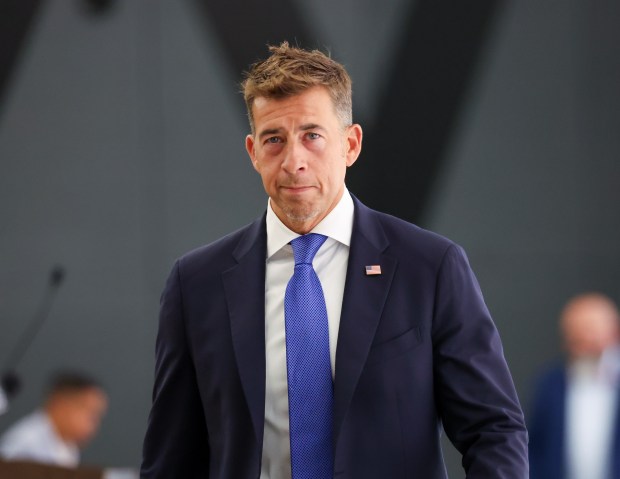 Illinois Secretary of State Alexi Giannoulias leaves the lectern after speaking at the Cook County Democratic Party primary slating on July 18, 2025, in Chicago. (Stacey Wescott/Chicago Tribune)
Giannoulias declared Thursday a whopping $1.05 million in fourth quarter fundraising. The massive haul leaves him with $6.35 million as he seeks reelection in his current seat with no primary opponent.
A source close to Giannoulias touted the money as “just the tip of the iceberg” and said he will “most likely” enter the competition.
The potential candidate is increasingly taking jabs at the mayor, including in December as the mayor criticized investor Michael Sacks for helping to bankroll opposition to his corporate head tax proposal.
“Everyone that disagrees with you isn’t ‘protecting Trump,’” Giannoulias wrote in an X post in early December. “That rhetoric isn’t how you lead a city.”
Giannoulias could be bolstered by the reported $10 million held by the Common Ground Collective, a group backed by Sacks and other wealthy Chicagoans that is highly critical of Johnson.
Several of the circling challengers have sought to frame themselves as problem-solvers, especially when it comes to the city’s budget.
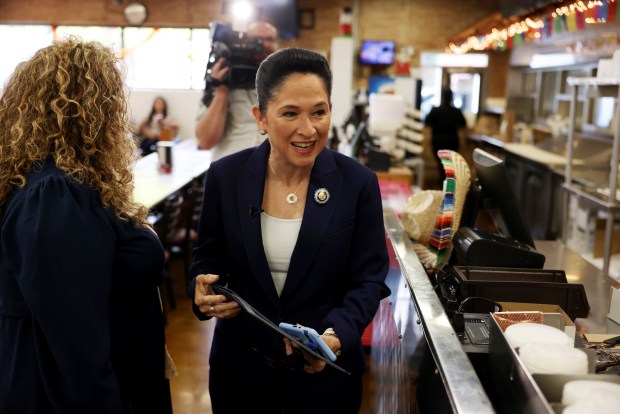 Illinois Comptroller Susana Mendoza greets people attending a news conference at Los Comales restaurant in Little Village on July 16, 2025, after announcing she would not run for reelection in 2026 as the state’s top fiscal officer. (Brian Cassella/Chicago Tribune)
Mendoza, who announced she would not run for reelection to her state position, has said she is “leaving the door open” to another mayoral run. Spokesman Abdon Pallasch said Mendoza is continuing a “thank you and listening” tour, but is not prepared to make an announcement yet.
In the most recent quarter that ended Dec. 31, Mendoza raised $178,000, leaving her with $1.6 million.
She was part of the 2019 scramble to succeed Mayor Rahm Emanuel but was cast by critics as too close to Ald. Ed Burke, who at the time was suspected of extortion. He has since been charged, convicted and released from jail for racketeering and bribery.
Mendoza has taken to TikTok and Instagram to make explainer videos throughout the city’s budget process, criticizing the drop in construction cranes across the city’s skyline and one-time deficit fillers.
In one video just after Halloween with a soundtrack of suspenseful music, she flashed a display skeleton to rally against the head tax, calling it a “job killer.”
“Make it more expensive to hire? Companies shrink or leave,” she said, removing fistfuls of candy from a glass bowl. “That means less opportunity, less jobs, everyone loses.”
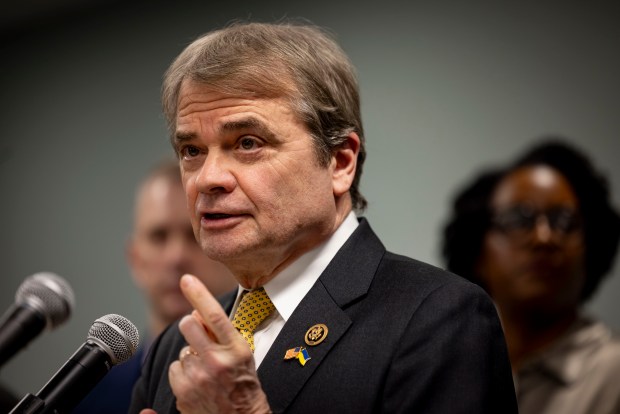 U.S. Rep. Mike Quigley, 5th, speaks as Illinois officials gathered to oppose federal budget cuts to services on Feb. 17, 2025. (Brian Cassella/Chicago Tribune)
Quigley has carefully grown his own campaign, and made a clear pledge to run. The North Side congressman has flirted with mayoral bids in the past, only to opt out, but promised the Tribune he is staying in the race now.
He wants to focus on balancing the city’s budget by trimming spending, and grow the city by removing restrictions on housing construction.
“I know how to solve this. I think I can build coalitions to do it,” he said. “We can grow our way out of this problem easier than we can tax our way out of this problem.”
He raised over $150,000 in his mayoral fund last quarter and will be able to transfer in another $1.2 million from his congressional campaign account.
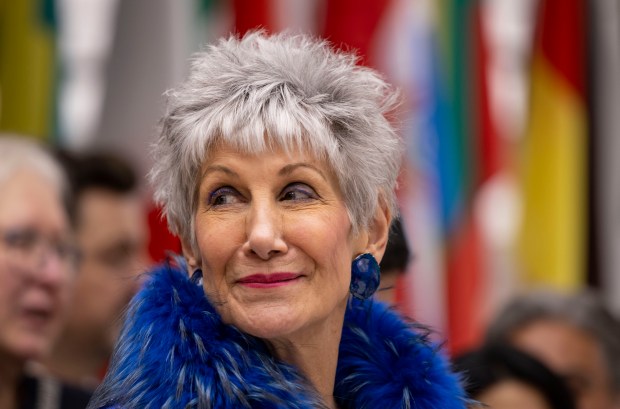 Cook County Treasurer Maria Pappas in her office on Jan. 10, 2024. (Brian Cassella/Chicago Tribune)
Pappas, meanwhile, vowed, “Under no circumstance will I get out of this race. Nobody is taking me out. I’m not going to be bullied or frightened. None of that, and that’s happening everywhere.”
Pappas, who has been reelected as Cook County treasurer six times, said she does not count Johnson out. But she said she was more focused on other opponents as she touted her experience.
She has $273,398 in her treasurer campaign account, a relatively small amount compared with other challengers. But the race will come down to who gets voters to the polls, not who has cash, she argued.
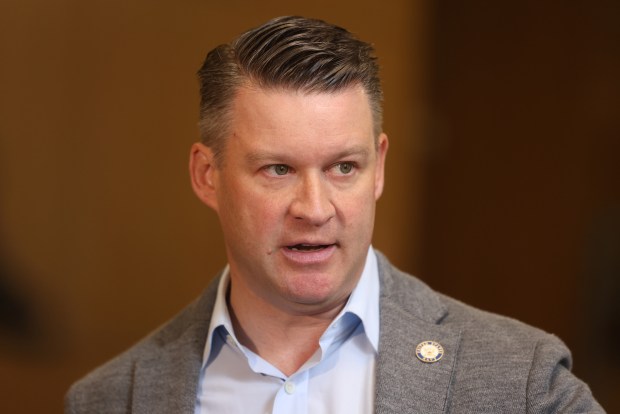 Ald. Bill Conway, 34th, speaks with reporters before a Chicago City Council committee hearing on April 30, 2025. (Antonio Perez/Chicago Tribune)
Conway, the freshman alderman representing the West Loop, said he is giving a run “serious consideration.” He has blasted Johnson’s financial plans from the council floor in recent months and hinted his campaign would take a similar line.
“You have some people who kind of talk about the city’s finances and future from afar, but I’m literally under the hood right now,” he said. “Our financial situation is so much worse than people realize, and if we don’t start getting it on the path right now, it will overwhelm community investments.”
The alderman also works as a Navy Reserve officer, and is sitting on nearly $700,000 with an ace up his sleeve: a billionaire father who co-founded the private equity firm Carlyle Group and bankrolled Conway’s unsuccessful 2020 Cook County state’s attorney race with over $10 million.
Attorney Bill Quinlan, known recently for representing fired former CPS CEO Pedro Martinez, and previously Jussie Smollett, began hosting events across the city in the fall through a 501(c)(4) nonprofit civic organization, Leading a Better Chicago.
Though Quinlan hadn’t publicly declared his intention about a mayoral run or formed a fundraising committee with the state, he was blunt with friends at a fundraiser at the Irish American Heritage Center in early November. “We started this not for profit, this plan, to move to the next level to run for mayor of Chicago,” he said.
“Brandon Johnson doesn’t stand for Chicago,” Quinlan said. “He stood for the teachers union, and at the end of the day, you need someone sitting on the fifth floor, on that side of the table, that stands for you.”
Entrepreneur Joe Holberg, the first candidate to officially declare for the race, has loaned himself over $400,000 to run and brought in $100,000 in contributions. The political neophyte said he has faced tough odds before, like living in his car while putting himself through the University of Michigan.
“It’s because I’m a political outsider, and it’s because I’m not tied to the shackles of the establishment that limit people’s ability to think critically,” Holberg said.
Lobbyist John Kelly Jr. raised over $400,000 for a potential run. And several other possible candidates round out the sure-to-grow field: Perennial candidate businessman Willie Wilson said he hasn’t made up his mind yet about another try, and activist-turned-entrepreneur Ja’Mal Green said he is “definitely exploring” another bid.
But despite the funds flying around the emerging race, Johnson still has critical working-class support, argued Perry, who predicted Johnson’s winning 2023 coalition will heal and coalesce again around shared values.
The idea that the mayor is weak comes from “ambitious politicians who want to obtain more power and status,” he said. But on South and West Side blocks, in churches and schools, the reaction to the mayor tells a different story, one of enthusiastic support, according to Perry.
“Organized people beat organized money,” he said. “Our focus is right now, making sure that the mayor has everything that he needs to lead Chicago from the seat that he’s in.”