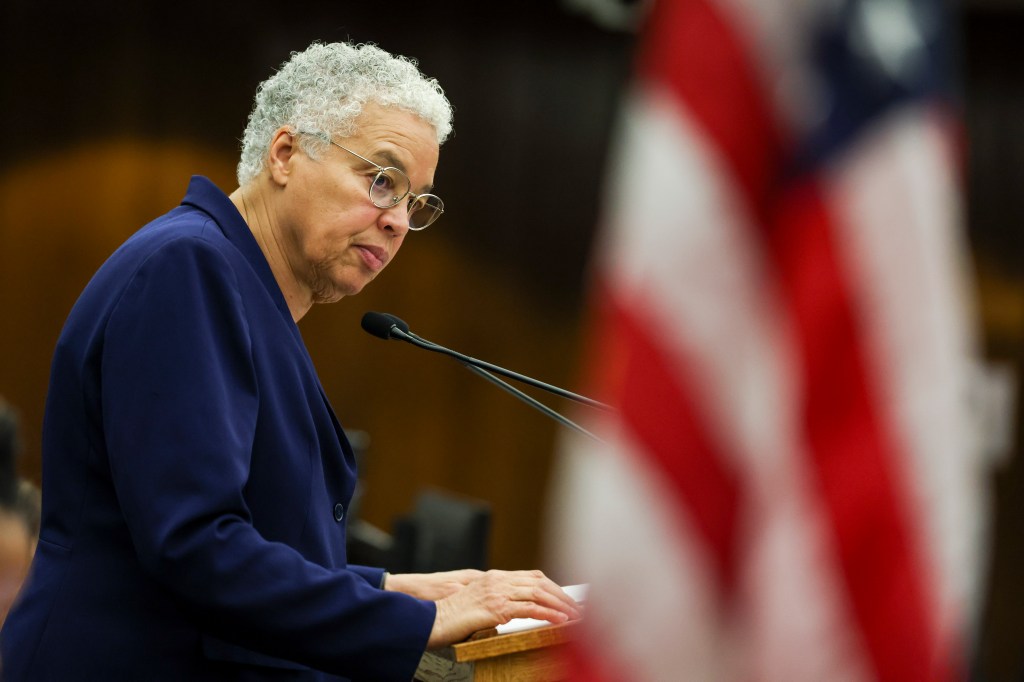
As she campaigns for a fifth term as Cook County Board president, Toni Preckwinkle is saying the unit of government she directly oversees hasn’t raised its base property tax levies over her 16 years in office. She can be legitimately proud of that achievement, and the 2026 budget the Cook County Board of Commissioners approved last year continues to keep the county’s property tax haul level.
But the county government is but one of several taxing bodies that make up your property tax bill if you live in Cook County. And some other governmental units — particularly school districts — have been hiking those levies relentlessly, to the point where we’re now seeing something akin to a property tax revolt.
Now, the county Preckwinkle has led for so long is exacerbating the problem in the form of a technology-contracting boondoggle that badly delayed firstly the issuance of property tax bills and secondly the distribution of those collected taxes among school districts and other taxing bodies that rely heavily on that revenue.
As the Tribune reported last week, school districts throughout Cook County had absorbed a stunning $121 million plus in costs (and that merely is as of Dec. 28) because of the tardy distribution of cash from property taxes. They’ve had to borrow to make payroll and cover other ordinary expenses, paying substantial interest on those loans. And they’ve lost out on investment income from the cash they would have had on hand but didn’t need to access immediately.
Since these entities likely will be turning again to taxpayers in the future to fix their fiscal problems, this debacle is starting to look to us a lot like a de facto Cook County-driven property tax increase.
We’d call it a property tax hike in all but name.
And it seriously undermines those admirable years of flat levies.
Granted, many of those school districts finally have received substantial chunks of what they’re owed due to special measures Cook County Treasurer Maria Pappas has taken in recent weeks, but there’s still billions more needing to be distributed to taxing bodies countywide. Pappas’ office says it is now prepared to use the balky computer system and plans to dole out the remainder over the next three weeks.
But, the office tells us, “If the new system malfunctions or otherwise behaves unexpectedly, the dates and amounts may be revised.”
Some districts are openly calling for reimbursement from both Texas-based Tyler Technologies, whose struggles to complete an overhaul of Cook County’s IT system are at the root of the problems, and even the county itself. They surely have a case.
Evanston/Skokie District 65, which recently voted to close Kingsley Elementary School in Evanston because of budget constraints, is incurring costs exceeding $1 million due to the county’s technology woes. The board last week voted for a resolution calling on the county to seek compensation from Tyler and in turn to reimburse “the Board of Education for the expenses incurred by the District for the combined failure of the County and Tyler Technologies.”
Chicago Public Schools, whose financial woes are well-documented, is absorbing a financial hit totaling at least $62 million from a combination of interest payments and lost interest income. At a school board agenda review committee meeting last Wednesday, acting CPS Chief Financial Officer Wally Stock said CPS will ask the board for another $400 million in borrowing authority to get through this period. The additional interest cost of that new debt is projected at about $6.6 million, he said. So now we’re talking something approaching $70 million.
At the meeting, more than one board member spoke openly about asking the county to compensate CPS. “At the end of the day, we’re losing millions,” board member Carlos Rivas said.
The district is paying $220,000 per day in interest to cover the cash-flow needs caused by the county’s failure. As Rivas observed, that exceeds the annual cost of paying a teacher. So every single day, because of the failure of Cook County, CPS is paying a lender or group of lenders far more than the equivalent of a teacher’s salary and benefits.
That’s a travesty.
We’ve no doubt other school boards are thinking the same and wouldn’t be surprised to hear that they’re delivering those messages directly to the county commissioners representing their areas.
So who’s precisely to blame? As we’ve written before, various elected officials in Cook County have done a lot of pointing fingers at each other or simply insisting that they collectively all are responsible. Still, the buck stops at the office of the president.
Thus, we would like to see some personal responsibility taken by Preckwinkle, who long has been known as a no-nonsense, detail-oriented administrator, which has propelled her to multiple reelections. She bears at least some of the responsibility for the selection of Tyler Technologies in the first place and the decision to retain the firm as the county’s technology vendor after major problems surfaced with their work years into the decade-long project.
As for taxpayers, they likely will care more about their bottom line, inextricably linked to these school districts’ bottom lines. Both Tyler and Cook County should share in the financial burden they’ve created.
Submit a letter, of no more than 400 words, to the editor here or email letters@chicagotribune.com.