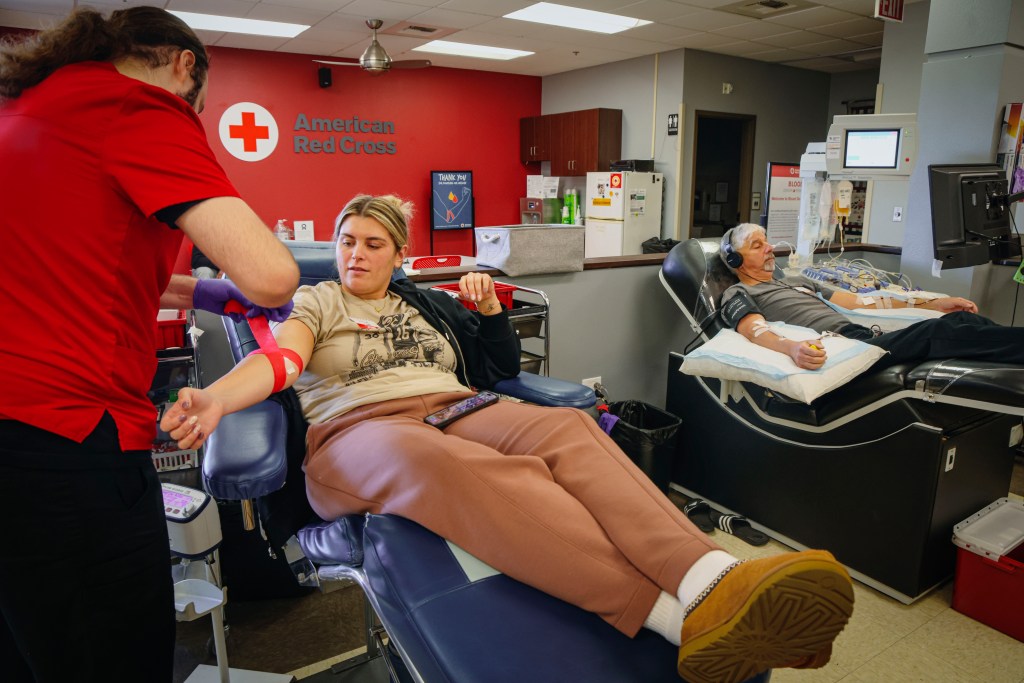
With comparatively excellent weather and a flu season that has not yet raged as fiercely as it has in many other places, San Diego County has an opportunity to step up big and help solve a blood shortage that has plagued communities nationwide.
This week, the American Red Cross called for increased donations from coast to coast, declaring a “severe blood shortage after the national blood supply fell about 35% over the past month.” Following its parent organization’s lead, the nonprofit’s San Diego chapter is urging the public to schedule donation appointments in a dozen cities across San Diego County.
“High flu activity in nearly every state may be sidlining donors, slowing efforts to rebuild vital blood inventories to help patients and relieve pressure on hospitals,” a Red Cross statement said. “The shortage is especially serious for types O, A negative and B negative.
“Without immediate action, patients who rely on transfusions — including trauma victims, mothers in childbirth, and people with sickle celll disease or cancer — face serious risk.”
Factors at work in other places have just not been as severe here.
While rising, just 2.7% of local emergency visits showed flu symptoms compared to 5.3% nationwide, according to the most recent national and San Diego reports.
And, yes, there is rain in San Diego’s forecast, but that’s nothing compared to the major storm predicted to bring ice and heavy snow to much of the United States from the South to the Midwest and Northeast.
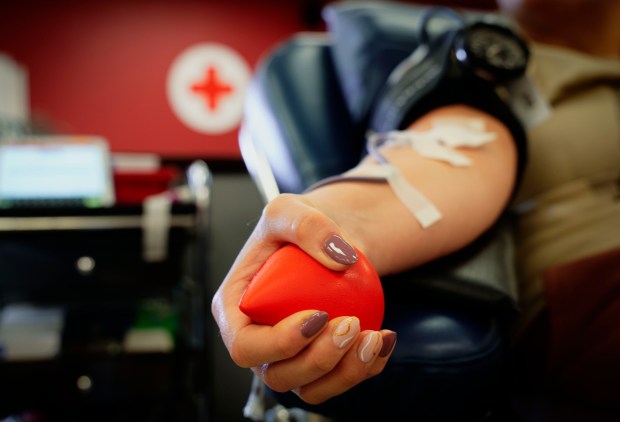 Ella Tarabini squezzes a foamy while giving blood at The San Diego Blood Bank on Tuesday, January 20, 2026 in Kearny Mesa. (Photo by Sandy Huffaker for The San Diego Union-Tribune)
Collections do tend to drop after the holiday season, and San Diego County’s two main collectors, the Red Cross and San Diego Blood Bank, do tend to hold extra events after the new year to ensure a robust supply.
Thus far, though, regional supply has been robust enough to avoid the kinds of urgent pleas that have cropped up elsewhere.
Significant blood shortages have been declared in several major metropolitan areas across the nation, including a plea for donations from the New York Blood Center & New Jersey Blood Services on Jan. 6 that indicated that 10,000 fewer donations than normal contributed to a 40% drop in supply. And on Jan. 5, Bloodworks Northwest, which serves western Washington and Oregon, issued a “code red” warning to the communities it serves to come forward and immediately fill nearly 30,000 slots with urgent need for type O blood and platelets. And, on Dec. 29, the Kentucky Blood Center in Lexington pleaded for increased donations after a drop in supply during the holidays created a need for significant increases to supply 70 hospitals in the state.
And some California communities are already sounding the alarm. On Jan. 12, the Northern California Blood Bank ran out of O negative stock, asking its community members to attend a series of upcoming donation events.
Dr. Catherine Mazzei, a Southern California medical director for Red Cross, noted that the organization’s national footprint provides an opportunity to send supply where it is needed.
“When they get blizzards back East and they can’t collect blood, then some of us, the blood that we can collect here in sunny California, will get sent to help those areas so that patients don’t go without,” Mazzei said.
Douglas Morton, chief executive officer of San Diego Blood Bank, said that this is the time when blood banks prove their ability to flex production to meet demand.
“Our collections have been solid, but I always tell my staff that collection goals mean nothing, it’s about the patient needs,” Morton said. “So when the patient need increases, we just have to go find more, and that’s kind of where we are at right now.”
Dr. Laura Dilly, a pathologist and blood coordinator at UC San Diego Health, noted that the public has few opportunities to help their fellow citizens that are as powerful as donating blood.
“In the United States, someone needs blood and or platlets every two seconds,” Dilly said. “And this need for blood transfusion support is entirely dependent on voluntary blood donors.
“A single donation can save more than one life.”
More information on donating in the coming weeks is available at redcross.org or by calling (800)-RED CROSS (1-800-733-2767) or at sandiegobloodbank.org or by calling (619) 400-8251.