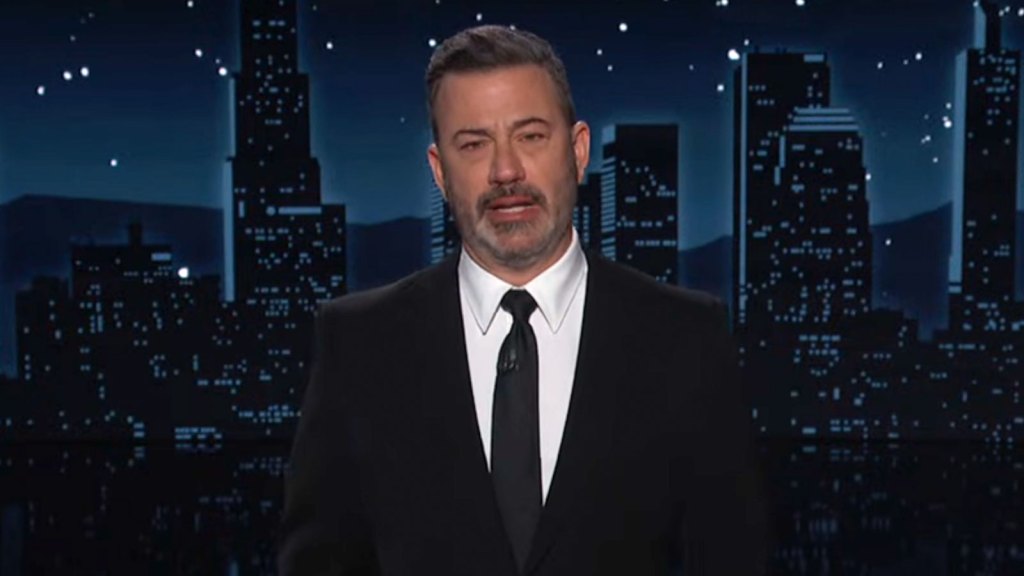
Jimmy Kimmel responded to the FCC‘s announcement this week that talk shows like his may be on the hook to offer equal time to political candidates, calling it Chairman Brendan Carr‘s “sneaky little way of keeping viewpoints that aren’t his off the air.”
“It’s his latest attack on free speech,” Kimmel said on his ABC late-night show on Thursday.
The FCC’s Media Bureau issued guidance this week on the agency’s equal time rule, which requires that broadcasters who feature political candidates provide comparable airtime to rivals, if it is requested. Stations have long enjoyed an exemption for their news programming, and in recent decades have thought that to include daytime and late night talk shows as well.
But the Media Bureau warned broadcasters this week that talk shows may not be exempt, meaning shows like Jimmy Kimmel Live, The Late Show with Stephen Colbert and The View may put their stations on the hook for equal time when they feature political candidates as guests. Many talk shows had assumed that they were exempt, given a 2006 FCC decision that NBC stations didn’t have to give equal time to a Democratic rival of California Governor Arnold Schwarzenegger after he appeared on The Tonight Show with Jay Leno.
Kimmel said that the rules — which apply to broadcasters but not cable, satellite or streaming — were a throwback to the early days of radio and TV.
Kimmel said, “Equal time was designed to limit how much influence broadcasters have over public opinion. But we’re not the only thing on television anymore. We’re a small fish now. We used to be the whole pond. Now we’re part of like this enormous Las Vegas buffet. We’re the mashed potatoes on the buffet, and now the FCC wants to mash us even more. They’re mashing our potatoes.”
He added, “I have no idea what the outcome of this is going to be. We will find out….It is another example of this administration trying to squash anyone who doesn’t support them by following the rules. And we know how much respect these people have for the rules.”
Kimmel and other talk show hosts, as well as ABC the daytime show The View have been targets of Trump and his allies.
Last fall, Carr warned ABC stations following comments that Kimmel made about the response to Charlie Kirk’s assassination. Hours later, ABC pulled the show, but the late-night host was brought back the next week after a backlash.
Carr also had cited ABC’s The View in warning that the FCC would re-examine the exemptions to the equal time rule.
“Importantly, the FCC has not been presented with any evidence that the interview portion of any late night or daytime television talk show program on air presently would qualify for the bona fide news exemption,” the FCC stated in its recent guidance. “Moreover, a program that is motivated by partisan purposes, for example, would not be entitled to an exemption under longstanding FCC precedent.”
The View has featured candidates as guests, including Kamala Harris and Joe Biden, and producers say that GOP rivals have been invited, but they don’t always take up the offer. Trump last appeared, via phone, in 2015.
The FCC’s guidance was aimed at TV talk shows, but legal experts say that that the equal time rule applies to radio as well. That would mean that broadcast talk radio, dominated by voices on the right, would also have to take into account the possibility that they would have to offer Democratic rivals to Republican candidates airtime.
An FCC spokesperson did not immediately return a request for comment.
Robert Corn-Revere, chief counsel for the Foundation for Individual Rights and Expression and former chief counsel at the FCC, said that the agency has historically interpreted the exemption “quite broadly to avoid a First Amendment confrontation.”
“This recent interpretation appears to be geared toward TV talk shows because that is one of Brendan Carr’s hobby horses (based on what appears to preoccupy the President), but the law is not limited to that issue,” Corn-Revere said via email. “Any actual FCC action on this in a particular case would set up a First Amendment confrontation.”
Sean Hannity, who hosts a daily radio show in addition to his primetime Fox News show, seemed to decry the idea of a more stringent enforcement in a statement to the Los Angeles Times.
“Talk radio is successful because people are smart and understand we are the antidote to corrupt and abusively biased left wing legacy media,” Hannity told the Times. “We need less government regulation and more freedom. Let the American people decide where to get their information from without any government interference.”
The equal time rule applies to political candidates, not the mere expression of political views. The rule is often confused with the Fairness Doctrine, who required stations to carry a balance of different viewpoints on issues of public importance.
The doctrine was abandoned in 1987, yet there are some fears that the latest FCC guidance would lead to talk stations avoiding candidate voices altogether.
Michael Harrison, the publisher of Talkers, a trade publication covering the talk media industry, warned that stations would try to limit their exposure.
“When broadcasters are unsure of the guidelines and consequences of booking political candidates – or simply spokespeople – they tend to avoid engaging in that kind of programming to a great extent,” he said. “We learned during the days of the Fairness Doctrine how that kind of regulation chills political speech on the airwaves as opposed to encouraging it.”