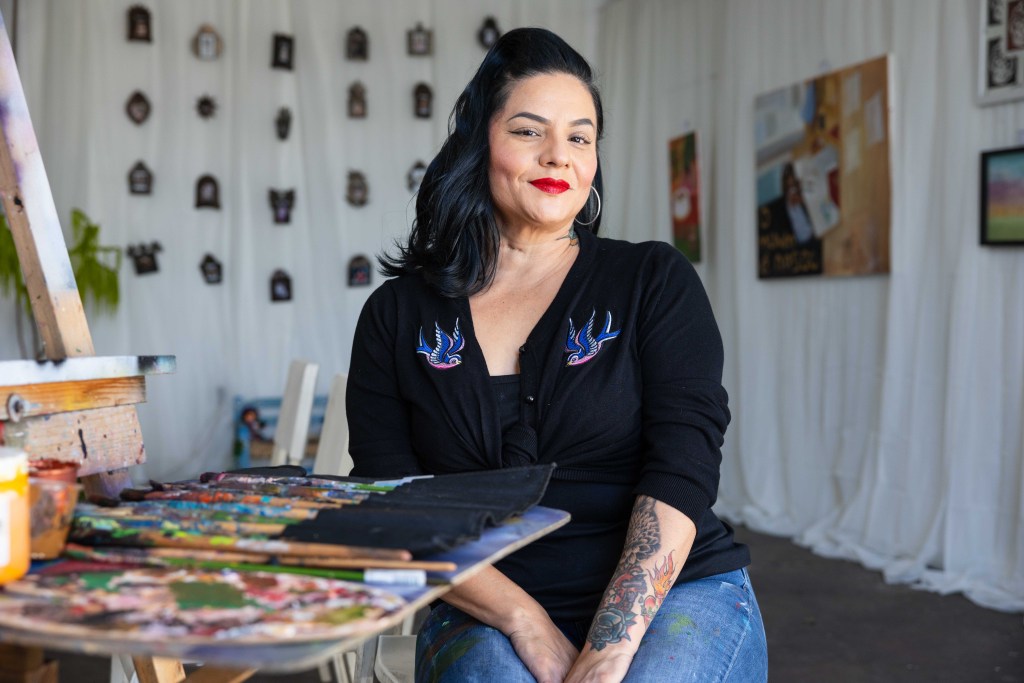
For Maira Meza, it started with those poster contests for kids encouraging them to say no to drugs. As a kid who loved to draw, she entered those annual contests and won — twice. Later, she got married and had kids, setting her art aside to figure out how to take care of herself and her young family. When she began having health issues in her late 20s, the experience took a heavy toll.
“It was very frustrating, and that’s what took me into that place where I didn’t want to be mentally. My son had asked me for this expensive Metal Mulisha sticker, and I said, ‘Heck, no, I’m not going to buy you that sticker. … Let me draw it up for you,’ so I drew it for him. That made me not think of everything that was so loud in my head,” she said, recalling the frustration of going back and forth with doctors, navigating surgery and prescriptions, and going through a divorce. “I have all of these loud thoughts in my head that nobody else is putting there; it’s myself and the way I’m feeling, and it just wasn’t where I wanted to be. When I was drawing, I didn’t think about that; it was just me and my paper and my pen, or my pencil, whatever it is I was using.”
In 2015, she started painting again, organizing a pumpkin painting session with her kids. She couldn’t afford expensive art supplies, so she used her creativity and gathered up old makeup brushes, cotton swabs, and whatever else she could find around the house. It was therapeutic for her, and then some friends noticed her talent and encouraged her to seek out local art galleries and ask about showing her work. She was hesitant, but did it anyway and was included in a “Star Wars” group exhibition at La Bodega Gallery in Logan Heights, where she created a version of the Darth Vader character that she called “Darth Vato” (the space closed permanently at the end of 2019).
“Never did I think my art was going to sell, and it just started selling. It really motivated me to keep creating, not just to sell my art pieces, but to let other people see themselves in it, and to see things that they were brought up with,” she says.
Today, Meza, 45, is an artist, muralist, instructor who runs Arte Hasta La Muerte, and illustrator of the children’s book “The Spirit of Chicano Park/El espíritu del Parque Chicano” by Beatrice Zamora, winner of the 2021 Tomas Rivera Book Award. She took some time to talk about her family and her culture, and the ways they’ve influenced who she is as an artist.
Q: What kind of influence has your upbringing, your culture had on the art that you create? Are there ways that you see your upbringing as having informed your art practice?
A: My dad built furniture, so I say that he was an artist. He did that big Santa Claus chair at (Westfield) Plaza Bonita. He was an upholsterer and every summer, my mom had new furniture because my dad made it, so I do believe that that is a form of art, as well. My mom was always handy with floral arrangements, and she would make matching dresses for my Cabbage Patch dolls and myself. That’s art, as well.
My parents were both immigrants. They came here for the reason that other families come here, to provide a better life for myself and my siblings and our kids. It’s so easy to kind of learn to hide in the shadows. My dad was scared of la migra, so “Let’s not be loud. Let’s not make ourselves be seen,” not because he wasn’t proud of where he came from because, fortunately, I was able to grow up with the music that he likes, the culture, the traditions and everything. But as far as being loud and being proud, I can’t say that he didn’t want to be, but he was scared of getting kicked out of this country, he was scared of getting deported. I am thankful and I’m grateful that I am a citizen and that I don’t have that fear, although a lot of us do in these times. That’s scary, but at the same time, I’m not going to let that fear silence my voice and I’m going to continue to be proud of my roots and encourage my kids to be proud of their roots, to be proud of the skin color that they’re in because our history is going to be silenced if we’re not.
What I love about Logan Heights/Barrio Logan…
I love that there’s just so much history and I love that it’s a community that continues to come together and helps each other. We find our own resources to do things that the city fails to do for us. It’s an underserved community, and the people that serve it are their own people. So, whether that be the art classes that I give every summer, or the monthly food distribution, along with diapers, women’s necessities and different resources—that’s my home, that’s my community.
Q: Do you exclusively paint murals? Do you create art in other media?
A: So I was, I was definitely blessed with being able to paint at Chicano Park, which is so close to my heart. I’m so bad with dates, but I believe it was 2023 where I got to help out with the MEChA mural during the Chicano Park restoration project. Painting at that park is just so sacred because of the struggles and the victories that have happened in that park. I don’t even have words for it because painting there was almost like a religious experience. I was able to paint two portraits of two very powerful pillars of the community, Patricia Cruz and Carmen Kalo, both wonderful artists and friends of mine. Shortly after, I was able to do my own mural by the restrooms of Chicano Park, as well. Those are two of my biggest accomplishments and just an incredible moment. I just can’t explain the feeling of being able to have those murals there, in a national landmark.
I did also illustrate (the children’s book by Beatrice Zamora) “The Spirit of Chicano Park.” That was one of another one of my biggest accomplishments. I met her at one of my painting classes at the Centro Cultural, and she approached me afterwards and we kind of hit it off. She asked me if I’d painted anything about Chicano Park and said she was writing this book and would I want to illustrate it. Right away, I’m like, ‘Heck yeah!’ Then, at the end of the night, I’m like, ‘What in the heck did I get myself into?’ I felt like there were so many better qualified artists than myself to be able to do such a huge project. This is the first children’s book of Chicano Park that explains, in detail, the struggles and the victories of the journey to build this park for the community, by the people. This is huge and I felt so nervous. I did it, but there were doubts in me. I think that’s normal, and I’m forever grateful for that opportunity. That’s another thing that I’m able to leave behind when I’m no longer here and my grandkids are.
Q: What do you want your art to say? What do you want people to get from your work?
A: That’s it’s OK to be proud of where you’re from, where your family is from. That it’s important to dig into our roots and to discover things that we didn’t know about ourselves. And it’s important to give back.
Q: What inspires you in your art?
A: Creating my culture, my people, my history, my family.
Q: Are there things that you gravitate toward painting?
A: Anything that has to do with my culture, from the foods that we eat to the places that we visit, the traditions in our families. I consider myself a Chicana, so a lot of my work is inspired by the Chicano/Chicana history and movement.
Q: What has this work taught you about yourself?
A: That I could do it. There’s so many times where I have found myself in a position where, even just from the beginning of my painting journey, where I find myself in a position where I think that it’s not going to happen, where I think, ‘Life. How much worse can it get? Another slap in the face that life is going to hit me with.’ And I paint. Just self-determination, just getting up and doing it. Nobody’s going to do it for you, so I just got to get up and do it.
Q: What is the best advice you’ve ever received?
A: People are going to try to tell you how your art should look, or how your art should be done, or that you’re doing it wrong. I’ve seen that in myself where, of course I’m not the same artist that I was when I first started. I can see the drastic change because it’s something that I do on a daily basis, but it’s important that I don’t change who I am and I don’t change what I want to paint, who I want to paint, and just stick with who you are.
Q: What is one thing people would be surprised to find out about you?
A: That I’m a self-taught artist. If you want something and you have the discipline to keep on doing it, you’re going to get better at it and you’re going to take yourself as far as you want to take yourself.
Q: Please describe your ideal San Diego weekend.
A: Just take a cruise (drive) somewhere, be in the sun, enjoy our weather, enjoy my family, enjoy my friends. Take a ride somewhere and be outdoors, at our beaches, go hang out at the art galleries.