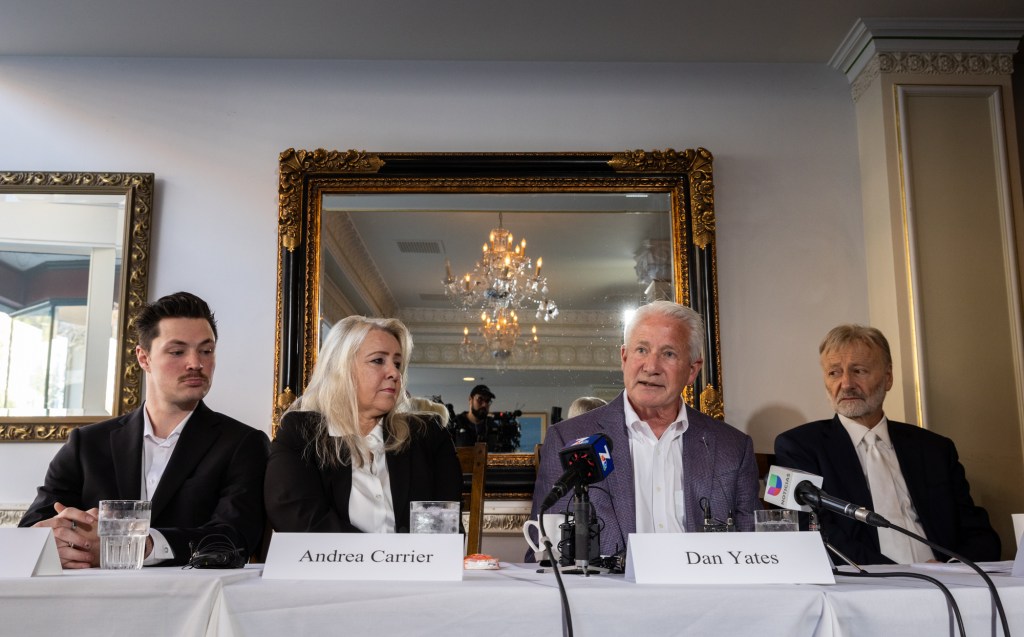
A new filing in the lawsuit over the murder of 24-year-old Brandon Yates alleges jail staff ignored clear warning signs that the man who killed him was too dangerous to be housed with others.
The amended complaint, filed Jan. 16 in federal court by Yates’ parents, lays out a detailed timeline of the weeks leading up to the killing, documenting repeated opportunities for jail staff to intervene as Alvin Ruis — a man with a history of psychosis, violence and self-harm — deteriorated.
Yates was arrested on Jan. 15, 2024, after being found sleeping in a backyard shed. He had struggled with mental illness and substance use, his parents said, but was trying to turn his life around.
Less than 24 hours after he was booked into jail, Yates was found dead in the cell he shared with Ruis.
“It never occurred to me that his life was at risk,” Yates’ mother, Andrea Carrier, told the San Diego Union-Tribune in an interview last year.
The amended complaint — which names the county of San Diego, Sheriff Kelly Martinez, jail medical contractor NaphCare and more than a dozen deputies and mental health clinicians as defendants — details Ruis’ escalating psychiatric crisis in the weeks before he killed Yates.
Spokespeople for the county and Sheriff’s Office declined to comment on the new filing, citing active litigation.

Prior to his arrest on Dec. 27, 2023, Ruis had been involuntarily hospitalized multiple times for psychosis, had assaulted family members and attacked a flight attendant midair as he tried to flee the country.
In jail, he threatened deputies and other incarcerated people and attempted suicide multiple times, the lawsuit says.
Despite this behavior, the lawsuit says, mental health staff never recommended Ruis be placed in the jail’s psychiatric stabilization unit, where he would receive a higher level of care and monitoring. Nor did anyone respond to his request to “get back on” the antipsychotic medication Seroquel.
According to the filing, Ruis begged multiple clinicians for the medication. He also reported hearing voices and believed deputies were out to get him.
On at least four occasions, he was placed in a safety cell or enhanced observation housing because he was deemed a danger to himself or others. The day before he killed Yates, Ruis asked a mental health clinician to put him in “level seven protective custody.” The jail’s administrative separation unit is on the seventh floor.
The amended complaint alleges that more than a dozen mental health staff and deputies had access to Ruis’ records and firsthand knowledge that he had become progressively more violent and delusional over his nearly three weeks in jail.
It also alleges that jail classification deputies failed to upgrade Ruis’ security level, even after he assaulted a deputy and threatened others. Had Ruis been reclassified from Level 3 to Level 4, the lawsuit says, jail policy would have prohibited him from being housed with Yates.
Ruis had also been designated a “bypass” or “keep separate” inmate — a classification meant for people who can’t safely be around others. Deputies who placed Yates in Ruis’ cell would have been required under department policy to confirm whether shared housing was allowed, the lawsuit says.
Deputies moved Yates into Ruis’ cell on Jan. 16 after two men warned a deputy that “there would be trouble” if Yates was not removed from their housing unit. The lawsuit says Yates was disoriented and “babbling nonstop.”
Once Yates was inside Ruis’ cell, the lawsuit says, the men began arguing about religion and things quickly escalated. Ruis later told an investigator that he believed Yates was the devil and that God had given him permission to kill him.
During the attack, Yates repeatedly pressed the cell’s emergency call button, the lawsuit alleges, and begged deputies over the intercom to intervene, but no one came. Men in nearby cells also yelled for help, the lawsuit says.
According to the complaint, deputies either ignored the calls or muted the intercom system.
Ruis placed Yates in a chokehold, poured liquid soap into his nose and mouth and smothered him with a blanket until he died, the lawsuit says. Afterward, Ruis stripped Yates’ body and arranged it to resemble Jesus’ crucifixion.
Ruis later told investigators he staged the scene to show that Yates’ death was not a suicide.
The amended complaint alleges that Yates’ death resulted from “deliberate indifference” by jail staff who repeatedly ignored warning signs — an argument a federal judge has already found plausible.
In an Aug. 21 order declining to dismiss the case, U.S. District Judge Thomas J. Whelan wrote that “the right to be free from inmate-on-inmate violence is clearly established.”
The new filing also follows a countersuit filed Sept. 27 by the county against jail medical contractor NaphCare and subcontractor Liberty Healthcare, which has since been dismissed as a defendant because none of its employees were involved in Ruis’ care. The countersuit argues that failures by the contractors’ employees to flag Ruis as dangerous contributed to Yates’ death.
The county is seeking indemnification from any damages awarded to Yates’ family, as well as reimbursement of legal costs. The countersuit does not concede that the family’s allegations are true, but argues the contractors are responsible for injuries or deaths caused by “any act, error, omission or negligence” by their employees.
NaphCare’s motion to dismiss, also filed last month, argues that the county bears responsibility for Yates being placed in a cell with Ruis.
The Alabama-based for-profit company, which took over jail medical services in July 2022, has previously denied any wrongdoing.
Ruis has been charged with murder and remains in custody. No trial date has been set in either his criminal case or the Yates family’s civil lawsuit.