It’s the first week of the 8th Chicago International Puppet Theater Festival and this is our first dispatch with brief reviews of some of the shows we’ve seen so far. From skeletons to shadow puppets and matchboxes, the productions display the amazing ingenuity of puppetry storytelling and the great variety of puppet characters that we meet. The puppet stories are powerful dramas, comedies and musicals, some for all ages, some definitely not for kids.
The 12 days of the puppet fest, which continue through Sunday, February 1, feature performances at 14 theater venues all over the city, plus free puppet productions at 10 Chicago neighborhood locations, such as parks and community centers from Rogers Park to Grand Crossing, from Old Town to Austin. See our preview of the festival and watch for our second dispatch next week. Find complete information and buy tickets here.
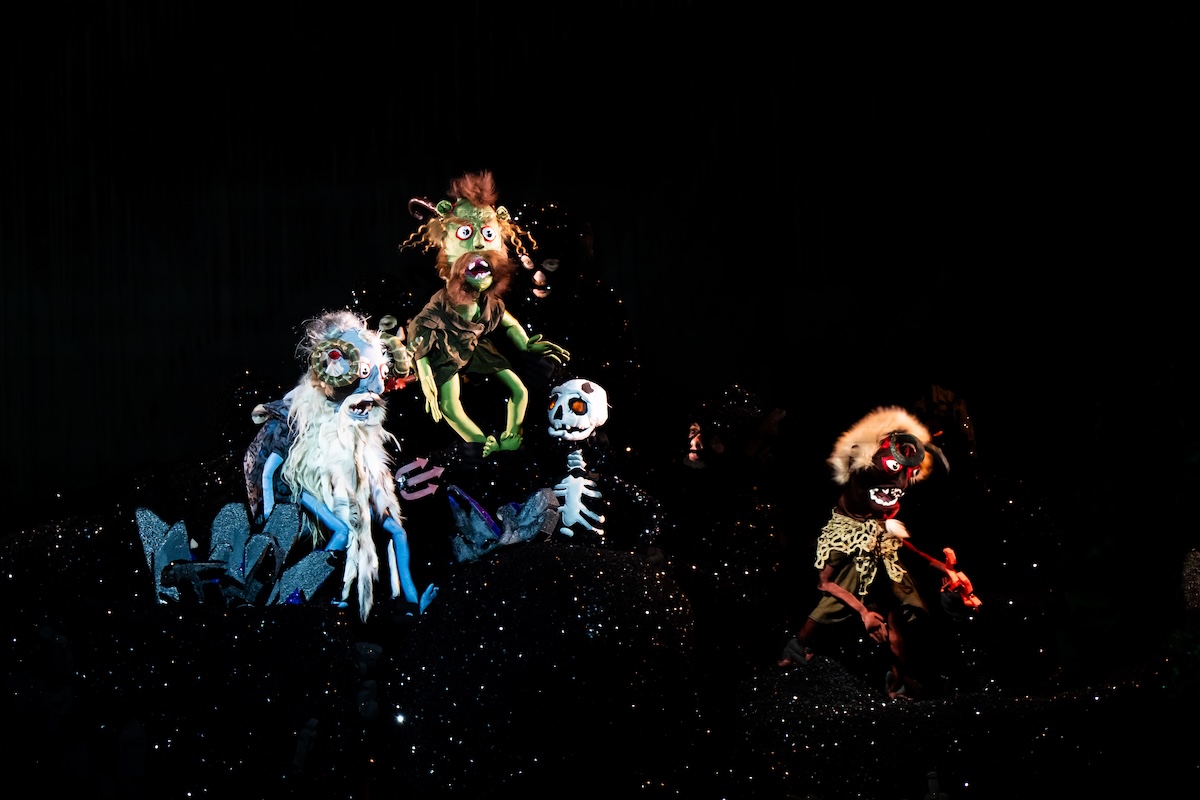 Dead as a Dodo. Photo by Chuncheon.
Dead as a Dodo (Norway/New York)
This beautifully designed and engineered performance was the festival’s opening night production at the Studebaker Theater. (I saw it several days later.) Dead as a Dodo by Wakka Wakka tells a story of survival, transformation and friendship. Living deep in the underworld, two skeletons—the Dodo and the Boy—are fearful they will wither away as the Boy begins to lose limbs. But suddenly, a miracle happens. The Dodo begins to grow feathers and flesh; it’s on its way to becoming a fully fleshed and feathered creature again.
This full transformation only happens after the Boy and the Dodo, trying to stay together, finally are able to flee the underworld and its devilish denizens—many gorgeous colorful devil characters, including the King of the Underworld. Ultimately, a chorus of puppets performs a syncopated song with the refrain, “You have to go down to get up!” The show’s final words are “The Age of the Dodo has begun.”
Some brilliant puppet plays are produced and performed by one or two designers and puppeteers. (As in The Matchbox Shows below.) Dead as a Dodo is a group effort with thrilling, constantly changing projections (by Erato Tzavara) and lighting design (by Daphne Ogosin), plus eight puppeteers fully garbed in black sparkly fabric. (Yes, you might think you see them but you really don’t; on the darkened stage, only the puppets are illuminated.)
Dead as a Dodo is written and directed by Gwendolyn Warnock and Kirjan Waage (with help from the ensemble). Waage creates and constructs the puppets. Original music and sound design is by Thor Gunnar Thorvaldsson. (Nancy S Bishop)
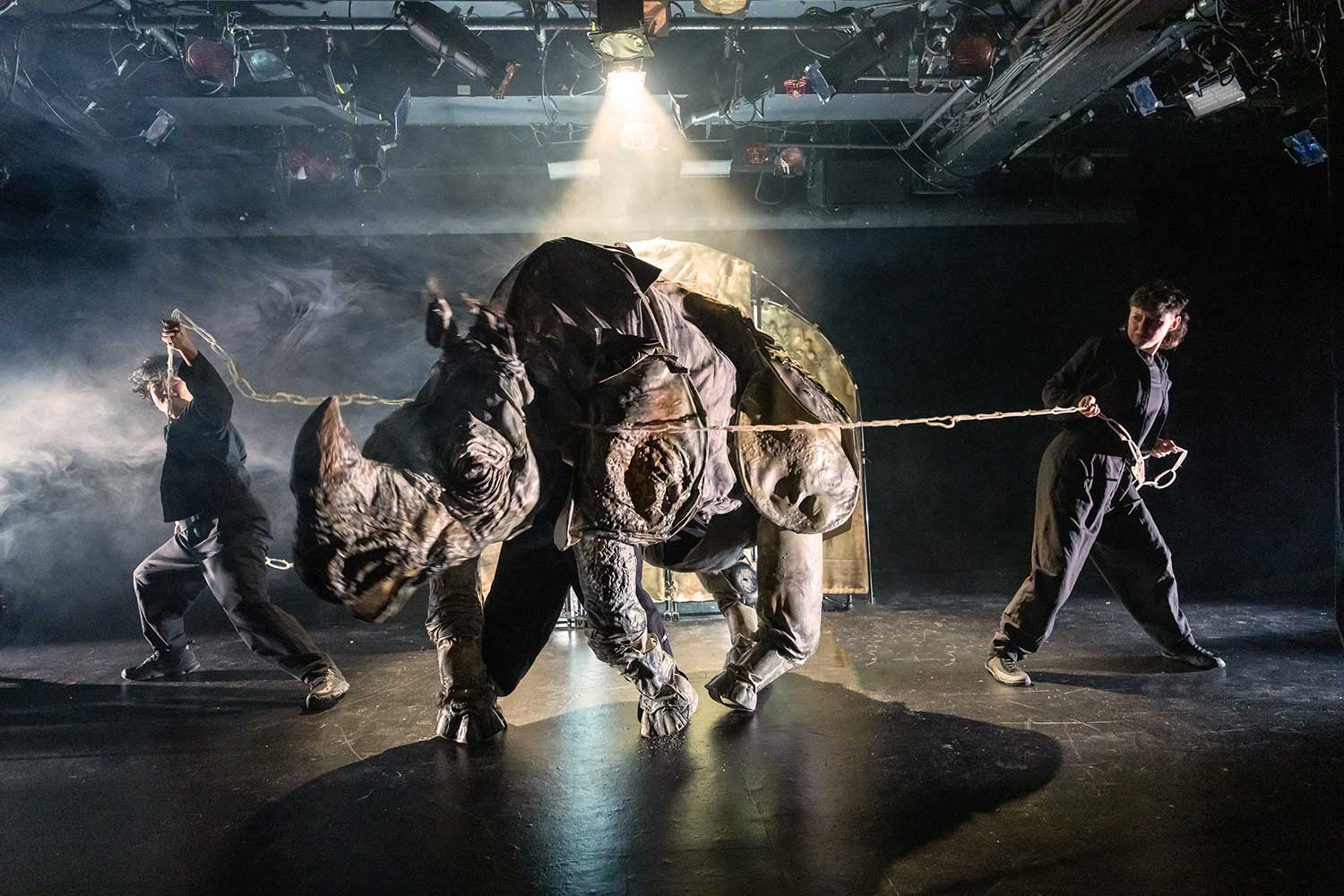 Rhynoceron. Photo by Richard Termine.
Rhynoceron (Chicago)
Acclaimed Chicago sculptor and puppeteer KT Shivak’s contribution to the festival is a mystical display of uncanny arts. Rhynoceron, based on a true story, follows a Renaissance-era one-horned rhinoceros traded among a sultan, king, and pope. Presented in one glorious hour at the Biograph Theater, the show splits into two parts, the first focusing on the human point of view and the second on the animal.
During the human segment, our four talented puppeteers recreate historical figures through a combination of masks, illustrations, table top puppets, and body puppets. For each historical figure we get a monologue, either from the figure himself or someone who knew him, about how they acquired the rhino, their impressions of it, and why they choose to send it away. While the character designs and puppet performances are strong, this half, more than the second, is clunky.
The show is at its best when it achieves a certain magical quality. Ben Zucker provides onstage accompaniment, and his xylophone and synth devices go a long way to creating a floaty, arcane vibe. Several times during the human monologues, however, I was separated from that environment. Some puppets spoke with modern language, and the occasional dips into anachronisms, I thought, were like memes drawn on frescos.
The second half, when we finally meet the rhino talked about so much in the first, is an absolute revelation. The rhino, operated by two or three people, is one of the coolest puppets in the city. The life-sized creature moves with believable grace and weight. Watching the animal characters, I experienced that amazing double-vision we so want from a puppet show, where we can see the strings but for a moment cannot doubt the thing onstage is alive. The kind of feeling one wishes they could bottle. (Adam Kaz)
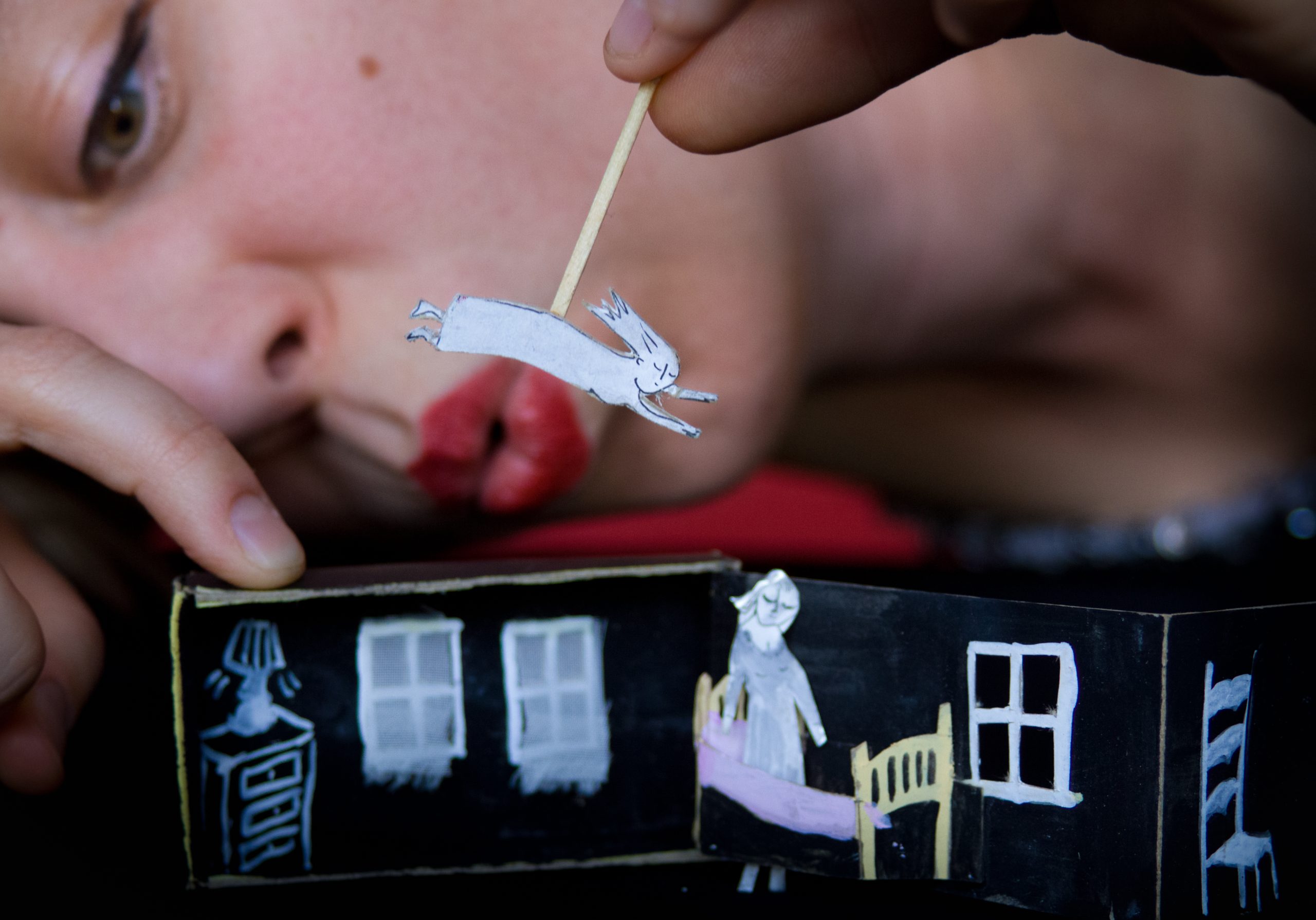 The Matchbox Shows. Photo by Sean Meredith.
The Matchbox Shows (Portland, Oregon)
On frigid Friday, January 23, Portland-based Laura Heit celebrated the 25th anniversary of The Matchbox Shows, which debuted at Links Hall in 2000. Heit received her BFA from the Art Institute (MFA in London) and was also an intern for Puppet Fest founder Blair Thomas’s Redmoon Theater. The performance was at Constellation in Avondale
Written, designed and created by Heit, this hourlong show is a mini-marvel of mostly-autobiographical vignettes using real matchbooks, some actual flame, and tiny figures (mostly metal to survive that flame) marionetted by matchstick, reminiscent of Lynda Barry’s people and sometimes Edward Gorey’s milieu. Camera operator Sam Deutsch follows the miniature action with a tiny camera that projects the sketches on a large upstage screen.
Wearing a sequined blue top (to provide a glittery scrim behind the action), carrying a glass of red wine (to fuel the confessions), and speaking quiet, conversational tones into her face-mounted microphone, Heit spins tales of ballerinas, circus actors and animals, Little Red Riding Hood, and much more using simple stick puppetry techniques, along with more elaborate flips and reveals, sometimes using scrolls and multiple dimensions. The stories range from sweet to bittersweet to sad, all revealed with quiet humor and reflection.
This palm-sized play, which regularly rotates material, also employs clever callbacks from previous sequences, and is sometimes quite meta: a wee art history slide show shows students seated on floor cushions, in front of some patrons on floor cushions in the almost sold-out proscenium space. Minneapolis pops up with Bob Mould in the preshow music and Prince in a clever, multi-layered and appropriately reverential reveal.
Heit’s final sketch is “27 Pictures of Myself Naked,” a tiny compendium of herself nude and welding, on a pommel horse, on a landline and a Zoom call, and more. The show shares remarkable skill to create such mobile and expressive Lilliputian players, and a meditative sweetness about our collections of life experiences from this rich little match girl. Heit’s short films will play at the Music Box Theatre on January 26-27. (Karin McKie)
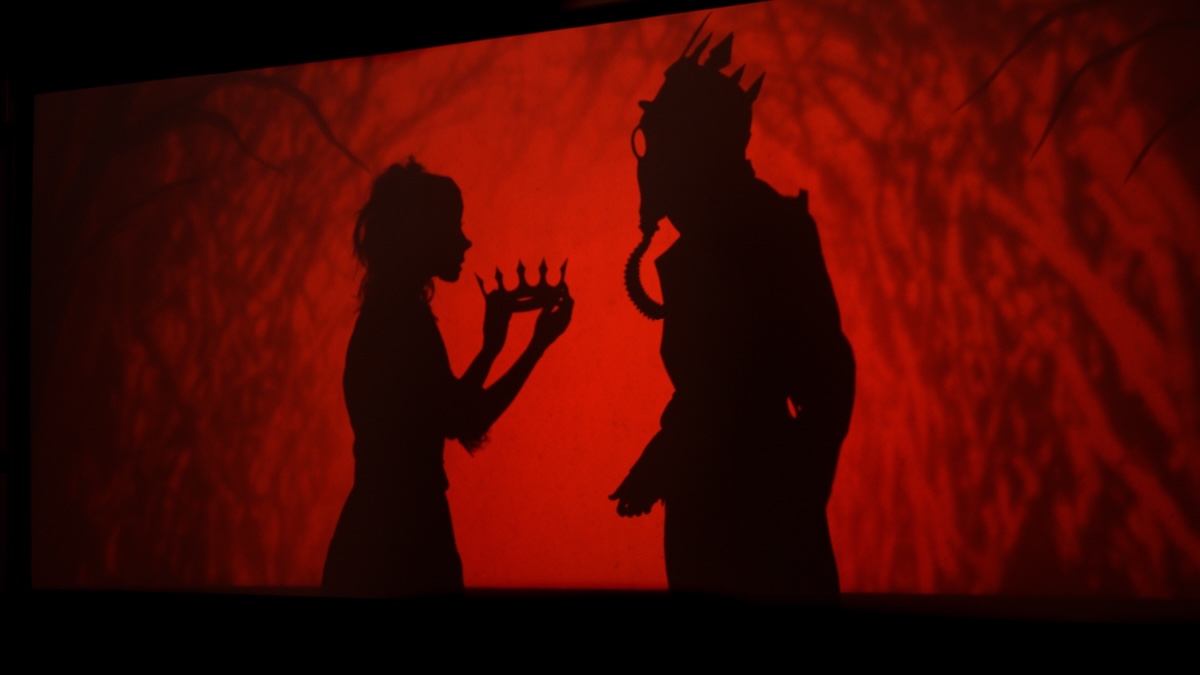 The 4th Witch. Photo courtesy Puppet Theater Festival.
The 4th Witch (Chicago)
Manual Cinema’s contribution to the 2026 International Puppet Theater Festival is The 4th Witch, conceived and directed by Drew Dir. The production draws on key elements of Macbeth and focuses on the three witches in Birnam Wood.
The 4th Witch takes place during the occupation of Paris during wartime, with General Macbeth aiming to be king or dictator. Bombs fall on the Trois Oiseaux Cafe, killing the owners and orphaning a little girl. She escapes to Birnam Wood and is rescued by a witch. Each Manual Cinema production uses different types of technology. The 4th Witch is performed using shadow puppets and actors in silhouette with overhead projectors. Lovely, colorful slides of mushrooms and greenery are interspersed with the shadow images.
The play is accompanied by haunting music with a score by Ben Kauffmann and Kyle Vetger. The trio from Manual Cinema’s recent Christmas Carol production plays and sings the soundtrack: Lia Kohl on cello, Lucy Little on violin, and Alicia Walter on keyboards and lead vocals. The 4th Witch has all of the elements of a fairy tale in the style of Grimm or the darker Hans Christian Andersen stories. A young girl is orphaned, encounters danger, and emerges victorious.
Manual Cinema has made its reputation as an innovator with technology old and new. I highly recommend seeing a Manual Cinema performance. It is an experience that you won’t soon forget. The founders of Manual Cinema are puppeteers and musicians. Drew Dir, Sarah Fornace, Ben Kauffman, Julia Miller, and Kyle Vetger founded the group in 2010. (Kathy D. Hey)
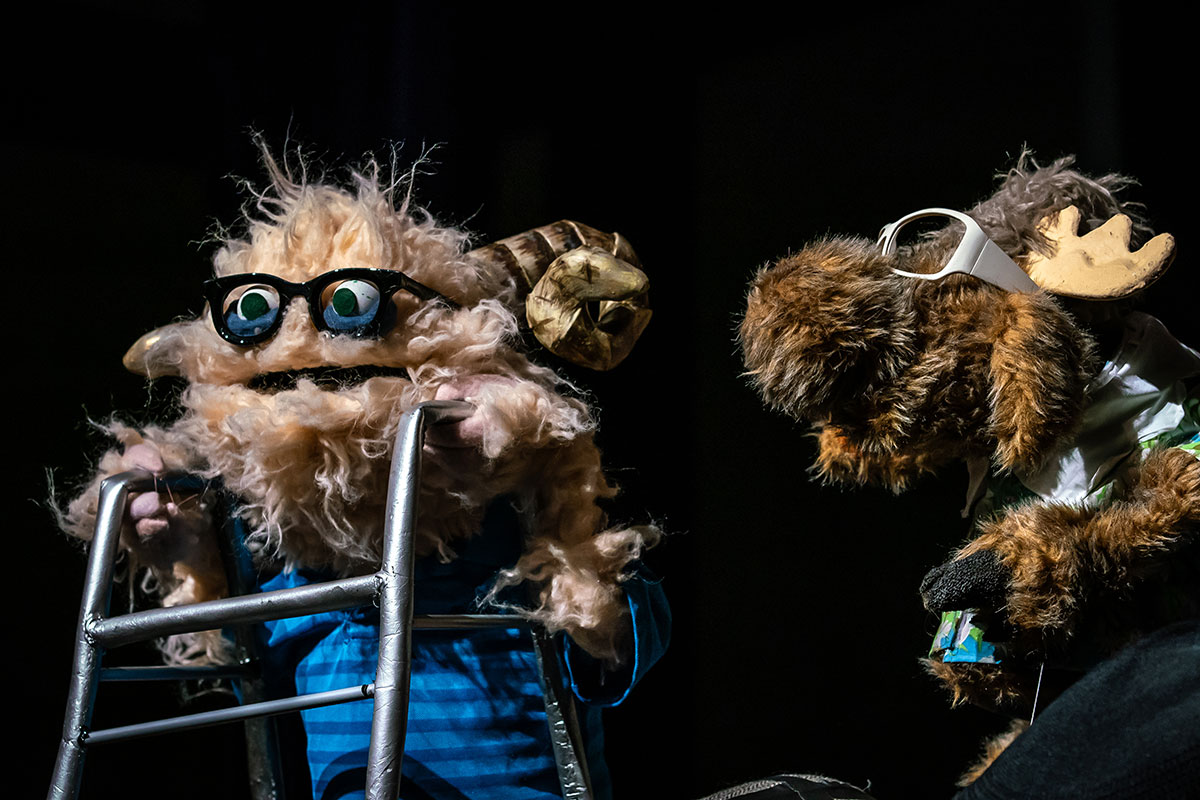 Nasty, Brutish and Short. Photo by Richard Termine.
Nasty, Brutish and Short (Chicago/International)
Philosopher Thomas Hobbes said this about the state of nature without a government: “no arts; no letters; no society; and which is worst of all, continual fear, and danger of violent death; and the life of man, solitary, nasty, brutish, and short.” This sentiment resonates in this particular political moment, and provides the title Nasty, Brutish and Short for this 60-minute showcase of global puppeteers, performed at Constellation.
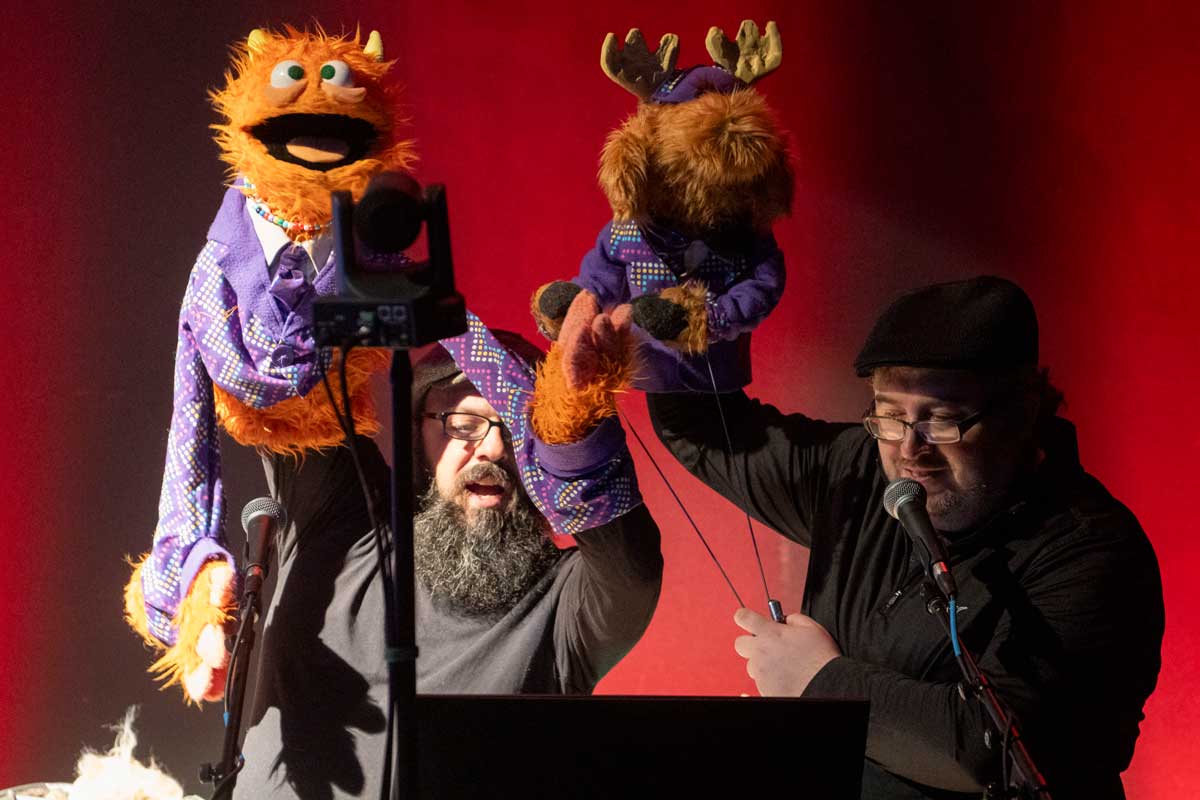
Curated by Rough House Puppet Arts, and hosted by Noah Ginex Puppet Company’s cabaret host Jameson (and others like a moose and a yeti), this late-night (10:30pm) lineup is a smorgasbord of rotating different eight-minute or briefer acts, also streamed live and recorded. This puppet slam is for finished works and those in progress. In front of a packed house, Chicagoan Karen Hoyer shares a story of a ballerina, and Philly’s Maisie O’Brien tells a tale using a rolling shadow box (great ASMR), a delicate backlit Balinese concoction.
Tian Gombau of Spain uses stones and finger legs on a tabletop to create a sweet seaside story, while New York’s Zlata Godunova uses her voluminous, pocketed skirt to cleverly reveal the story of mischievous, murderous matriarchal monarch Saint Olga of Kyiv.
Minneapolis’s Oanh Vu shares a door-infused vignette, and the Rubicon Studios pair (from Chicago and Boise) “wear” near life-sized puppets in a wild, Sweeney Todd-type story (with a splattering of Titus Andronicus) about a pair of elderly tomato growers and their secret recipe. (Karin McKie)
 Harlem Doll Palace. Photo by Richard Termine.
The Harlem Doll Palace (New York)
The Harlem Doll Palace is based on a real museum in the brownstone apartment of Lenon Holder Hoyte, aka Aunt Len. When she retired as a New York public school teacher, she opened Aunt Len’s Doll and Toy Museum, featuring a collection of up to 6,000 dolls and toys. This wonderful 90-minute production was written and performed by Alva Rogers, directed by Ash Winkfield and performed at the Reva and David Logan Center for the Arts.
The puppets tell the history of the eras in which they were created. Hoyte had dolls that represented Black women in an era where they had little representation. There was Black Nurse and the Thomas Alva Edison talking doll with articulated limbs, a porcelain face, and fixed eyes. The Edison doll in this show is dressed in army attire and announces a tally of the museum population like a morning “reveille.” The count goes down as the show goes on. People and vandals took advantage of Aunt Len as she grew older and less vigilant.
Rogers’ performance as Aunt Len is brilliant. It’s a composite apparition of the older Black women I met as a child: relatives, neighbors, and my granny’s friends. Rogers’ sweet singing voice echoes Sunday morning hymns, and she plays Hoyte as someone who believed she was part of her dolls’ world as much as they were of hers. The production design is by Winkfield and Jessica Simon. The light blue valance over the stage creates a proscenium arch over the collection of dolls.
It felt like a step back in time, on a cellular level, recalling the tchotchke-filled homes of the elders of my youth. It was a nostalgia-inducing and bittersweet step back in time that pays tribute to women’s contributions, often overlooked or forgotten. Alva Rogers has immortalized Lenan Holden-Hoyte through puppetry. (Kathy D. Hey)
Support arts and culture journalism today. This work doesn’t happen without your support. Contribute today and ensure we can continue to share the latest reviews, essays, and previews of the most anticipated arts and culture events across the city.