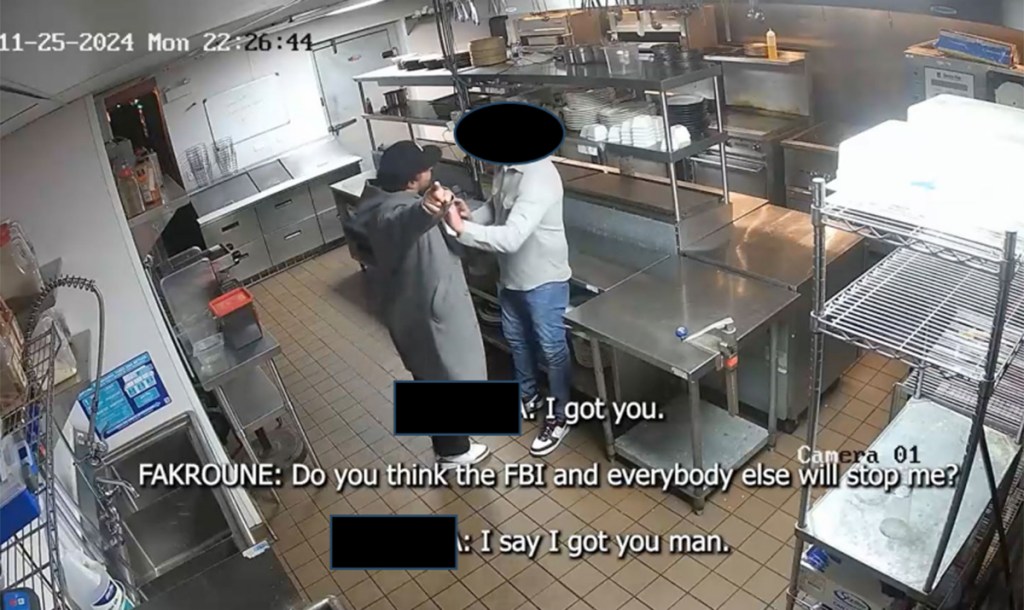
No one denies Jawad Fakroune pretended to be the son of a Colombian drug lord, or lied about connections to the Chicago mob, or that he went “bonkers” and threatened to castrate and kill a Chicago restaurateur and his family in a 2024 tirade caught on camera.
The question presented to a federal jury has been: why?
Fakroune’s attorney said in closing arguments of his extortion trial Tuesday that his client flew off the handle over a failing business relationship with Adolfo Garcia, the then-owner of a string of fledgling restaurants in Chicago, including Yours Truly, the River North oyster and martini bar where the beating took place.
But going “ballistic” isn’t proof he was trying to collect on a debt, defense attorney Damon Cheronis told the jury.
“(Fakroune) said horrible things, no doubt,” Cheronis said. “But look at the fuse that lit the wick that led to that.”
Cheronis said Garcia, who was cooperating with the FBI at the time, set Fakroune off by lying about how much money he’d repaid to him — one of just a string of self-serving falsehoods Cheronis said Garcia put forth in the case.
“Watch how many times (Fakroune) is trying to walk out the door,” Cheronis told the jury about the recorded beating. “Garcia says two-eighty ($280,000) and ladies and gentleman, that is when everything goes bonkers.”
In his rebuttal argument, Assistant U.S. Attorney Richard Rothblatt said calling Fakroune the victim in a case where he attacked someone and threatened to murder their entire family is “interesting” but “not the case you just saw.”
“You cannot beat someone or threaten someone if there is a disagreement over how much money someone owes,” Rothblatt said. “That is not the law.”
Rothblatt also mocked the defense’s portrayal of Garcia as out to dupe Fakroune. Why would he go to such lengths to try to trick someone he believed was the son of infamous Colombian drug lord Pablo Escobar, who had a history of violence that included threatening Garcia with a gun in public, and had falsely told Garcia that some of the money he’d arranged as a loan came from the Chicago mob?
“This the guy that Adolfo Garcia is planning to rip off with a fake promissory note?” Rothblatt said, sarcastically, as Fakroune sat at the defense table rubbing his temples. “…This is not a close case. The evidence is overwhelming.”
Fakroune, 47, a Moroccan national also known as Angelino Escobar, Giovanni Costello and a host of other aliases, is charged with two extortion-related counts. After a weeklong trial, the jury began deliberating the case at about 12:45 p.m. Tuesday.
The trial has offered a fascinating window into the often-cutthroat restaurant industry in Chicago, as well as some of the people Fakroune encountered, including well-known Chicago restaurateurs and a former aide to Gov. JB Pritzker.
Much of the evidence the jury saw over the past week dealt with the events leading up to the Nov. 25, 2024, beating at Yours Truly, which shut down shortly thereafter.
Security camera footage watched by the jury showed García standing alone in the bar’s basement when Fakroune, dressed in a long, grey coat and black baseball hat walked in and demanded money.
“Get my money,” he said. “Ready tomorrow. Or I (expletive) kill you …. I will hunt you down, man. Every day, every night. Believe that.”
The two wound up in the kitchen where Fakroune stalked Garcia around a stainless steel table, punched and kicked him and shouted questions and threats as García, holding his head from an earlier blow, begged him to “please just stop.”
García testified last week that he took Fakroune’s statements very seriously, driving around the Loop and South Loop and taking a butcher knife from his kitchen to put beside the bed that night.
In a phone call secretly taped by the FBI the day after the encounter, he told Fakroune he was trying to scare up cash to replace the $8,000 check he’d made out to Angelino Escobar, Fakroune’s alias, which had set off the confrontation in Yours Truly.
“I’m already a dead man walking by your standards, so (expletive) it,” he said.
“I hope you understand that,” Fakroune replied.
“I do, thank you,” García said. “You told me last night 9,000 (expletive) times.”
On cross-examination, Cheronis zeroed in on García’s difficult history in the city restaurant scene and legal skirmishes with other people he’d worked with over the years.
García admitted to being “an absolute failure” as a restaurant operator and to facing serious personal problems as he sank deeper and deeper into financial distress throughout his dealings with Fakroune.
“You had a reputation in the restaurant industry for being a bad operator … and for taking money from your partners,” Cheronis said. “Almost every business partner that you’ve worked with has called you a fraud.”
Cheronis also pointed out inconsistencies in García’s statements between meetings with federal agents, documents that the federal government hadn’t reviewed and generally poking holes in his assertion that his relationship with Fakroune — as opposed to his own bad decisions — was what had bled the oyster bar dry.
In his closing argument Tuesday, Cheronis said the lies from Garcia should add up to a not guilty verdict.
“He’s their star witness. He’s the one that you have two believe when you’re deliberating this case,” Cheronis said.
There was one fascinating aspect of Fakroune’s case that the jury did not hear, due to a pretrial ruling by U.S. District Judge Manish Shah.
Three weeks after the beating, the FBI tracked Fakroune to an apartment in New York and knocked on the door.
According to prosecutors, he fled nearly naked out a back door as two female acquaintances watched in shock, then ran nearly a mile down the chilly streets of Manhattan with a black garbage bag over his head as a smock, entering a high-end Italian restaurant and asking for clothes.
Fakroune was eventually arrested in January 2025 at a home in Michigan City, Indiana.
In addition to the extortion case, Fakroune is also charged with fraud and tax evasion in a separate indictment alleging he bilked millions from investors who’d been promised handsome returns on various ventures, including a marijuana-growing operation, coffee shops and a Mexican restaurant, court records show.
That case is expected to go to trial next year.
jmeisner@chicagotribune.com