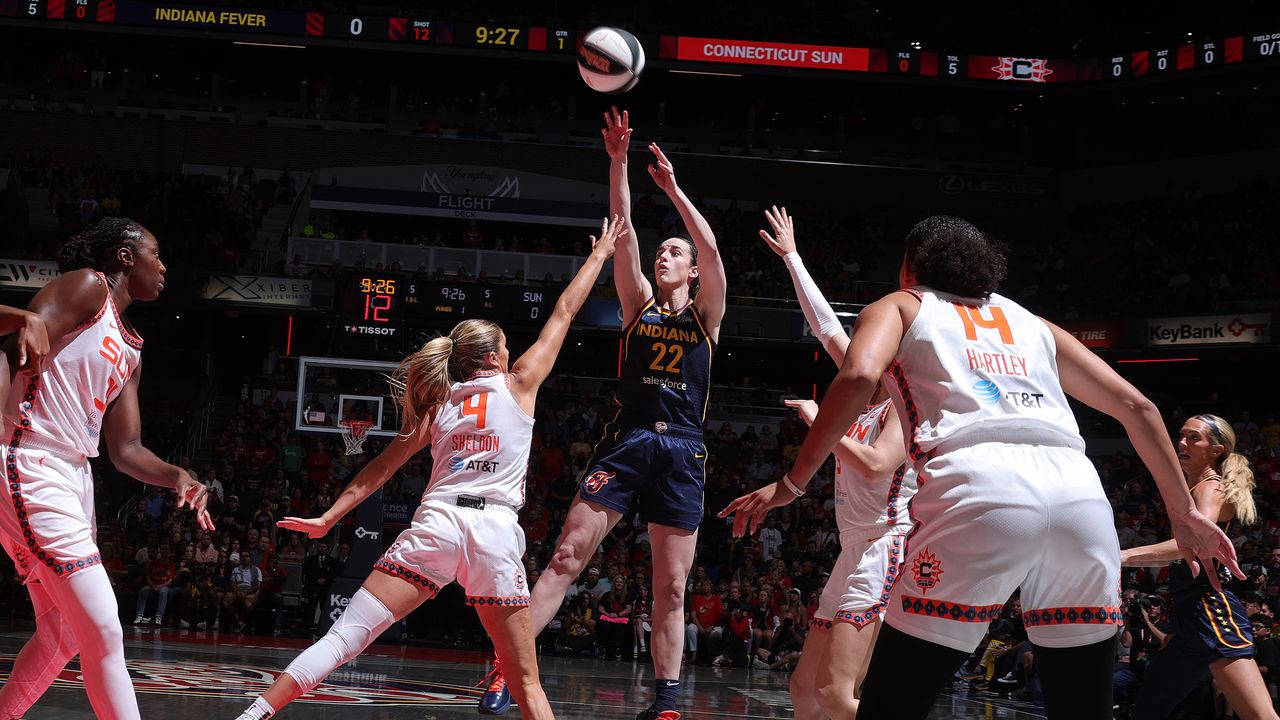
For longtime fans of the league, and, it seems, for more than a few people in and around it, the context of all that contact is important. The league is “very physical,” these tenured fans explain to the new ones (or “casuals”). Players, especially rookies, get this treatment all the time. And Clark is a very good player—a great one—but she’s not on the level of A’ja Wilson, or Breanna Stewart, or Napheesa Collier, at least not yet. Failing to recognize this context, these fans suggest, is a kind of erasure: it diminishes the history of a league that has long been full of great players, most of them Black and many of them queer.
Even some of Clark’s biggest supporters are careful to consider her as a key figure in the long progression of the sport, rather than as a sui-generis phenomenon. The sports journalist Howard Megdal, founder of the Next, an online outlet that focusses on women’s basketball, recently wrote a book about Clark that goes deep on the history of basketball in Iowa, where she’s from. In Megdal’s telling, Clark—with her charisma, her all-American backstory, her reasonable handling of such fraught circumstances, and yes, her race—is helping to supercharge a surge of interest in women’s basketball that was already well under way. And there’s plenty of evidence to back that view. W.N.B.A. ratings have been rising for years. The sport was succeeding and finding new audiences despite egregious underinvestment. Although Clark is clearly the league’s biggest draw, ratings have been breaking records even when she doesn’t play. The owners of the Golden State Warriors paid a fifty-million-dollar expansion fee to join the league in 2023 before Clark had joined the pros. Just a few years earlier, teams were selling for about a fifth of that. The Golden State Valkyries’ valuation now is projected to be nearly ten times that—in some part because of the attention Clark has brought to the sport, but not because she fills the stands at the Chase Center, in San Francisco, every night. The Valkyries are projected to bring in fifty-five million dollars in revenue from sponsorships and ticket sales this year alone, far more than Clark’s team, the Indiana Fever, raked in last year. They are succeeding because they are resourced and marketed like an actual professional sports team.
To others, any effort to downplay Clark’s individual appeal is preposterous. “As the most promising day in the history of the WNBA arrives, the American cultural spotlight shines brighter than it ever has on a female athlete in a team sport, and on the possibility she brings to lift basketball and all women’s sports to a place they have never been,” the USA Today columnist Christine Brennan wrote, ahead of Clark’s league début. “But the glare of that bright and sometimes harsh light hasn’t fixed on the magical Caitlin Clark alone. Over the past couple of weeks, it has focused on the players who have come before her, some of whom strangely appear to be having trouble accepting and dealing with her fame, even as they will benefit greatly from it.” Brennan, whose book about Clark, “On Her Game,” will be published in early July, believes that the W.N.B.A. is fumbling the ball by not more aggressively promoting Clark. After the scuffles between the Fever and the Sun on Tuesday, Brennan suggested that the W.N.B.A. needed to protect its most popular player. “This happened last night to the most important audience magnet and TV and corporate draw in the history of a business (WNBA) that is desperately trying to advance and succeed in a very crowded, male-dominated sports marketplace,” she wrote on X, quote-tweeting a video of the altercation captioned “This league treats her like a punching bag.”
Brennan has been writing about women’s sports for decades, and, like Megdal, she tries to place Clark’s ascendance in context. But her history highlights the success of Title IX and of the U.S. women’s soccer team, along with Iowa, and her argument is that Clark is a singular figure. In this view, Clark is a living revolution, a rupture in the history of women’s basketball and maybe in all of women’s sports. And there’s evidence to support this view, too. Twice as many people watched the W.N.B.A. draft last year, when Clark was drafted, compared with this year, for instance. Ratings and attendance when Clark plays are significantly higher than when she does not. (Her games averaged more than a million viewers last season; the league’s other games averaged less than half that.) No other player in the history of women’s basketball comes remotely close to her celebrity. It’s hard to think of an analogue who drives such a high percentage of interest in attention in any other team sport. “When will these ladies realize, accept, and appreciate @CaitlinClark22 is the best thing that ever happened to women’s basketball,” the tennis legend Chris Evert wrote on X, quoting one of Brennan’s tweets.