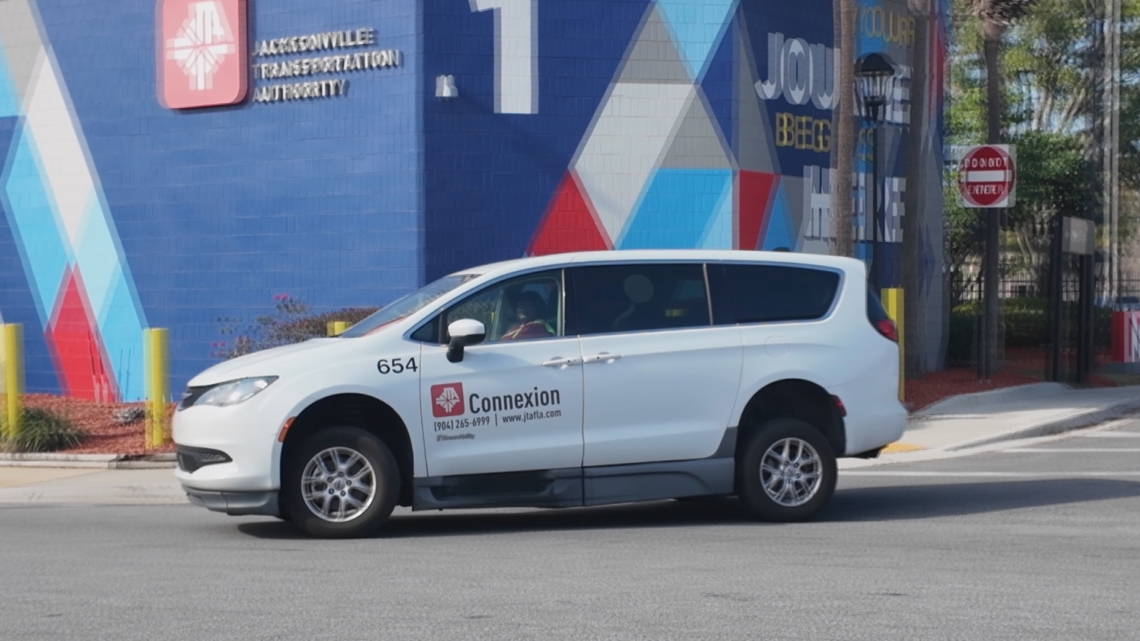
Jacksonville City Council member Jimmy Peluso urged the Jacksonville Transportation Authority to keep Connexion Plus fares unchanged.
JACKSONVILLE, Fla. — Jacksonville City Council member Jimmy Peluso is warning the Jacksonville Transportation Authority to keep fares steady for its Connexion Plus service or risk city council stepping in, potentially by withholding funding.
Connexion Plus provides door-to-door transportation for riders with disabilities and has been under scrutiny for weeks as costs continue to rise and fare changes are considered.
According to JTA, the cost of operating Connexion Plus increased from $2.8 million in 2022 to $6.3 million last year and when asked the reasoning for the proposed change, JTA said, “Connexion Plus currently costs on average $5 per mile to operate, with paratransit customers contributing $0.40 per mile. The JTA subsidizes the remaining $4.60. The JTA has never raised the Connexion Plus fare and this level of subsidy has placed growing strain on the program’s long-term sustainability.”
Costs are projected to reach $8 million this year.
As expenses climb, riders have been told fare increases could be on the table.
Peluso says rising costs tied to the broader economy should not be passed on to riders who rely on the service.
“Cost is rising because of how bad things are going in the larger economy, but okay, let’s take some of the gas tax money and make sure that we’re offsetting this cost,” Peluso said. “The council can do that. I have no problem looking at the gas tax again and rearranging how those dollars are spent.”
Under JTA’s proposed fare structure, Connexion Plus riders would pay $10 for the first eight miles and $3.50 per mile after that. Currently, riders pay $6 for the first 15 miles and $2 per mile thereafter.
After hearing from riders during public meetings, JTA announced it will keep Connexion Plus fares the same until April 1.
Peluso says that temporary delay is not enough.
“Here’s a system that has worked effectively for many years — people rely on it,” Peluso said. “For those in the disabled community, many on fixed incomes, this is their main form of travel. Why would we increase that fare?”
JTA has said that even under the proposed rate structure, the agency would still cover more than 75% of the cost of the average Connexion Plus ride.
Peluso argues JTA leadership should take a broader look at how transportation services are funded and what costs are reasonable for riders.
“Leadership at JTA needs to reassess how they intend to move people in this city and what is going to be acceptable to individuals in terms of the cost to operate these systems,” he said.
Peluso says he wants Connexion Plus fares to remain the same long term and not just through the spring.
“I’m going to give them another couple of weeks in the hopes that they’ll show us this isn’t just until April — that this is going to be long-term,” Peluso said.
When asked whether it plans to adjust Connexion Plus fares, JTA said, “The JTA Board of Directors voted this month to postpone any Connexion Plus fare adjustment until at least April. That decision was made so that JTA staff can take a closer look at the private ride service, customer rates, operational costs, ridership data, and the feedback we’ve received from our customers. During this time, we will continue our discussions with the paratransit community and talk to potential partners and stakeholders to figure out the best path forward.”