The Office of the Zoning Administrator reviews historical information for a property in order to prove a legally existing residential unit count. The information provided below details the step-by-step process the Zoning Administrator and staff use to make a determination.
1. Review historical building permits
- Any building permit being considered to determine a residential unit count would need to be examined and approved by the Office of the Zoning Administrator.
- The building permit must contain a zoning approval stamp and clearly note the number of existing residential units.
- Electrical, sign and express permits do not prove an existing residential unit count.
- Previously issued building permits can be searched for online using the Department of Buildings record search or the Chicago Data Portal.
- Once specific permitting information is found, you may submit a Freedom of Information Act request to obtain additional information from the Department of Buildings, such as copies of handwritten permit applications and previous permit drawings. Requests must specifically ask for handwritten permit applications or previously approved plans to receive copies of documents that show a zoning approval stamp.
If there are no building permits that can be used to prove an existing residential unit verification, see step 2.
2. Check Water Annual Examination Books
- The Chicago Zoning Map can be used to find the appropriate Water Annual Examination Book for a property. Multiple books may appear when selecting your property. Each book will need to be reviewed in order to determine which specific book and page contains the accurate property information. (See below for information on how to read the Water Annual Examination Book.)
- Multiple Water Annual Examination Books may contain information for a property. In those cases, the most recent book will be used.
- If there is a conflicting building permit that has been examined and approved by the Office of the Zoning Administrator and is more recent than the water record, the permit will supersede the Water Annual Examination Book.
If no Water Annual Examination Book exists or there is no information within the book to determine the existing residential unit amount, see step 3.
3. Seek determination from the Office of the Zoning Administrator
- A rebuild letter from the Zoning Administrator can provide a determination on the legal number of residential units.
- If no information can be found from steps 1 and 2, staff will review and consider additional information to come to a determination, such as previously issued certificate of zoning compliance forms, Sanborn Fire Insurance Maps, census data, utility records and photographs. Any of this information may be provided for review along with the request for a rebuild letter.
How to read a Water Annual Examination Book
A Water Annual Examination Book is a historical inspection record maintained by DPD’s Bureau of Zoning. It is sometimes used to help determine the legal residential unit count for a building. However, if other conflicting information exists, it may override the water record. Ultimately, the Office of the Zoning Administrator makes the final decision on the legal residential unit count.
- Use the Chicago Zoning Map to determine what water record books you need to search to find your property.
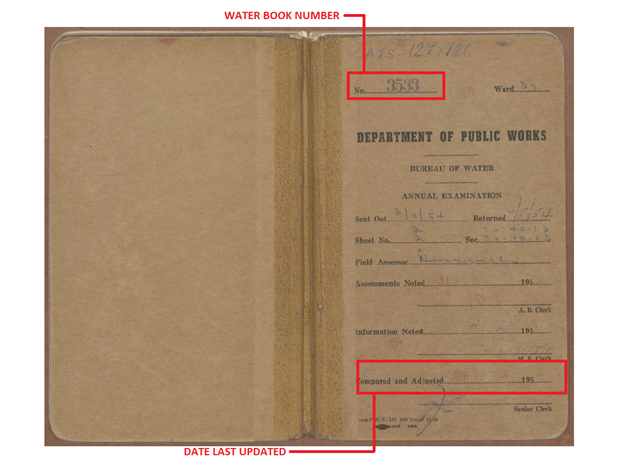
- Once you click on the Water Annual Examination Book number, the corresponding book will open in a new tab. The book cover should be shown with the book number and the date the book was last updated.
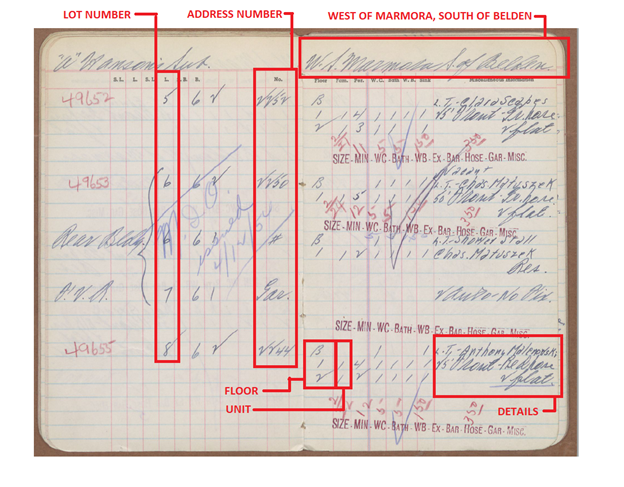
- To locate your property, use the notation typically found on the top right of each page, which details where the group of below addresses is located in relation to surrounding streets. A specific property can be found by using this information coupled with the address number and lot number.
- Searching through the Water Annual Examination Book, information is shown related to the lot number (L.), address (No.), floors (Floor), families (Fam.), person (Per.), water closet (W.C.), wash basins (W.B.), and sink (Sink). There are sometimes additional details written for specific properties.
- The number of families shown on a floor is typically an indicator of the amount of dwelling units per floor. Some properties with additional details have the number of dwelling units noted, sometimes referred to as apartments (Apts) or flats.
- Some information found within the Water Annual Examination Book cannot be interpreted or have its meaning determined.