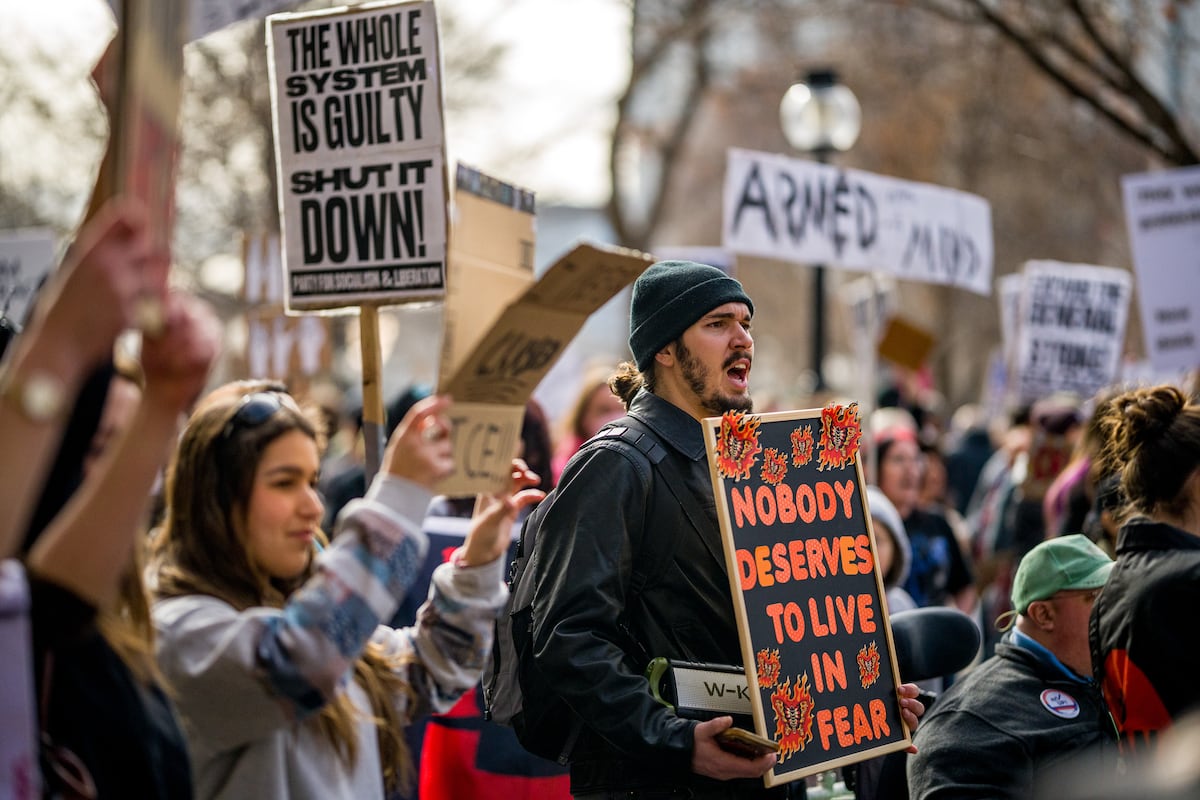
Standing on the steps of Salt Lake City Hall, Jakey Sala Siolo told a crowd of more than a thousand that he was tired. He was angry.
He has family in Minneapolis, he said, and his sister’s workplace is on the street where Renee Good was killed by federal immigration agents earlier this month.
“Hearing these stories directly from those on the ground has been devastating,” said Siolo, director of NuaNua Collective, a group that advocates for LGBTQ+ Pacific Islanders. “But I’m still paying attention.”
The justice the crowd seeks, he warned, will take work beyond Friday’s protests.
Utahns had gathered at City Hall before marching as part of a “National Shutdown,” organized to protest the Trump administration’s crackdown on immigration and the actions of U.S. Immigration and Customs Enforcement and U.S. Customs and Border Protection.
Their agents killed Silverio Villegas González in a Chicago suburb in September, Keith “Pooter” Porter Jr. in Los Angeles on New Year’s Eve, and Good and Alex Pretti less than a month apart in Minneapolis.
In cities across the state on Friday, from Ogden to St. George, business owners closed their doors and students walked out of classes in support of the national effort. More events were planned for Saturday across the state.
Protesters packed into Washington Square in Salt Lake City before the downtown march began, standing shoulder-to-shoulder and filling much of the park’s west side. They held signs and shouted chants including “Power to the people, no one is illegal,” and, “No justice, no peace, we want ICE off our streets.”
Passing motorists honked their horns. A banner hanging from City Hall read “SLC [loves] YOU” while signs in the windows proclaimed “This is your home.” Community members doled out hand warmers, freshly baked cookies, coffee, apple cider and water.
Standing on the sidewalk near State Street, Randi Hardy spoke from inside a pink blow-up axolotl costume and waved at passing cars. She said she’d seen — and heard — a lot of support from passersby.
(Trent Nelson | The Salt Lake Tribune) People attend an anti-ICE protest at City Hall in Salt Lake City on Friday, Jan. 30, 2026.
(Trent Nelson | The Salt Lake Tribune) People attend an anti-ICE protest at City Hall in Salt Lake City on Friday, Jan. 30, 2026.
”I think we need to stop killing people in the streets. The federal government needs to be held accountable to what they’re doing,” she said, “and the camaraderie in the community that we have here is amazing.”
It was a mild, sunny winter day, and condensation collected in the small window that showed Hardy’s face, but she said it was important for her to dress this way. The costume was for “visibility” and to show onlookers that protesters aren’t scary or “out of control,” she said. At least three others sporting pink axolotl costumes were spotted, as was a green frog wearing a crown and cape, carrying a sign.
Annie Omer, a nurse, held a sign at the Salt Lake City protest that read: “Nurses for Alex Pretti.” She said she has been “filled with sorrow and rage about everything that’s been happening.” As a nurse, Pretti’s killing “hit close to home.”
“I can’t take it anymore,” Omer said, “and I want us to stand up for what is right. We can overcome what is happening if enough of us get out and show our rage and support and anger in the streets.”
The Trump administration has said that its immigration policies make the country safer. The operations have “resulted in countless dangerous criminal illegals being removed from the streets — including rapists, murderers, burglars, drunk drivers,” White House spokesperson Abigail Jackson said in a statement earlier this week.
On the march
Sue Widdison joined Friday’s protest from Millcreek and mused that recent events have seemed relentless.
“A sign that I saw last year said, ‘Too much s— for one sign,’” she said. “And it really feels like that, because you get your sign made, you get up in the morning and it’s totally outdated. Something else has happened.”
On Friday, she held several signs. One, affixed to the back of her hat with paper clips, displayed a bullseye. It read, “Unpaid Target.”
(Trent Nelson | The Salt Lake Tribune) People attend an anti-ICE protest at City Hall in Salt Lake City on Friday, Jan. 30, 2026.
(Trent Nelson | The Salt Lake Tribune) People attend an anti-ICE protest at City Hall in Salt Lake City on Friday, Jan. 30, 2026.
Utah groups listed as supporters on the national organizing site included the Salt Lake Community Bail Fund, Peoples’ Freedom Party Utah, Organization of Utahn Young Adult Activists and the Utah Valley University Chapter of the American Federation of Teachers/American Association of University Professors.
Protester Autumn Blaustein-Olfen said “something has to be done.” She said she hopes politicians will see the crowds and “think, ‘Wow, OK, they want us to put a stop to what ICE is doing to immigrants.’” She hopes the number of protesters will inspire more people to action “because there’s enough people doing it now, that there’s no reason to hide.”
Blaustein-Olfen and other protesters in Utah’s capital began marching at about 3:15 p.m. toward the local field office of U.S. Citizenship and Immigration Services along 200 East, between 600 South and 700 South.
They stopped in front of the building for several minutes, filling the street and overflowing into the adjacent building’s courtyard, climbing trees and concrete ledges to get a better view. They chanted, while speakers continued to address the crowd from the middle of the road.
From there, demonstrators marched to 700 South before turning on State Street and heading back to Washington Square Park. Salt Lake City police officers followed the route, blocking traffic for the marchers, and reminding them at least once over a loudspeaker from a black van to stay on one side of the road.
The crowd began dispersing from Washington Square park shortly before 4:30 p.m. Some time later, four protesters were arrested for failure to disperse because they were blocking traffic nearby, a Salt Lake City police spokesperson said.
(Christopher Cherrington | The Salt Lake Tribune)
Striking out in St. George
In St. George, around 40 people gathered downtown on the corner of Main Street and St. George Boulevard to protest. Drivers honked their horns as they passed, and the occasional driver yelled “go back to California” out their window.
Attendees ranged from local retirees to tourists taking time out of their vacation to protest. They held signs that said, “ICE out” and “The wrong ice is melting” while wearing shorts and T-shirts on a warm southwest Utah day.
Marie Straka was visiting from Minnesota, a state that has been a focal point of the Trump administration’s immigration crackdown. “I was involved in protesting at home in Minnesota,” she said. “It’s a lot easier here.”
She showed up to protest during her vacation because she wants immigrants to be protected, she added.
(Brooke Larsen | The Salt Lake Tribune) A woman holds a sign during a protest against ICE and federal immigration policies in downtown St. George on Friday, Jan. 30, 2026.
Peter Dowdle, a student at Southern Utah University, drove down to St. George for the protest from Cedar City.
“Letting people in communities like this know that they’re not alone in their dislike of what the government is doing right now, I think that is the best support I can do from some random rural town in Utah,” he said.
‘Love thy neighbor’
Before the Salt Lake City march began, drag performer Divina 2.0 had stood on the steps of City Hall steps in four-inch heels, a zebra-print dress and a voluminous blonde wig. She urged the community to come together in all of its diversity.
“At the end of the day, we all want and need the same things: we are human, we are all connected, we are love, and we are strong,” Divina said. ”I’m gonna take it back to my Mormon missionary roots, but I want to give you three simple words: love thy neighbor.”
Siolo reminded protesters that 2026 is an election year, and urged voters to elect candidates who will “stand ten toes down on abolishing ICE.”
But he told the crowd that power is not built through the electoral system. It’s built, he said, on the streets, by the people. “There is power,” Siolo said, “in us being here together.”
He also urged listeners to “not let your fight stop here today. Today is not about making cute, witty f—-ing posters and signs. It’s not an excuse to call out of work,” he said.
“Today is a vow, a statement, a dedication — or a covenant, for the Mormons in the crowd — to dedicate our lives to building people power.”