Published on February 1, 2026
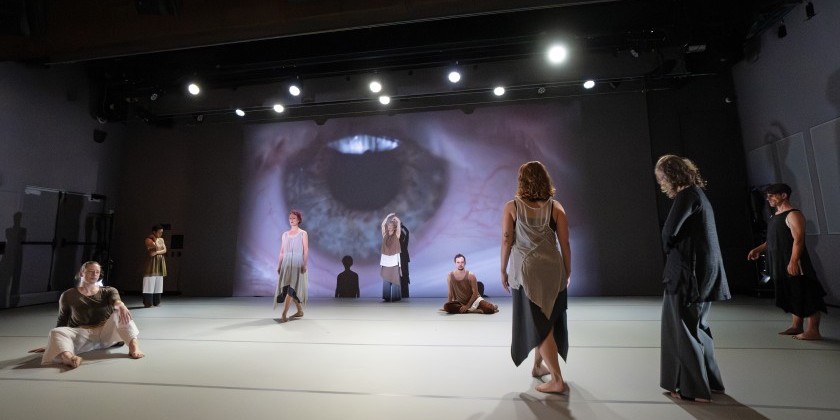
Heidi Latsky Dance in “Days of Awe”. Photo: Richard Termine
Danspace Project co-presented with Live Artery, New York Live Arts
Ishmael Houston-Jones’
OO-GA-La Reimagined (The Fred Holland (1951-2016) and Ishmael Houston-Jones 1983 Untitled Duet Danced into the 21st Century)
Improvised in Performance by Stephanie Hewett, Kris Lee, and AJ Wilmore
Costume Consultant Malcolm-x Betts
Archival Video Taped by Cathy Weis and Lisa Nelson
Archival Sound Score by Mark Larson
January 8-10, 2026
92NY Mainstage Series presents Women Move the World
Heidi Latsky Dance, Who Am I Now?
Tracking Parallel:
Rupture
Choreography: Heidi Latsky
Soundscore: Heidi Latsky with Nathan Trice’s voice
Dancer: Nathan Trice
Days of Awe
Choreography: Heidi Latsky in collaboration with the dancers including Santi Braz
Soundscore: Heidi Latsky with MRI sounds, Latsky’s brothers reciting the Mourner’s Kaddish, and original music by Ximena Borges, Ainesh Madan, Christopher Brierley, Marty Beller, and Randall Woolf
Film: Heidi Latsky with footage courtesy of the College of the Arts at Montclair State University.
Additional footage: Richard Ducker and Alison Rootberg
Lighting Design: Robert Wierzel
Projection Consultant: Janet Wong
Costumes: Heidi Latsky
January 10-11, 2026
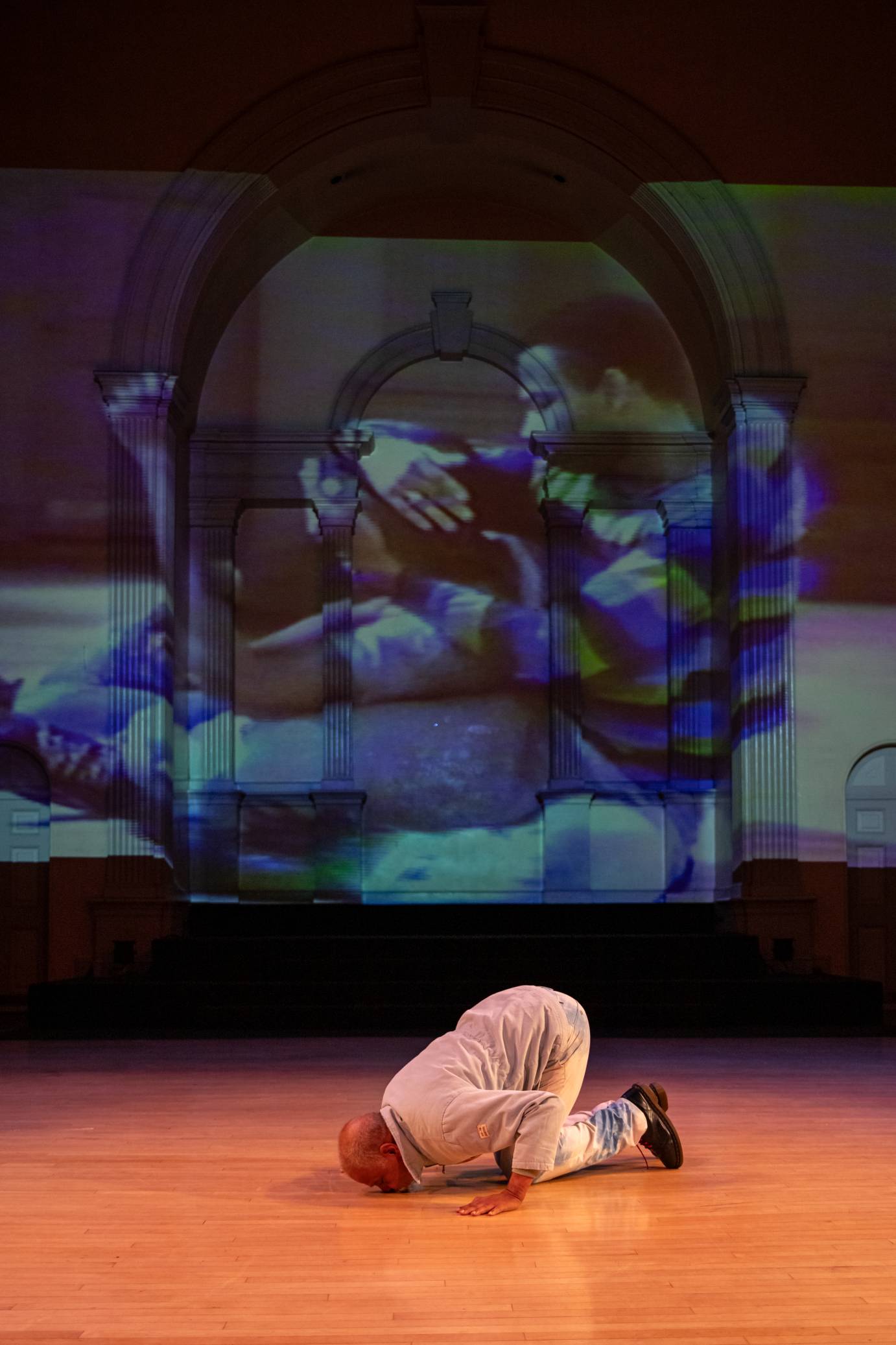
Ishmael Houston-Jones (foreground) in front of the screened image of Fred Holland and Houston-Jones in OO-GA-LA Reimagined. Photo: Rachel Keane
Ishmael Houston-Jones and Heidi Latsky have both devoted their careers to bodies that the dance field has not always known how to see without inherited assumptions: Black and brown bodies, aging bodies, bodies marked by illness or disability. Both reject virtuosity as the primary measure of value, and both center lived experience. Yet the presented works approach this shared ethos in strikingly different ways. Where Latsky’s Who Am I Now? at 92NY addresses physical crisis through recovery, reflection, and personal reckoning, Houston-Jones’s OO-GA-LA Reimagined at Danspace Project emerges from lineage, ghosts, and social friction, embedding its politics inside the choreography itself.
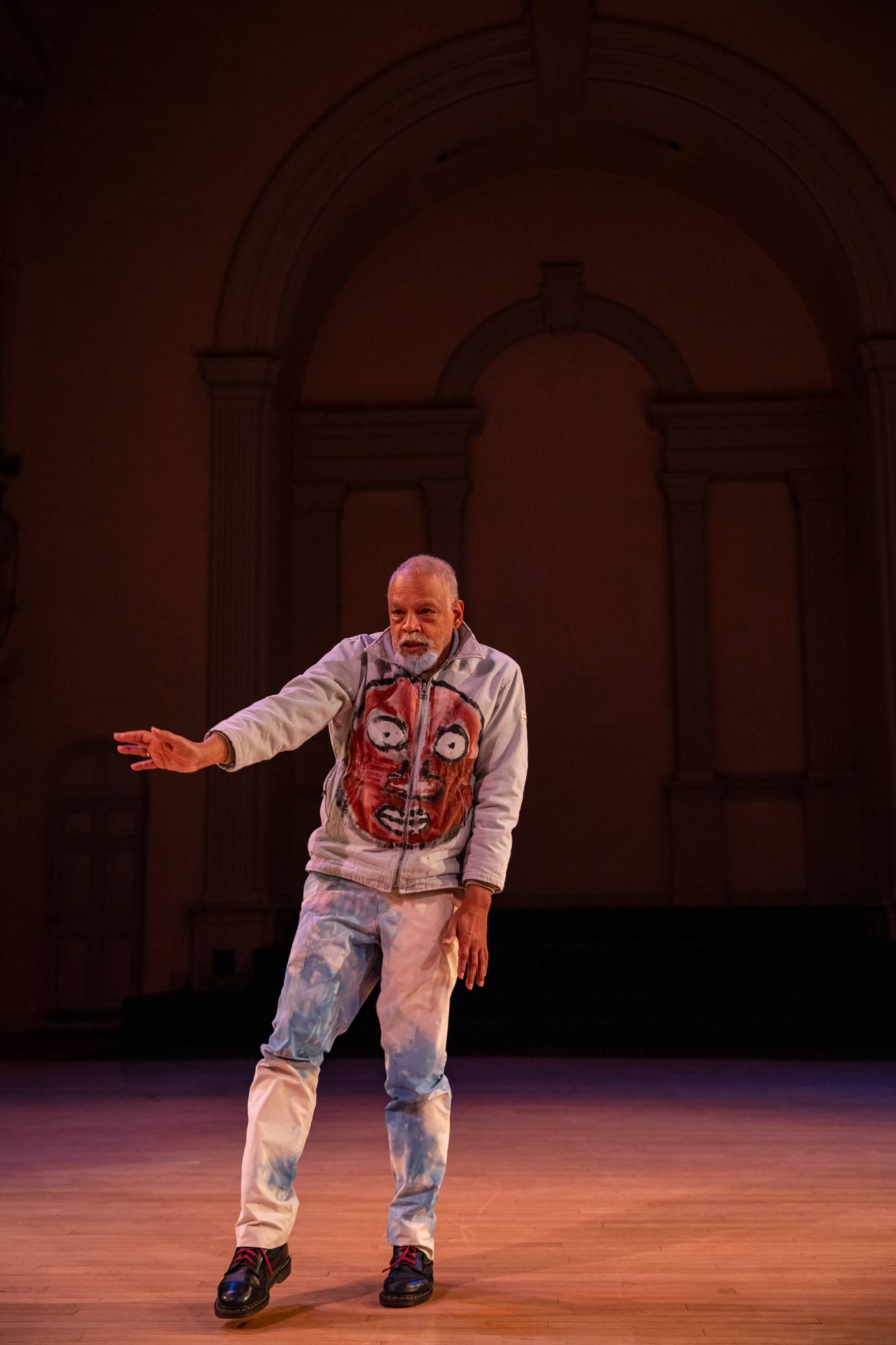
Ishmael Houston-Jones in OO-GA-LA Reimagined. Photo: Rachel Keane
As the audience finds their seats, a clip of the original Fred Holland and Ishmael Houston-Jones duet from 1983 is screened onto the altar wall of St. Mark’s Church-in-the-Bowery, the figures rendered faint and ghostly as if already receding into memory. Addressing the audience from center stage, Houston-Jones speaks of “dancing with ghosts,” noting that the building was likely constructed by enslaved laborers and that Peter Stuyvesant, a slaveholder, is buried beneath the floor. “You can’t always choose which ghosts you dance with,” he says, before naming artist friends who shaped his world and are now gone: Holland, Blondell Cummings, Gus Solomons Jr., and John Bernd. This dance engages with racialized labor, AIDS-era and wider losses within the community, and artistic inheritance.
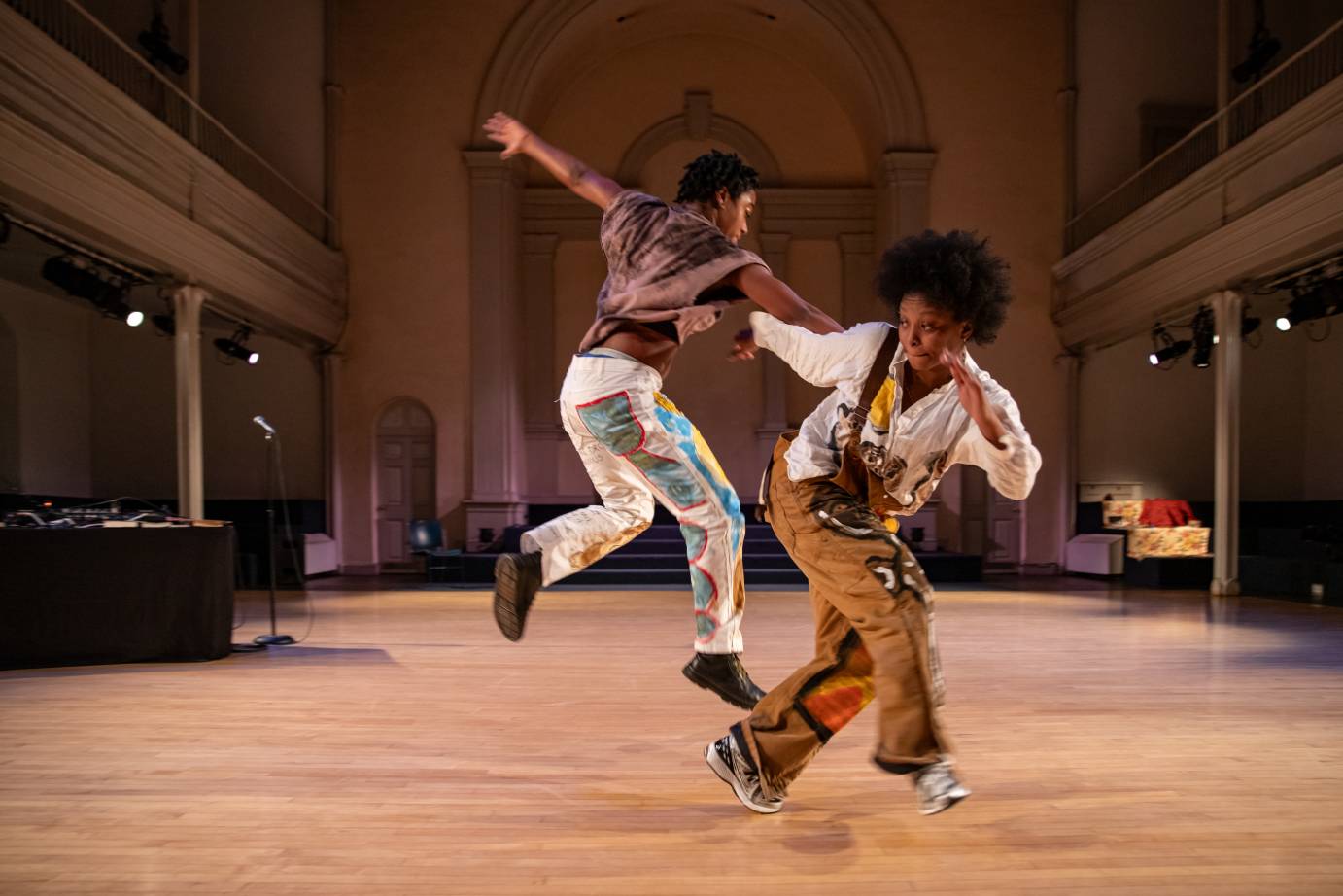
Kris Lee and AJ Wilmore in Ishmael Houston-Jones’ OO-GA-LA Reimagined. Photo: Rachel Keane
A makeshift kitchen occupies an upper corner of the stage. Before the dancing begins, Houston-Jones and a trio of young, queer, Black women performers (Stephanie Hewett, Kris Lee and AJ Wilmore) embrace, establishing the revival as transmission rather than reconstruction. When Houston-Jones, a long-respected elder, pounds the floor before exiting through the center aisle of the audience, the gesture feels weighted with mourning and defiance, even as it introduces a new generation.
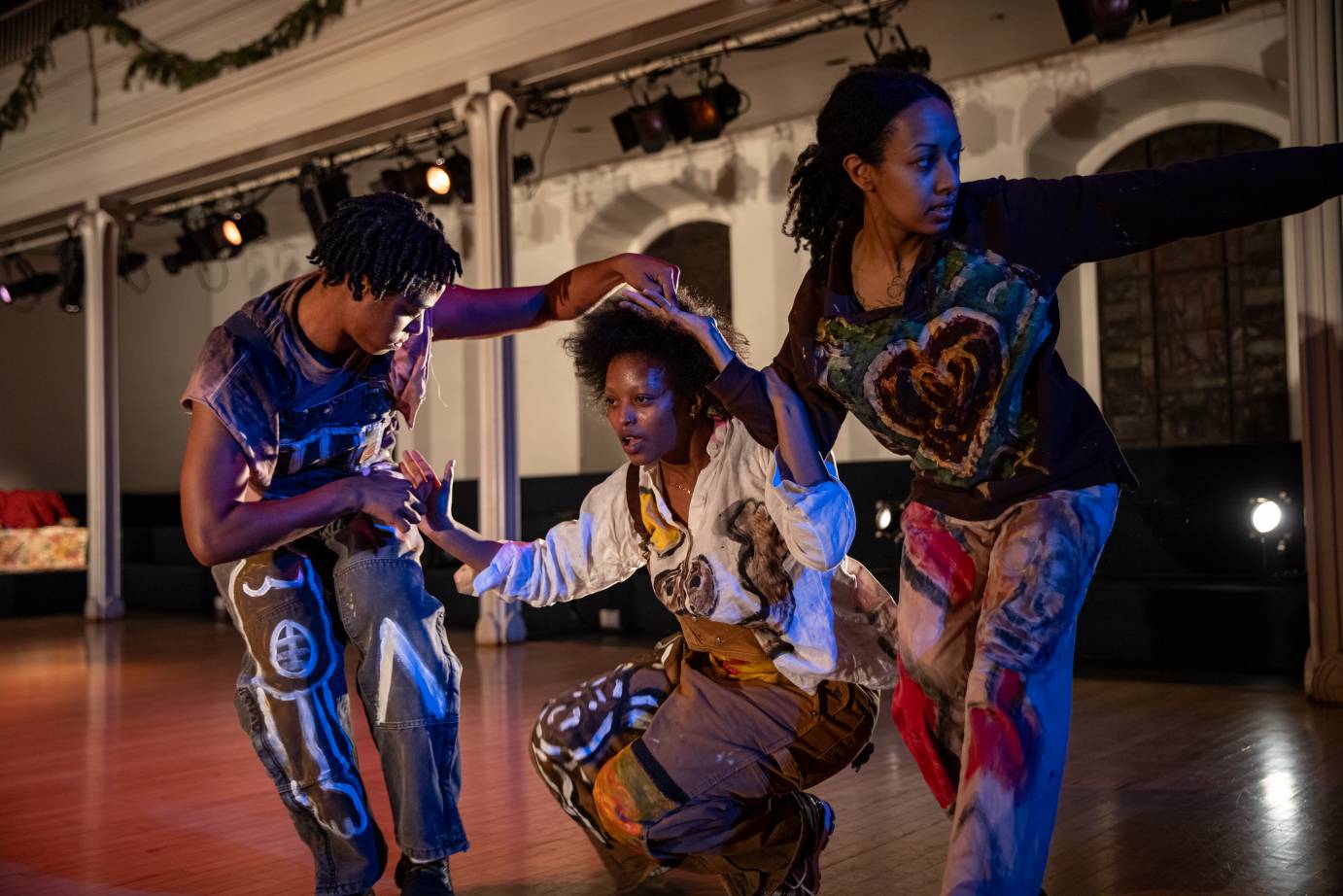
(L to R) Kris Lee, AJ Wilmore and Stephanie Hewett in Ishmael Houston-Jones’ OO-GA-LA Reimagined. Photo: Rachel Keane
One performer assumes the role of DJ while the other two perform duets or parallel solos, then shift into trios as club culture and domesticity merge into the improvisation. Holland’s riveting passages of turns, falls, leaps, and sudden suspensions, including a 45-second sequence Houston-Jones later singled out as one of his favorite moments in dance, place the trio in constant dialogue with a physical intensity that belongs to the work’s historical moment.
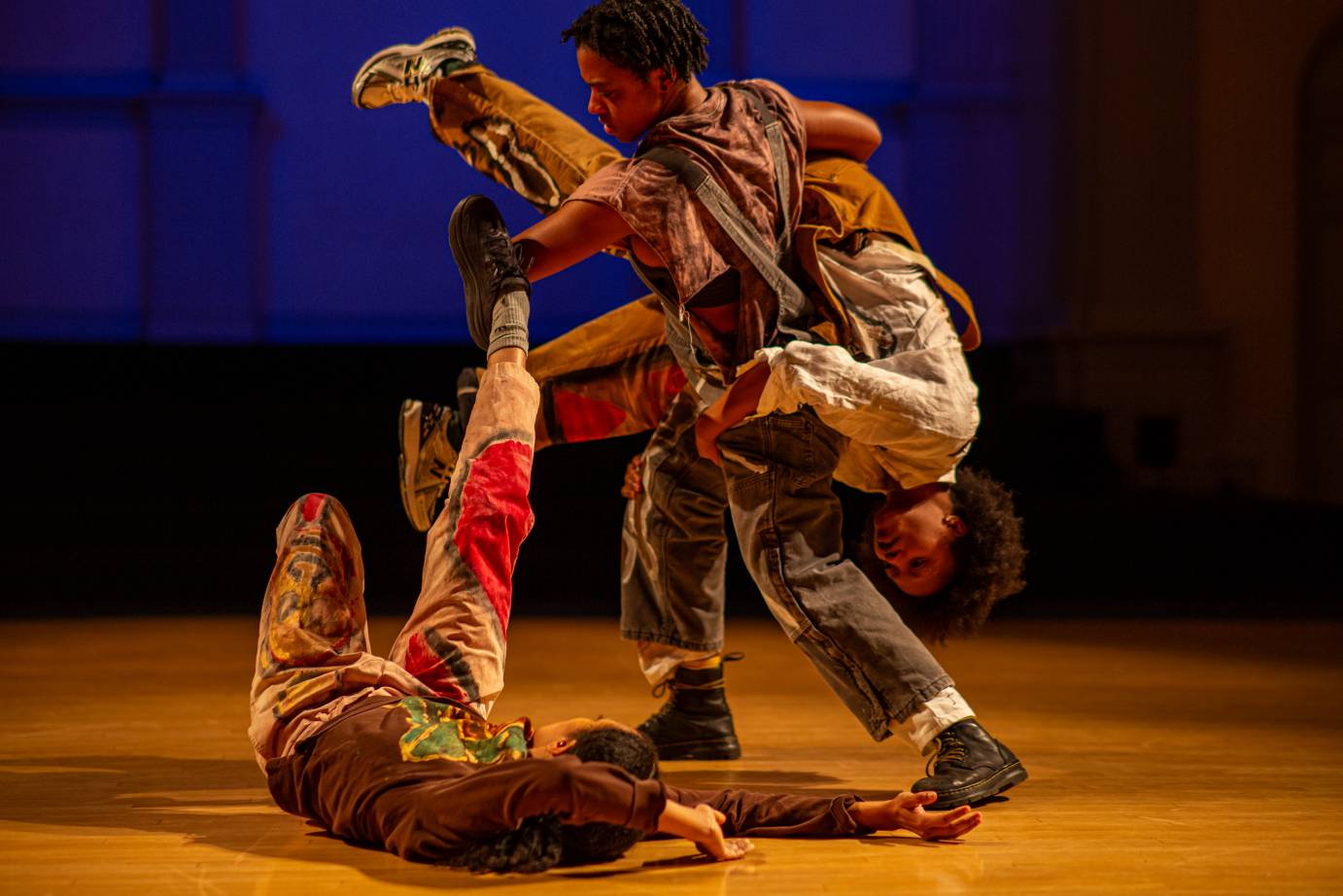
(L to R) Stephanie Hewett, Kris Lee and AJ Wilmore in Ishmael Houston-Jones’ OO-GA-LA Reimagined. Photo: Rachel Keane
The original Holland and Houston-Jones manifesto states, “We will stay out of physical contact as much as possible,” a line that reads less as literal instruction than as a stance toward a hostile social world. This trio is electrifying, fully offering themselves to the room and inhabiting the tension between proximity and restraint. Humor, flirtation, confrontation, and care coexist: cooking is mimed in gestures recalling Cummings’s Chicken Soup and sex is simulated. A poem from 1965 is read aloud about the “survival of roaches,” a metaphor for endurance in hostile environments. These moments refuse politeness in a space that remains, despite its progressive history, largely white. The work looks outward, insisting on visibility, pleasure, and insistent vitality.
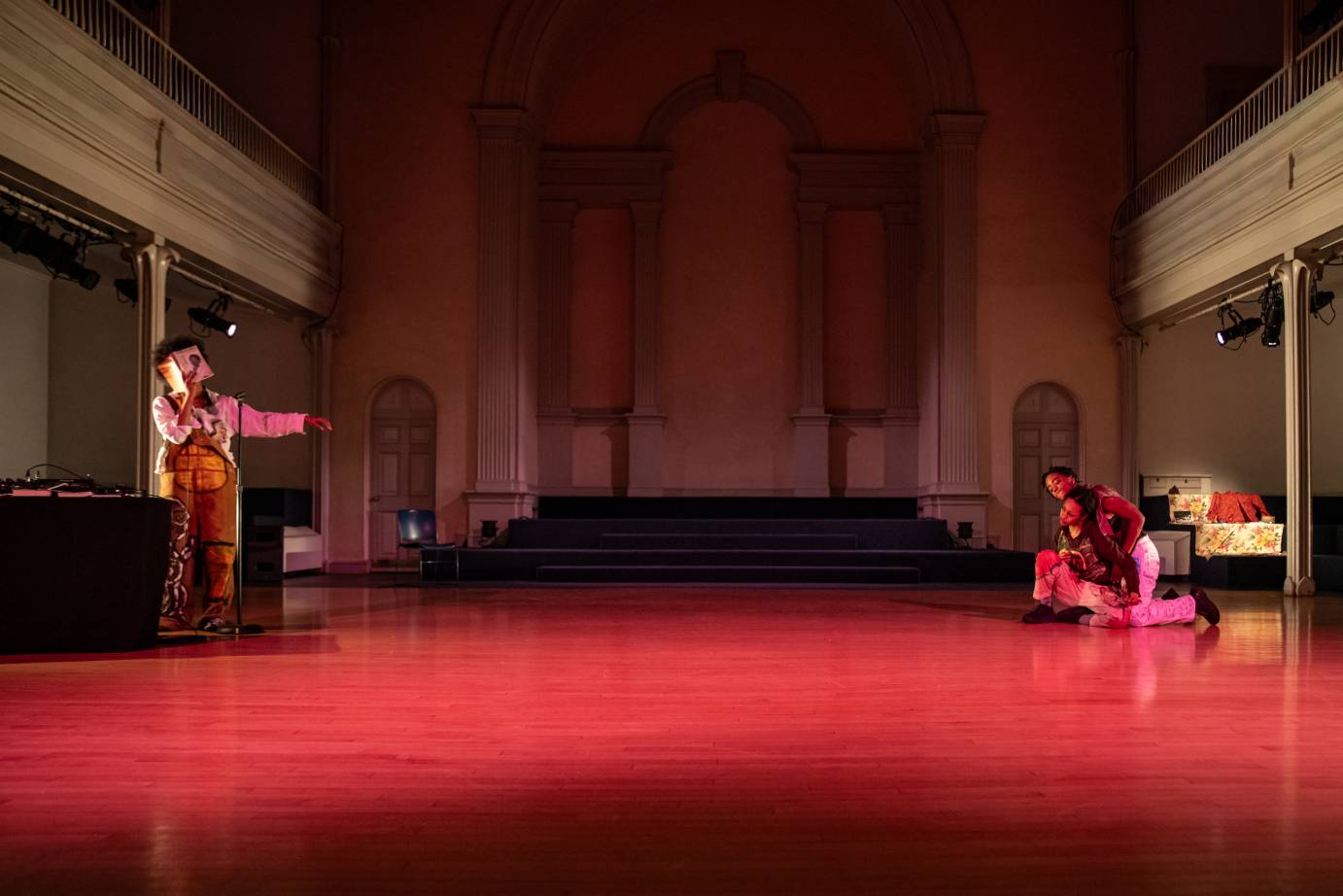
(L to R) AJ Wilmore, Stephanie Hewett and Kris Lee in Ishmael Houston-Jones’ OO-GA-LA Reimagined. Photo: Rachel Keane
Even the titles suggest different ways of speaking to the audience. OO-GA-LA, rendered in all caps, reads as a percussive, declarative, and collective chant. Who Am I Now? is grammatically precise and inward-looking, shaped as a question and rooted in first-person reflection.

Jillian Hollis (center foreground) and Heidi Latsky Dance in Days of Awe. Photo: Richard Termine
Heidi Latsky’s Who Am I Now? (the evening’s title) begins in the rehearsal studio, where the audience sits along the four walls while the unsentimental Nathan Trice traces the perimeter of the spare and clinical-feeling room in Rupture. Dressed simply, he dances to the steady hum from an MRI machine layered beneath his recorded voice recounting the logistics of brain surgery. The calm delivery contrasts starkly with the severity of the words (“They’re going to cut into my head and scrape the tumor off my brain”). The sharp, linear, and insistently repetitive movement suggests recovery through the discipline of this fine performer.
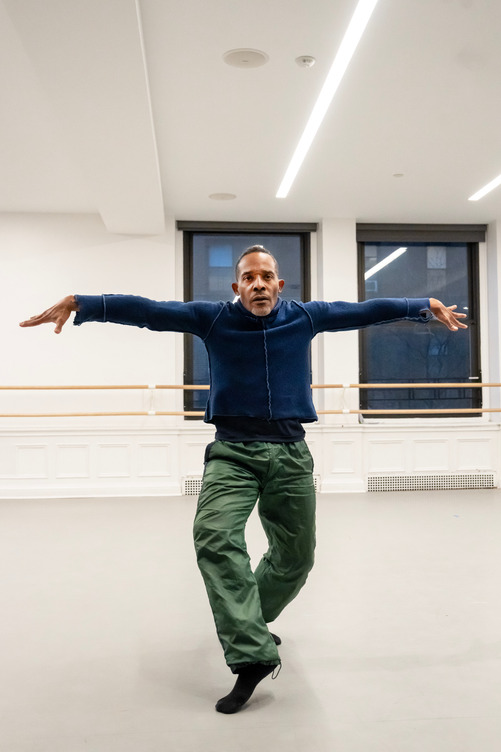
Nathan Trice in Heidi Latsky’s Rupture. Photo: Richard Termine
When the audience enters the main theater, Days of Awe (the second dance in the three-part Tracking Parallel work; the third not as yet created) expands into an eight-performer dance. Days of Awe, named for the period between Rosh Hashanah and Yom Kippur, carries the weight of reflection and mourning into the choreography.
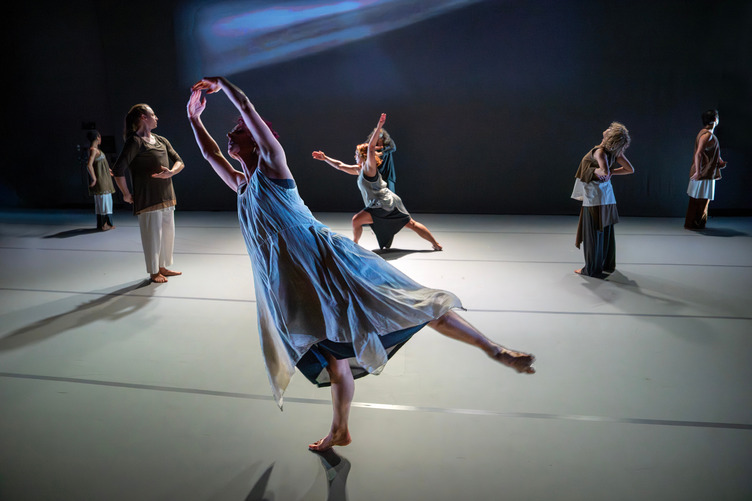
Meredith Fages (foreground) and Heidi Latsky Dance in Days of Awe. Photo: Richard Termine
Two dancers, Meredith Fages and Jillian Hollis, smoothly travel in unison in and out of the group with quiet authority. They never touch. Others remain largely in place, registering change through subtle shifts, repeated folds and arches (including Latsky, also a brain tumor survivor), as well as barely perceptible gestures. When touch finally occurs late in the dance, Henry Hollis and Nico Gonzales press their backs against each other and slip downward. They roll together, hold one another, and earn each other’s trust.
Dim lighting, muted costumes, and a soundscape that shifts between the industrial pulse of the MRI, the recitation of the Mourner’s Kaddish and a melodic, (somewhat saccharine) piano score reinforce a tone of inwardness and restraint. A giant eye, as if always watching and taking stock, is projected on the upstage screen. The duet’s continuous backward walking suggests time moving forward regardless of what the body is enduring.
The evening concluded with an extended conversation between Latsky and the audience, underscoring her commitment to shared reflection alongside performance.
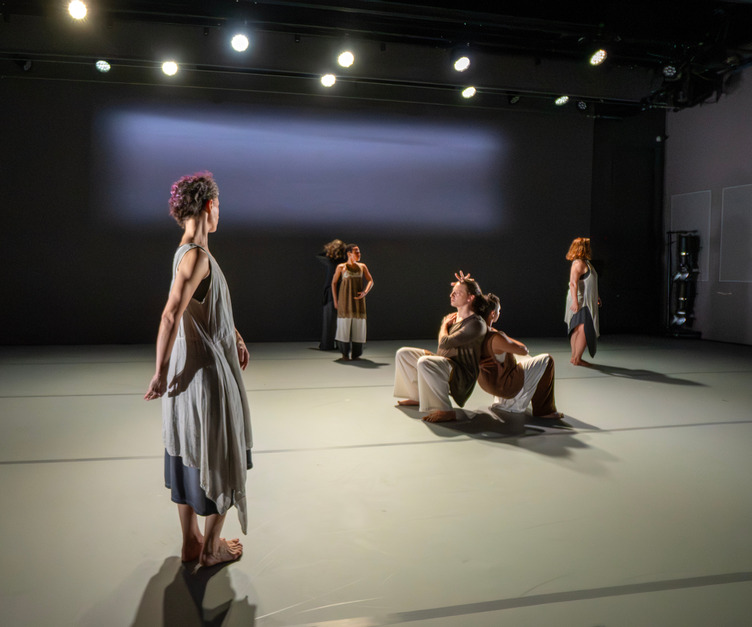
Henry Hollis and Nico Gonzales (center duet) and Heidi Latsky Dance in Days of Awe. Photo: Richard Termine
Seen together, OO-GA-LA Reimagined and Who Am I Now? suggest that choreography can shape not only how bodies move, but the ways in which the audience witnesses. In both cases, the choreography extends beyond physical phrasing to include how bodies, histories, and spectators are brought into relationship.
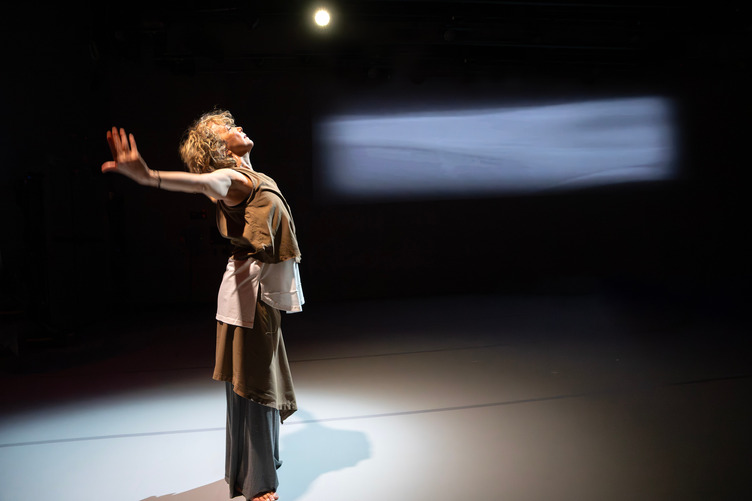
Heidi Latsky in Days of Awe. Photo: Richard Termine
The Dance Enthusiast Shares IMPRESSIONS/our brand of review, and creates conversation.
For more IMPRESSIONS, click here.
Share your #AudienceReview of performances. Write one today!
The Dance Enthusiast – News, Reviews, Interviews and an Open Invitation for YOU to join the Dance Conversation.