How thought becomes code
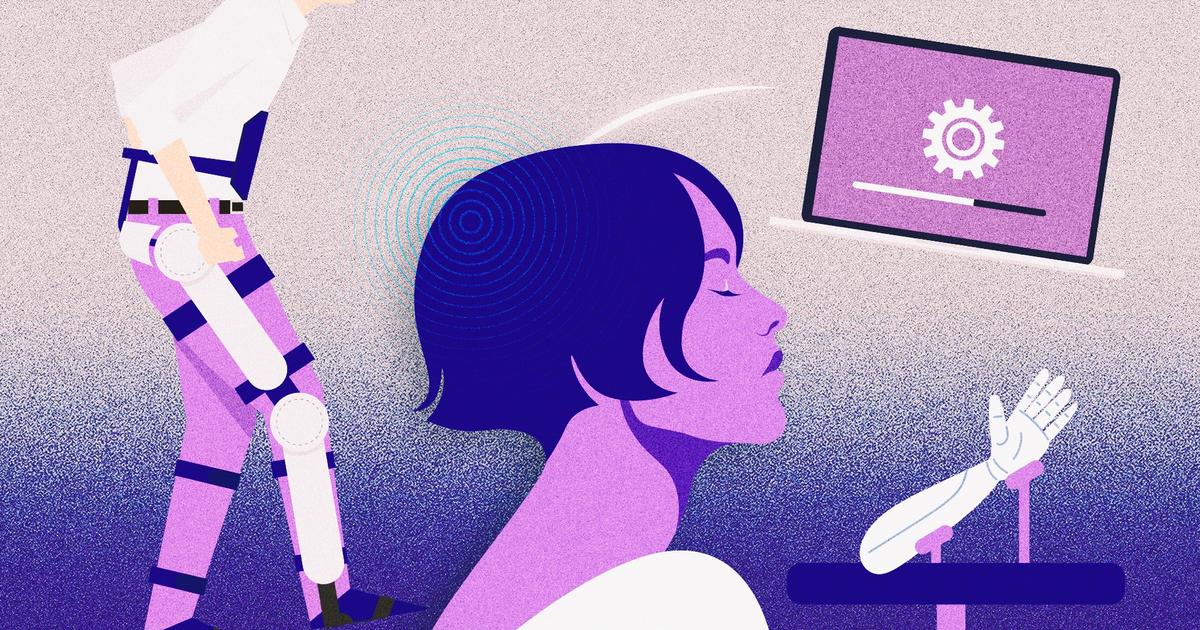
A tiny group of people now guide a computer with nothing but intention. The pathway starts with ultrafine electrodes listening to neurons inside motor cortex. Those signals look like noisy spikes, but machine learning models decode patterns into letters, clicks, or motions. The output drives a cursor, a wheelchair, or even a prosthesis.
Decoders are trained on minutes to hours of data, matching neural activity to attempted actions. Over time, the system becomes more personalized, and the user more fluent. The brain adapts too, strengthening useful circuits and suppressing distracting noise. What feels like “thinking” gradually becomes a new skill, practiced like a silent language.
The early adopters
Most participants live with severe paralysis, locked out of everyday interaction. Some had spinal cord injuries; others faced stroke or ALS. For them, typing with the mind restores agency and social connection. A message to family or a joke among friends becomes possible again, and that is profoundly human.
One user described the first successful click as “a door opening after years of quiet.” Another likened learned control to mastering a new instrument, where practice builds speed and confidence. Each trial adds a small layer of ease, until intent feels almost natural again.
AI, electrodes, and the invisible loop
Modern systems pair high‑channel arrays with deep‑learning decoders. The more stable the neural recordings, the better the control accuracy. Some implants sit on the brain’s surface, while others penetrate a few millimeters. Wireless links reduce cables, enabling movement outside the lab.
Critically, there is a closed feedback loop. The user sees results, the brain adjusts strategy, and the decoder updates its weights. This reciprocal tuning yields faster typing or smoother navigation. As engineers like to say, “it’s not mind reading, it’s signal translation.”
“People worry we’re peering into private thoughts,” one researcher said. “In reality, we decode a very specific motor‑control intention, not inner monologues.”
From lab trials to daily life
Translation into daily use demands durability, safety, and simplicity. Implants must resist corrosion and immune responses over years, not weeks. Software must recover from glitches and protect against intrusions. Care teams need clear protocols for updates, cleaning, and support.
The most compelling progress blends brain signals with other assistive tech. Eye tracking speeds typing, while word prediction boosts throughput. Voice synthesis gives decoded text immediate presence. Together, they create a fluid human‑computer dialogue, where intent meets elegant design.
Risks, limits, and ethics
Every implant carries surgical risk, even with expert teams. Infection, scarring, or signal drift can erode performance or require revision. Privacy demands strong governance, from on‑device encryption to clear consent. And because models learn from neural data, auditability and bias matters.
Key concerns shaping the field:
- Transparent data policies and user ownership
- Robust cybersecurity and fail‑safe modes
- Equitable access and reimbursement pathways
- Long‑term maintenance and device retirement
- Inclusive design and user agency
Regulators increasingly ask for post‑market studies and reliability metrics. That scrutiny helps ensure that rare breakthroughs become trustworthy products. The goal is not wizardry, but safe, stable function in ordinary, unpredictable life.
What comes next
Several trends point toward broader use and better experience. Noninvasive systems using EEG or neuro‑ultrasound promise lower risk, though with less bandwidth today. Improved electrode materials may reduce inflammation and extend signal lifespan. Hybrid decoders that fuse brain and eye or muscle signals could raise speed without extra burden.
Near‑term focus areas include home‑ready interfaces and streamlined training. Imagine unboxing a head‑worn device, completing a brief calibration, and typing a paragraph within minutes. For implanted users, smarter autocalibration and battery‑sipping chips will cut setup time and expand daily range.
Societally, the conversation must remain grounded and humane. These tools are for restoring capabilities, not replacing human worth. The club of neural‑interface users may stay small, but its lessons are widely relevant. When we re‑enable communication and mobility, we preserve identity and dignity.
In the end, the marvel is not silicon or software, impressive as they are. It is the brain’s capacity to reroute signals and relearn control after catastrophe. Guided by careful ethics and clear evidence, that capacity can reconnect people to work, to community, and to joy. For a few hundred today—and many more tomorrow—thinking is once again a meaningful action.