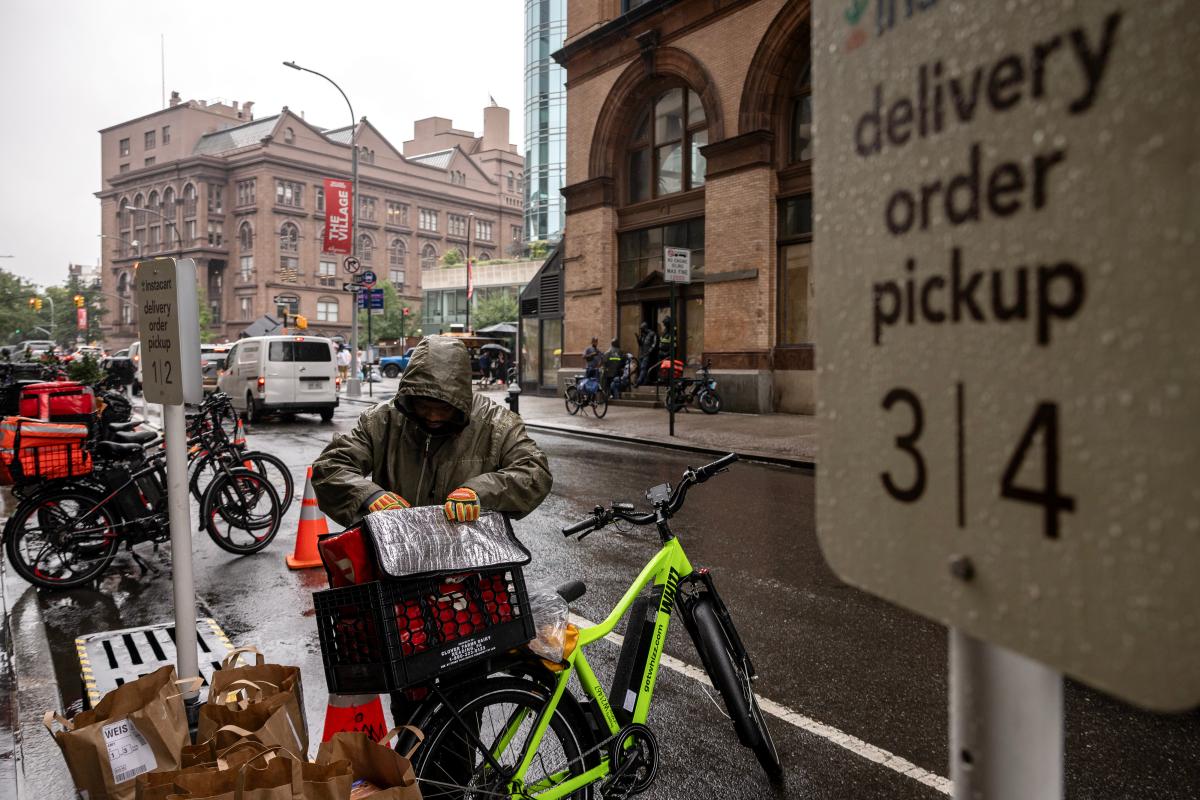
When New York City’s new minimum-wage rules for grocery delivery workers kicked in last week, they immediately hit us at the checkout.
The evidence pops up as soon as you open your Instacart app.
Click to pay for your grocery order and there it is: a fresh $5.99 line item labeled “Regulatory Response Fee.”
Just below, the tip box isn’t blank like it used to be — the app now pre-loads a 10% tip on your order.
Surprise!
That “Regulatory Response” surcharge isn’t some random cash grab.
It’s how Instacart is spelling out exactly what the City Council just did with a new law setting a $21.44 hourly wage for app-based grocery delivery workers — who, as independent contractors, previously worked mainly for tips and earned as little as $5.39 an hour in wages.
That might sound like good news for the 80,000 deliveristas who help keep Gotham fed.
But delivery companies warned for months that if City Hall made them pay workers more, they’d have to make us pay more.
A higher minimum-wage floor would mean higher prices and more fees, they said — reducing orders and accelerating automation.
Instacart isn’t the first company to respond to a City Council wage initiative with a Gotham-only surcharge: DoorDash and Uber Eats have quietly done the same, tied to a 2023 pay law for restaurant-delivery workers.
Worse yet, the rising wage floor is now on autopilot.
Under the law, it will start ratcheting up every January based on the three-year average of Northeast inflation — and it’s already set to jump from $21.44 to $22.13 on April 1.
That means the “regulatory fee” for consumers is just at its starting point.
And while you can legislate a higher wage, you can’t legislate away the cost — it just finds a new home, often in the customer’s wallet.
The result might be some real wins for labor.
Make no mistake, though, the money is coming out of New Yorkers’ pockets one way or another.
Now imagine how your costs will rise if Albany jacks up wages even higher.
Last week state Sen. Julia Salazar kicked off her campaign for a $30-an-hour statewide minimum wage, indexed to the cost of living, as part of a “Living Wage for All” package.
It’s an understandable sentiment: Who can live in New York on today’s minimum wage?
Salazar’s plan would effectively double the current base — now $17 in NYC, $16 upstate.
Get opinions and commentary from our columnists
Subscribe to our daily Post Opinion newsletter!
Thanks for signing up!
She’s not wrong that affordability is a problem, but the $6 fee staring me in the face on my latest grocery order teaches a more nuanced lesson about the solutions.
“So what if prices go up a bit?” proponents of $30 by 2030 essentially argue. “At least workers won’t live in poverty, and that benefits us all.”
Yes, we want workers to earn more.
But in practice, top-down wage edicts often have negative effects for the broader economy — from painful consumer price increases to job losses for minimum-wage workers themselves.
There are better ways to get workers a living wage, and to make life more affordable for all New Yorkers, delivery workers included.
Start with a larger, more frequent earned-income tax credit, perhaps one that’s paid out monthly rather than yearly in one lump sum.
Combine it with payroll-tax relief for low-wage workers, and we’ll boost paychecks without pricing people out of jobs.
Pair those measures with the real affordability fix: Build more housing and cut the red tape, like counterproductive rent controls, that keeps rents sky-high.
Boost apprenticeships and reform licensing so workers can move into higher-paying trades faster.
And smooth out the “benefit cliffs” — sharp income cut-offs that abruptly end assistance programs like Fair Fares and child-care subsidies — to stop punishing people for earning a little more.
That’s how you help workers keep more money — without turning every bodega, diner and day care into the next “regulatory response fee” machine.
New Yorkers want workers to be paid decently — that’s not the debate.
But Albany and the City Council’s answer is always the bluntest tool in the box.
Instacart’s response shows what happens when government raises pay by fiat: companies slap on surcharges, customers skimp on tips, demand flattens, and eventually jobs decline.
If lawmakers want to see bigger paychecks, they should find ways to help workers keep more of what they make — not make every checkout line a political battleground.
Santiago Vidal Calvo is a Cities policy analyst at the Manhattan Institute.