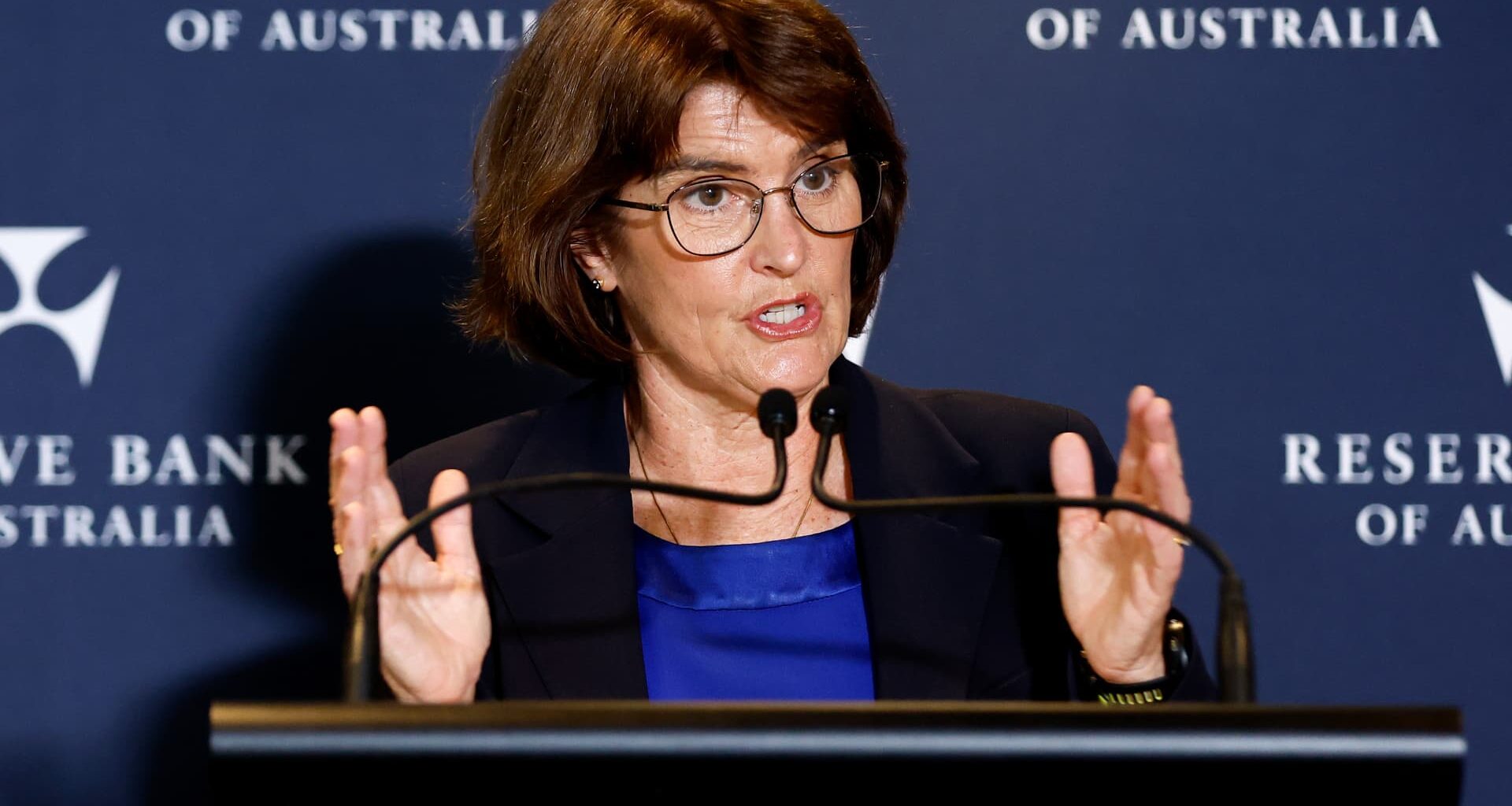
Michele Bullock, governor of the Reserve Bank of Australia (RBA), speaks during a news conference at the bank’s head office in Sydney, Australia, on Tuesday, Apr. 1, 2025.
Bloomberg | Bloomberg | Getty Images
Australia’s central bank raised its policy rate by 25 basis points to 3.85% on Tuesday, marking the Reserve Bank of Australia’s first rate hike since November 2023 as inflation continues to climb.
The Reserve Bank of Australia’s move matched expectations from economists polled by Reuters and followed data showing inflation at its highest level in six quarters.
The board voted unanimously to lift the cash rate, marking a reversal in direction after delivering three rate cuts in 2025.
“Private demand is growing more quickly than expected, capacity pressures are greater than previously assessed and labour market conditions are a little tight,” according to the central bank’s statement, noting that inflationary pressure picked up “materially” in the second half of last year.
“Inflation is now expected to stay above the target band well into next year before gradually coming back down,” said Sunny Nguyen, head of Australia economics at Moody’s Analytics.
Resilience in the global economy despite higher U.S. tariffs, along with export momentum from East Asian economies fueled by the artificial intelligence boom, has created a “double-edged sword” for the RBA, Nguyen said.
The forces have reduced the drag on domestic growth, but also limited the “natural cooling in an already overheating economy,” she added.
Australia’s annual consumer inflation rose 3.8% in December, edging up from 3.4% in the prior month. Housing costs, led by electricity bills, were the largest contributor to annual inflation over the preceding 12 months, as the state electricity rebates were used up by households.

Senior RBA officials have repeatedly pushed back against expectations of rate cuts. Earlier this year, Reserve Bank of Australia Deputy Gov. Andrew Hauser said the likelihood of near-term rate cuts was “probably very low,” citing persistently high inflation. The central bank has an inflation target of 2.5%
Gov. Michele Bullock echoed that stance after the bank’s rate decision on Dec. 9, saying interest rate cuts were not on the horizon for the foreseeable future.
When asked at the time if the bank would consider further increases, Bullock said that the bank would assess economic data on a “meeting-by-meeting” basis.
“If inflation continues to be persistent and looks like it is not coming back down towards the Board’s target… the Board might have to consider whether or not it’s appropriate to keep interest rates where they are or in fact at some point raise them,” she said.
Australia’s economy grew 2.1% in the third quarter, up from a revised 2% in the previous quarter and marking its fastest pace of expansion in about two years.