
Dominic Anthony Walsh/Houston Public Media
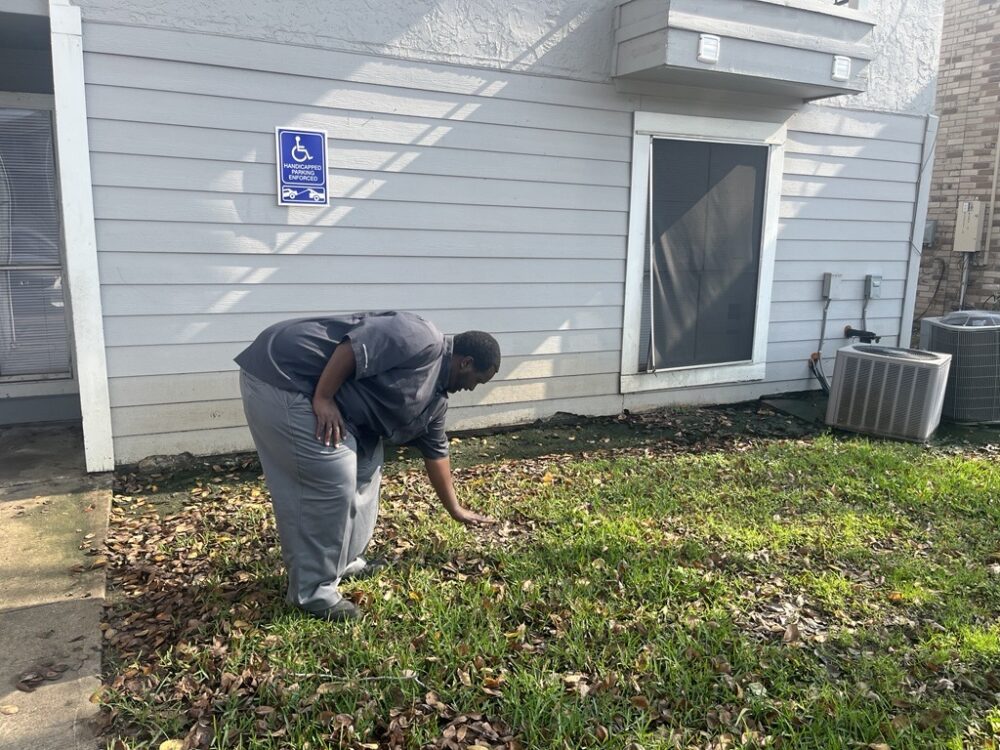
Chris Smith leans over in a grassy area outside his Houston apartment in January 2026, showing where sewage had leaked.
At an apartment complex in Southwest Houston, a light breeze carried a foul odor in early January.
Chris and Ketta Smith live in a 2-bedroom, ground-level unit at Toro Place Apartments. Just before Christmas, a sewage backup created a foot-high pool of contaminated fluid outside that leaked into their bathroom, master bedroom and their kid’s room. The backup wasn’t resolved until early January.
Sign up for the Hello, Houston! daily newsletter to get local reports like this delivered directly to your inbox.
“It was just a bad deal for us — to think that you’re going to celebrate Christmas and have like a couple family members over,” Ketta Smith said. “It’s embarrassing to have people — who would you have come over here in this?”
They called 311. The city health department came multiple times, and inspectors found more than 10 violations.
Click here for more inDepth features.
According to one of the inspection reports authored on Dec. 26 and obtained by Houston Public Media, “No accommodations have been provided for residents, no alternative restrooms, laundry facilities, or living quarters provided for tenants who are affected by either being unable to use toilets and water, or whose homes have been rendered unsuitable for habitation by sewage intrusion.” Four days later, another report stated “sewage is still present” around the Smiths’ building.
Under a proposed city ordinance, that many health and safety violations in such a short period of time would place the complex on a registry of “high-risk rental buildings” — making it subject to ongoing inspections and higher fines for continuing violations over the following six months.
The Smiths aren’t the only household calling the city for these types of issues. Over the past five years, Houston’s 311 center received an average of about 3,300 multifamily habitability complaints per year.
RELATED: Waste removal delays, water leaks top Houston 311’s list of most common complaints
When they heard about the proposed apartment inspection ordinance, the Smiths were all in — especially given the $1,200 they’re charged each month in rent.
“They continuously harass you about rent and paying your rent on time, but you can’t harass them about things that you need fixed,” Ketta Smith said.
“Something needs to be done,” Chris Smith added. “This is crazy.”
Inside their apartment, the carpet was still wet. They had moved their mattresses to the living room, the only dry area.
No workers were present at the building — but the nearby leasing office was bustling after a Harris County constable arrived. She told Houston Public Media she was there to conduct an eviction.
Dominic Anthony Walsh/Houston Public Media
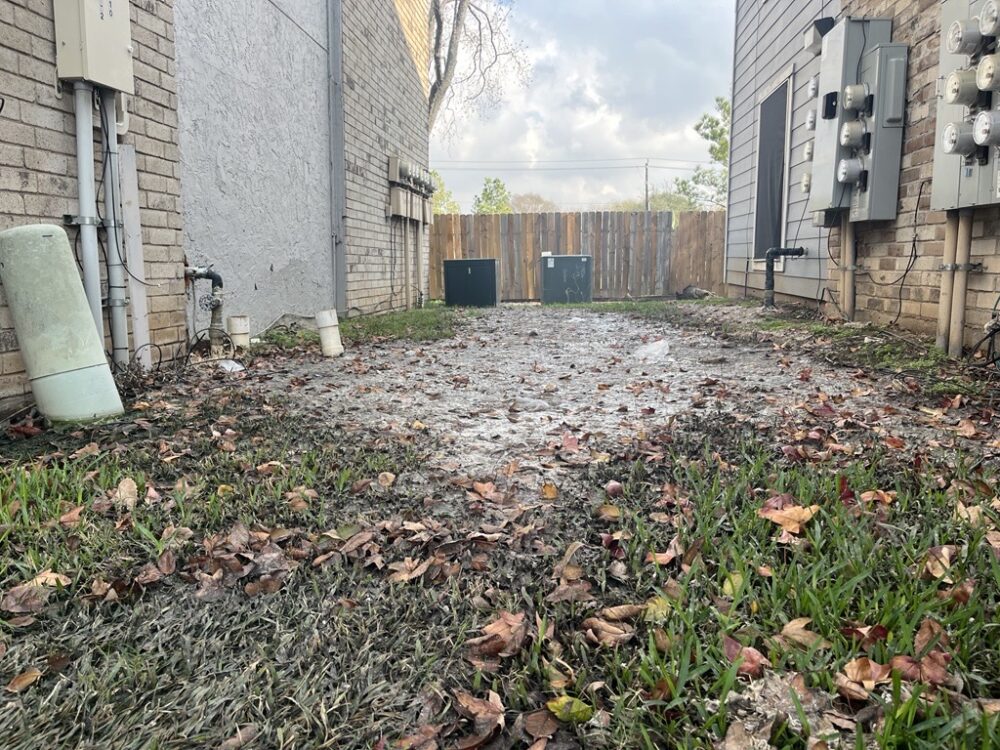
Pictured is a grassy area where sewage had leaked at the Toro Place Apartments in Houston.
The leasing office deferred comment to the owner. Reached by text message on Jan. 7, Patrick Duke said the problem was resolved. He said the property managers were “in constant contact” with the tenants throughout the process, and the backup required “extensive” work to address.
Nearly a month later, the Smiths’ apartment still hadn’t been fully remediated. The couple accused the property management of failing to follow through on scheduled remediation work, while Duke said the Smiths didn’t respond to multiple emails from the managers.
Asked for comment on the proposed apartment inspection rules, Duke wrote, “Any additional ordinance is just a money grab from the City. There are already ordinances in place (thus the citations you provided) that address the concerns.”
RELATED: Facing apartment industry pushback, Houston City Council delays decision on inspection ordinance
The ordinance would bring in more cash to the city of Houston — out of the pockets of noncompliant landlords. Failure to correct health and safety problems after additional inspections would draw fines of up to $2,000 for each violation.
“These landlords — they’ve gotten smart,” said former city council member Letitia Plummer, who spearheaded the proposal. “They know that once they get all these citations, no one’s really going to do anything to them. This ordinance gives it teeth.”
The rules were in the works from 2021 through last year, when Plummer stepped down to run for Harris County judge.
The proposal went through multiple revisions, and she agreed to hold off on a vote in December so the final draft could be reviewed by the city council’s economic development and housing committees.
At the time, Mayor John Whitmire said he wanted to get the rules passed, citing his experience working with tenants years ago as a case worker for the food stamp program.
“When you make calls and you ask the lady why her light bill is so high, she says, ‘I keep it on 24/7 to keep the rats from biting the baby’s milk bottle, destroying the nipple.’ So, I’m aware of the problem,” Whitmire said. “I personally think it would be beneficial not to delay it with a commitment from me that we’ll expedite it, hopefully in January.”
January is over, and those committees haven’t scheduled the ordinance for review — which surprised Plummer.
“I trusted the administration,” Plummer said. “I trusted the chair of economic development. I trusted the chair of housing. … And so I’m disappointed that this has not happened.”
Whitmire’s office did not respond to a request for comment — but he previously called for more public engagement on the most recent proposal.
Dominic Anthony Walsh/Houston Public Media
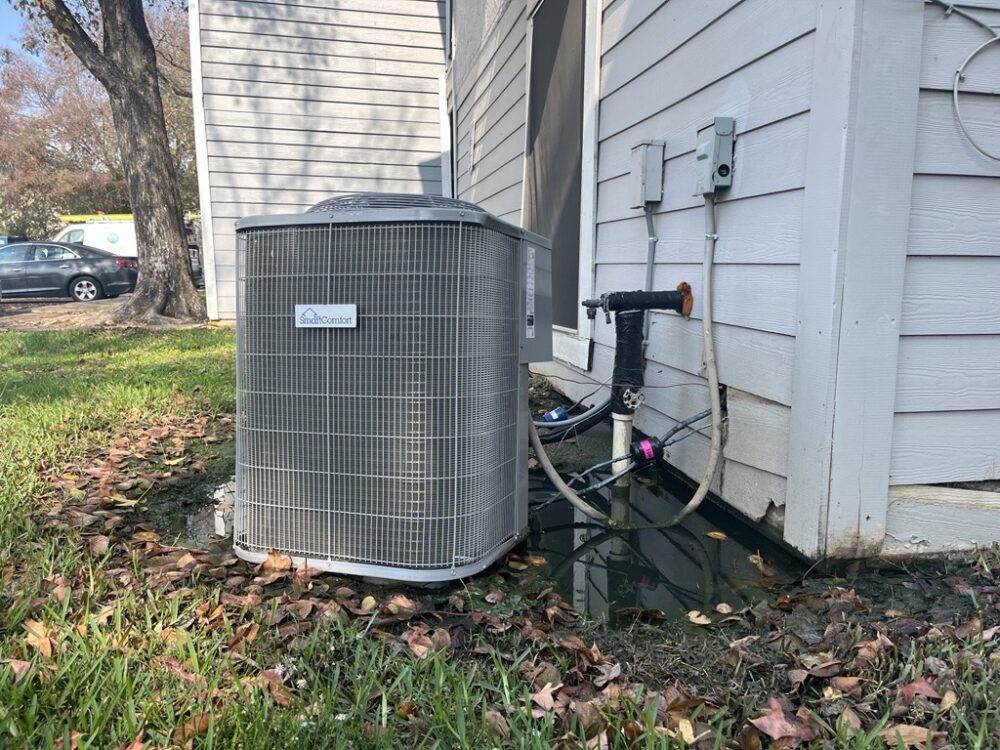
A liquid collects near an air-conditioning unit at the Toro Place Apartments in January 2026.
That’s what city officials are working on now.
Council members Martha Castex-Tatum and Tiffany Thomas — the respective chairs of the economic development and housing committees — said they planned to schedule community engagement meetings about the rules.
Thomas argued there wasn’t enough input to the most recent draft.
“Tenants don’t have time to wait, and that’s why we’re going to have robust community engagement that was not attached to the item previously,” Thomas said. “So we’re going to make sure that tenants actually have a say so in the community engagement … that we’re actually creating a space where they could speak about their issues to inform the ordinance better.”
Details of the community engagement meetings have not been finalized, according to a spokesperson for Thomas.
The ordinance was first delayed in October after the Houston Apartment Association voiced concerns over the way rental buildings would be added to the high-risk registry. City officials reworked it over the course of November, before it came back to the council in December.
The association’s head of government affairs, Ben McPhaul, said it still needs more work.
“It definitely seems to be that it was headed in the right direction,” McPaul said, “but I think ultimately it just needed to continue to be flushed out, which is why we supported it going back to this joint committee so that us and other stakeholders could have some input into — or more input into the process.”
Julia Orduña with tenant advocacy group Texas Housers argued there’s already been plenty of engagement over the past five years. She thinks more doesn’t hurt.
“I think that whenever the government is trying to hear from their constituents is a really great thing,” but, she added, “We definitely don’t want perfection to be the stop gap to progress. We need these things to continue forward.”
For now, tenants can continue to call 311 whenever they need an inspection. So far, in the first month of 2026, the city has received about 100 complaints about conditions at apartment complexes.