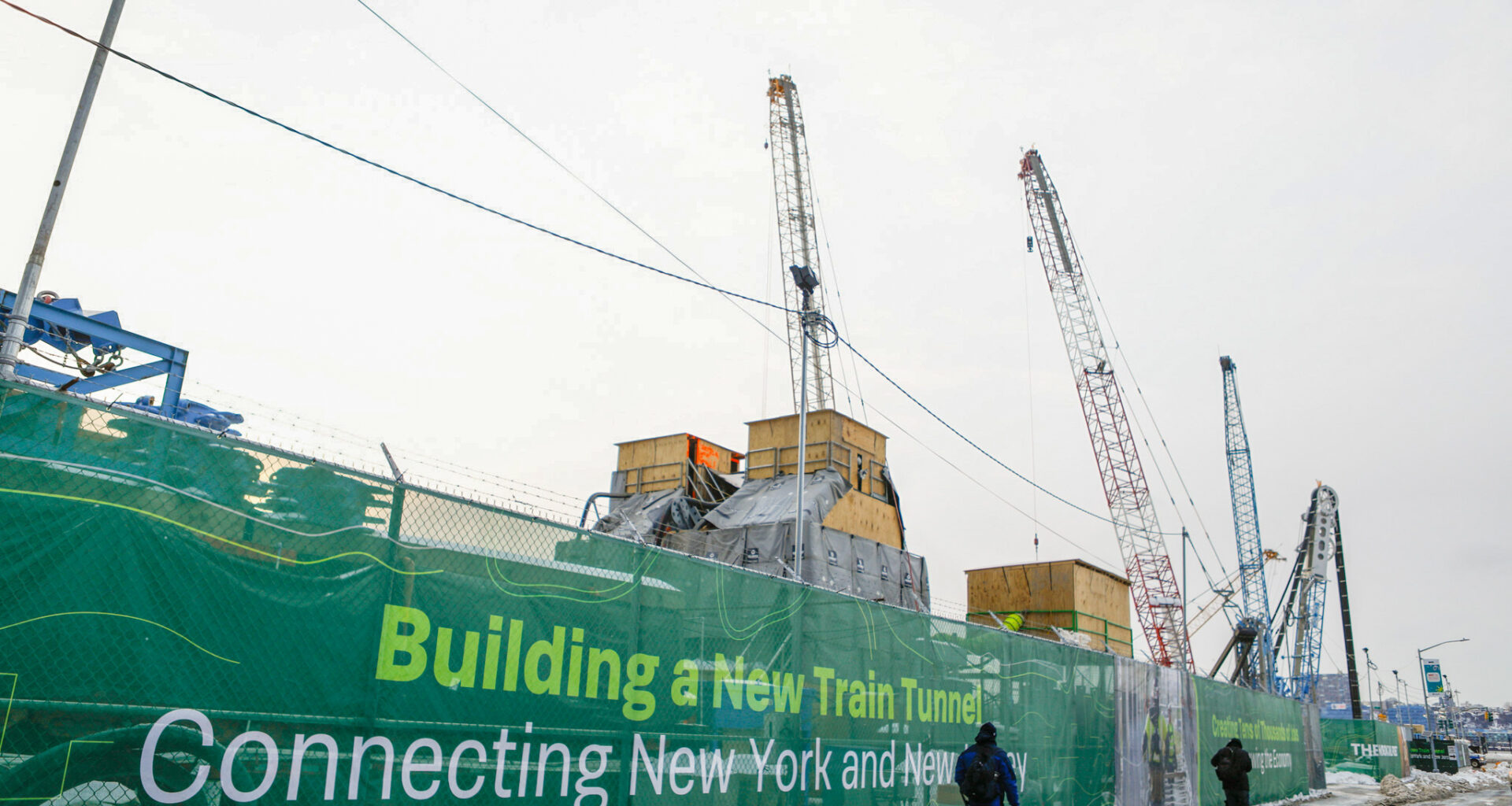
Facing a looming Saturday shutdown of work on a new Hudson River rail tunnel, the Gateway Development Commission is suing the federal government for an alleged breach of contract that may result in the potential loss of 1,000 jobs.
The lawsuit, filed in the U.S. Court of Federal Claims, accuses the U.S. Department of Transportation of improperly withholding $205,275,358 in contractually obligated funding for work on what is known as Gateway, a sprawling $16 billion project in the Hudson and at several construction sites on both sides of the river.
Gov. Kathy Hochul trashed the potential Feb. 6 shutdown of work by President Donald Trump a “brazen act of political retribution” against New Yorkers, while her New Jersey counterpart, Mikie Sherrill, said the Trump administration must be held accountable for putting jobs at stake on what the Gateway commission calls the “most urgent infrastructure program in the country.”
“For months, Donald Trump and his enablers in Washington have illegally withheld committed funding for this project in a brazen act of political retribution intended to hurt New Yorkers, putting thousands of union jobs and billions of dollars in economic benefits at risk,” Hochul said in a statement. “I said New York would fight like hell to keep this project moving and today, that is exactly what we are doing.”
The lawsuit comes after the commission last week said it would have to shut down work on the series of passenger-rail improvements between New York and New Jersey, whose centerpiece is a new tunnel in the Hudson. In all, the improvements span nine miles of new rail track between the two states
The tunnel is being built to replace the North River tunnel that has been operational for more than a century and which carries more than 200,000 commuters daily. The rail link is a vital transit and economic connector along the Boston-Washington rail corridor known as the Northeast Corridor.
But the existing tunnel is prone to delays and its critical equipment was damaged from flooding during Hurricane Sandy in 2012.
“There is absolutely no question about the need to build these new tunnels and repair the old ones,” said Tom Wright, president and chief executive of Regional Plan Association. “There is no alternative to doing that and it has to be done someday and hopefully before the existing ones fail.”
Work on the project has continued through a line of credit even after federal funding was paused during last year’s government shutdown. But with that line of credit now exhausted, the clock is ticking for workers at several job sites on both sides of the Hudson, with an orderly shutdown of the operation set to follow.
“Our goal has always been to work with our federal partners and get funding flowing again,” said Thomas Prendergast, chief executive officer of the commission. “At the same time, we must hold the federal government to its contractual obligations so that construction is not halted.”
The 75-page lawsuit lays out what it describes as a “straightforward breach of contract case,” accusing the federal government of withholding funds over the project’s Disadvantaged Business Enterprise (DBE) program, which the White House has labeled “unconstitutional DEI principles.”
The White House did not immediately respond to a request for comment, though a spokesperson last week blamed Senate Minority Leader Chuck Schumer and the Democrats for “refusing to negotiate with the Trump administration.”
Supporters of the rail project expressed frustration over the long-running Gateway saga. A previously proposed rail tunnel in the Hudson was canceled in 2010 by Chris Christie, then the governor of New Jersey.
“It’s insanity that we are still talking about Gateway’s funding — the project is moving, thousands of men and women of labor are working and the money is signed, sealed and needs to be delivered,” said Carlo Scissura, president and chief executive of the New York Building Congress, which represents the building and construction industry in the city. “Let’s stop the partisanship and stop punishing the people of the Northeast Corridor, through which 20% of our nation’s gross domestic product flows.”
During the government shutdown, the feds also targeted the MTA’s work on the Second Avenue Subway, blocking funding for work to extend the Q line north from 96th Street.
According to the lawsuit, the U.S. Department of Transportation’s concerns over the program’s DBE programs are “entirely unfounded,” with the commission saying it has “consistently administered the program in full compliance with DOT regulations.”
In the meantime, close to 1,000 workers on the Gateway project are facing the potential loss of employment. Several workers and labor representatives made personal appeals to Trump at last week’s commission meeting in Manhattan, pleading with the president to keep the project going.
“It is the very definition of American first,” Mike Hellstrom, a top official with the Laborers’ International Union of North America, testified last week. “It’s time to stop using this tunnel as a political pawn in a political fight — it doesn’t serve any of us.”
According to the commission, laborers account for 40% of the trades workers currently on the job. Heavy equipment operators, carpenters, Teamsters, ironworkers and others make up the remainder of the workforce.
Close to $2 billion has already been spent on the project, with approximately 150 contractors and subcontractors working on it for more than two years.
Milestones include the nearly 75% completion of concrete casing for the new tunnel that will pass beneath Hudson Yards en route to Penn Station. A bridge relocation in New Jersey that will allow tunnel boring to start as soon as this spring has also been substantially completed.
Wright, of Regional Plan Association, said it is “a really sad statement” that a lawsuit needed to be filed “essentially just to get the federal government and the U.S. Department of Transportation to do its job.”
He warned that slowing the project at any of its sites could have serious implications on its future.
“If work stops on any one of them, what it does is it disrupts the coordination of these projects, pushing them and delaying them all,” Wright said. “When you delay or terminate one of the projects, you really jeopardize the entire thing and add not just days or weeks but months or years to the entire project.”
Related