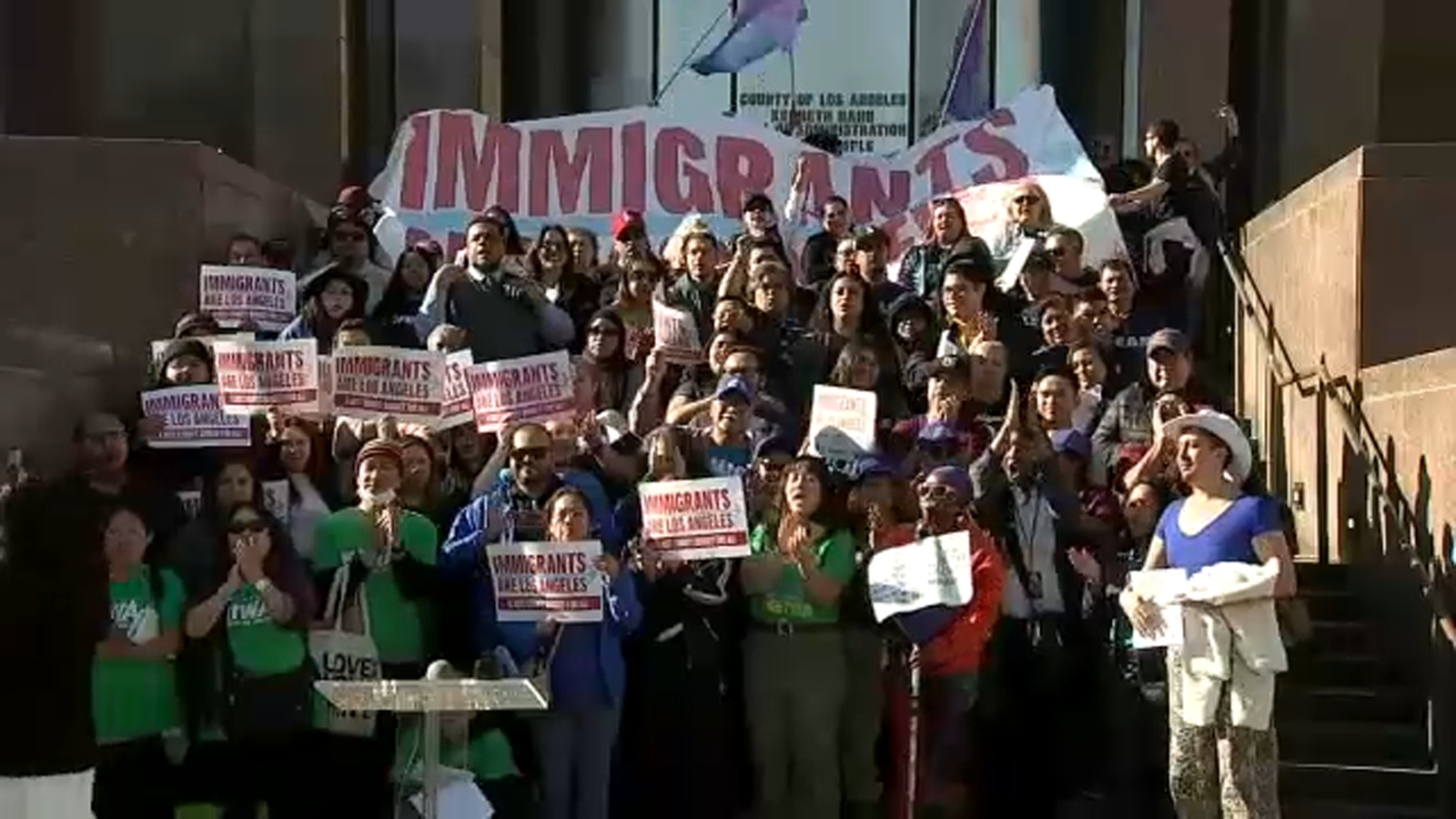
LOS ANGELES (KABC) — A coalition of immigrant rights groups in Los Angeles County is demanding change amid ongoing federal immigration raids. Among the changes sought are housing protections for immigrants.
As L.A. County examines how it will allocate its budget dollars next fiscal year, the coalition brought forward its priorities on Tuesday.
“These priorities did not come from the boardroom. They came from community members naming what they need and organizing together to demand change,” said Martha Arévalo, executive director of Central American Resource Center (CARECEN).
Immigrants Are LA (IRLA) detailed the priorities against the backdrop of the ongoing federal immigration operations, stressing that this, along with rising rents, is severely affecting Los Angeles immigrant families.
Their priorities are threefold, from increased renter protections through policies like freezing rent increases during the state of emergency over immigration raids, to the equitable implementation of immigrant programs through, for example, language access.
“There are Black immigrants who speak French, Haitian, Creole, Amharic and other languages,” said Jelani Hendrix of the Black Alliance for Just Immigration (BAJI).
“Too often, even when the county invests in these programs meant to help, those investments do not reach the immigrant communities in need,” said Hadir Azab of the Council on American-Islamic Relations Los Angeles (CAIR-LA).
IRLA also called for a program that would provide a guaranteed basic income for immigrant seniors who do not qualify for social security and other safety net programs.
“We work to pay rent, for bills, and we file taxes, and when we retire, we’re not going to have anything,” said Maria Caro with the Coalition for Humane Immigrant Rights (CHIRLA).
Ilario, a car wash worker and part of the Clean Car Wash Worker Center, said reduced work hours, as they have been hard hit by immigration sweeps, make it harder to pay rent and provide for their families.
During the Board of Supervisors meeting on Tuesday, many voiced support for a motion authored by Supervisors Janice Hahn and Chair Hilda Solis to draft an ordinance that would increase the threshold for formal evictions in unincorporated areas from one to two months of fair market rent. The motion passed 4-1.
Following public comment, Supervisor Lindsey Horvath said she will move to increase the threshold even higher to three months.
“I am moved by today’s testimony and am ready to do more to help Angelenos in need,” she said.
The motion will be heard next week.
Meanwhile, in a statement in Eyewitness News, Solis noted that the county is “experiencing significant budget constraints due to funding cuts and ongoing threats by the Trump administration to withhold additional federal resources.” She said the reductions will continue to limit the board’s fiscal flexibility.
Despite the financial challenges, Solis said her office is committed to exploring ways to advance proposals that support immigrant communities.
Solis noted that she co-led the effort to raise the evictable rent-debt threshold in unincorporated communities to two months. She said she has concerns with the proposal to raise the threshold beyond two months, fearing it could saddle renters with excessive debt.
Solis said a second round of rent relief launching this month will allow tenants to apply directly, so assistance can more effectively reach households in need. The first round was designed to deliver assistance quickly by leveraging infrastructure developed during the COVID-19 pandemic.
“The motion passed today will permanently strengthen tenant protections in unincorporated areas, where the County has direct authority. While the County cannot require incorporated cities to adopt the same protections, I strongly encourage them to do so. Many cities have followed the County’s lead-for example, when we previously established the one-month evictable rent-debt threshold, the City of Los Angeles implemented a similar policy,” Solis’ statement read, in part. “However, eviction procedures are primarily governed by state law, and ongoing litigation challenging the City’s one-month threshold makes it difficult to predict how similar measures may ultimately be implemented or enforced.”
Copyright © 2026 KABC Television, LLC. All rights reserved.