
University Provost Katherine Baicker said that the College will embark on a “multiyear plan” to increase enrollment to around 9,000 undergraduate students during an invite-only budget town hall on Tuesday.
Baicker noted that the College had been steadily increasing in size since the early 2000s until the COVID-19 pandemic in 2021, when growth leveled off. The plan would mark a return to a pre-pandemic growth trajectory, she said. The current undergraduate population is just over 7,500.
Undergraduate enrollment at UChicago grew annually by an average of about 3.2 percent from 2000 to 2021 and has decreased by about 0.5 percent on average each year since.
Baicker and Enterprise Chief Financial Officer Ivan Samstein also reiterated progress in eliminating the University’s operating deficit, projecting that it could be fully eliminated by the end of fiscal year (FY) 2028, in line with the original deficit reduction plan established in 2024. The operating deficit shrank by 44 percent from $288 million to $160 million in FY2025, but it remains more than four times its pre-pandemic size.
According to Baicker, the University estimates the total deficit will be reduced to $140 million this year, less than half of what it was two years ago. Samstein said hiring reductions and a voluntary retirement initiative have helped moderate growth in operating expenses, and that revenue increases would outpace overall operating expense growth for the second consecutive year.
 A figure displayed during the presentation shows a projected decrease of about $20 million in the University’s operating deficit between FY2025 and FY2026.
Administrators highlighted sustained fundraising efforts. In FY2025, the University reached a “record-breaking” $1.02 billion in private donations; it aims to raise an additional $1 billion by the end of FY2026. Gifts will make up 8 percent of the FY2026 budget, according to the presentation.
Samstein said some donations may not be reflected in the annual budget numbers until later, as donations are only recorded in the University’s financial statements after the money is received. He also cited an ongoing fundraising initiative to support the modernization of historic buildings on campus as one driver of donations.
A miscellaneous category of “other income” made up the highest percentage of operating revenue in the FY2026 budget at 29 percent, up from 22 percent last fiscal year. A University spokesperson did not immediately respond to questions about the shift and what revenue sources fall in that category.
Both government and private grants and contracts are projected to stay roughly constant at 13 and 4 percent, respectively, of the University’s operating revenue in FY2026. Academic and staff salaries will decline from a combined 51 percent to 45 percent of operating expenses, while benefits will increase from 12 to 16 percent. Miscellaneous costs—including travel, meals, and other non-personnel expenditures—will increase from 24 to 27 percent.
Baicker cited the continued expansion of the University’s non-degree programs as another potential driver of increased revenue in the future, saying that “we could double or triple our exec[utive] ed[ucation] revenues and still be relatively modest in size [relative to peer institutions].”
In addition to certificate programs, summer programs—for high school students, UChicago undergraduates, and visiting students—have grown over the past few years. The number of students on campus during the summer has nearly doubled since 2020 and has increased by about 40 percent since summer 2023, according to figures presented at the town hall.
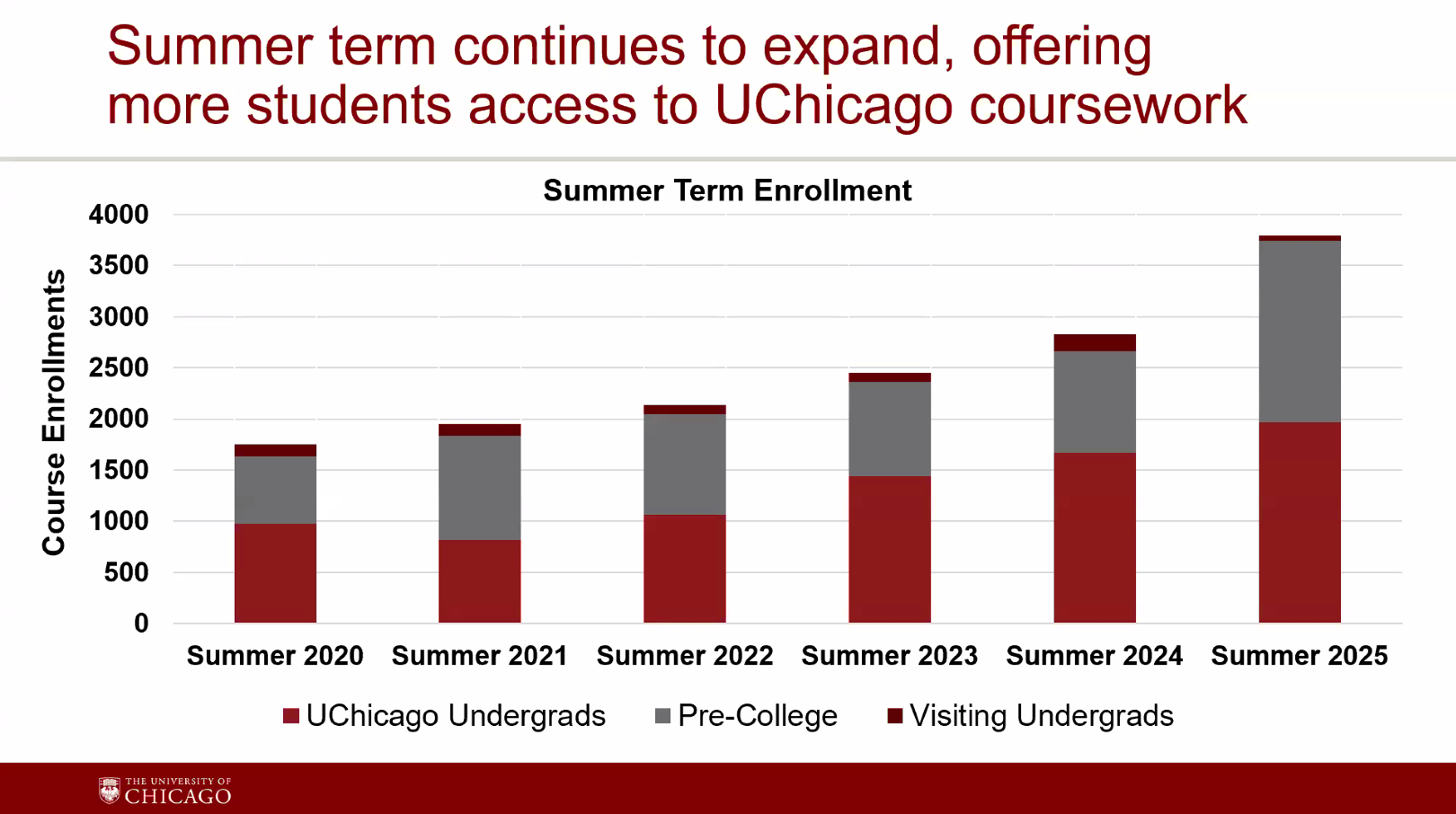 A figure displayed during the presentation shows growth in summer program enrollment since 2020.
The University began the new Summer Session Early Notification program, which offers participants in UChicago’s summer courses the opportunity to apply to the College on a separate early decision track, in 2024. Costs for these programs can run as high as $15,000. Approximately 3,750 students were on campus for a program during summer 2025, according to figures shown at the town hall.
Baicker also said that the University is considering adapting graduate programs in the social sciences and humanities divisions in response to an increasingly competitive job market.
The University needs to evaluate whether it is “getting students out with the education they need as quickly as they can get that education,” she said.
Baicker acknowledged that plans to increase undergraduate enrollment would require “be[ing] very creative about spaces that we have on campus that are underutilized in their current configuration,” and highlighted ongoing conversations about how to allocate teaching responsibilities between tenure- and non-tenure-track faculty as important to assessing the College’s enrollment capacity.
A committee led by Dean of the College Melina Hale and Dean of the Division of the Arts & Humanities Deborah Nelson had evaluated where tenure-track faculty instruction is “particularly important” and when a non-tenure-track instructor “might actually be the better person for teaching certain disciplines or to cover certain areas,” according to Baicker.
Baicker said that, over the period of College enrollment growth preceding the pandemic, “we were sort of catching up to our peers” in undergraduate population.
Continuing to increase enrollment is dependent on “grow[ing] the underlying resources that are necessary” for a strong College experience, and necessary resources may not scale perfectly with enrollment, she added. “All of the investments that will support having a College cohort across all four years of more like 9,000 need to be thought through and implemented in conjunction with that.”