
When the three members of the K-pop boy group Big Ocean walked onto the stage at the Avalon Hollywood & Bardot last month, the venue immediately filled with cheers. Across the crowd, many fans raised their arms and waved their open hands, offering a form of visual applause often used in deaf culture.
The unique greeting was the result of Big Ocean being the first K-pop group composed entirely of members with hearing loss. The welcoming crowd was just one example of the group’s growth as performers.
The concert opened with their new song “Cold Moon,” whose strong rhythm quickly set the energy for the night. The stage design was relatively simple, but the members filled the space with choreography, formation changes and live rap.
 Big Ocean performs for fans during soundcheck before their Los Angeles show begins. (Photo courtesy of Lisa Chen)
Big Ocean is made up of Park Hyun-jin, Kim Ji-seok and Lee Chanyeon. Before joining the group, each member had followed a different life path. In an interview with elevASIAN, Park said that before becoming a K-pop idol, Park had been a YouTube creator. He said he wanted to “break misunderstandings and stereotypes” about hearing impairment and bring more “positive energy” to society, which led him to join Big Ocean when the company introduced the idea of becoming a K-pop artist.
Kim was a professional skier before being discovered by the company, while Lee had a background related to audiology and later entered the training process through a recommendation.
Before the group had fully formed, Kim had once attended one of Park’s performances. Park joked in the interview that after watching him perform, Kim thought he could also become an artist.
 Big Ocean performs “Stay With Me,” blending sign language and choreography during the emotional cover. (Photo courtesy of Lisa Chen)
During the concert, Big Ocean covered “Stay With Me,” the theme song from the Korean drama “Guardian: The Lonely and Great God.” The members combined sign language with choreography, using a more visual form of performance to express the song’s intense emotions.
Asked whether sign language feels more like translation or part of the performance itself, Kim said, “We don’t separate it. It’s not just one or the other.” He added that whenever the group performs, they use ASL “as part of the whole performance.”
 Big Ocean performs “One Man Army,” one of the double title tracks from the group’s third mini album, THE GREATEST BATTLE. (Photo courtesy of Lisa Chen)
If “Stay With Me” showed how Big Ocean can turn sign language into emotional expression, “One Man Army” highlighted their growth as K-pop artists. Compared with the bright, youthful feeling of their debut song “Glow,” “One Man Army” showed a more mature and powerful side of Big Ocean. The live rap sections also added impact to the performance, showing how the group is continuing to expand its range on stage.
That shift on stage also connects to how the members understand their own identity now.
“When we debuted, it was more about really showing our group as a hearing-impaired group,” Kim said. Now, the group wants to share “Big Ocean’s story” like “a diary,” with deeper messages for fans. Park added that while they once focused mainly on dance and sign language, they are now trying more live elements, which have brought stronger reactions from fans.
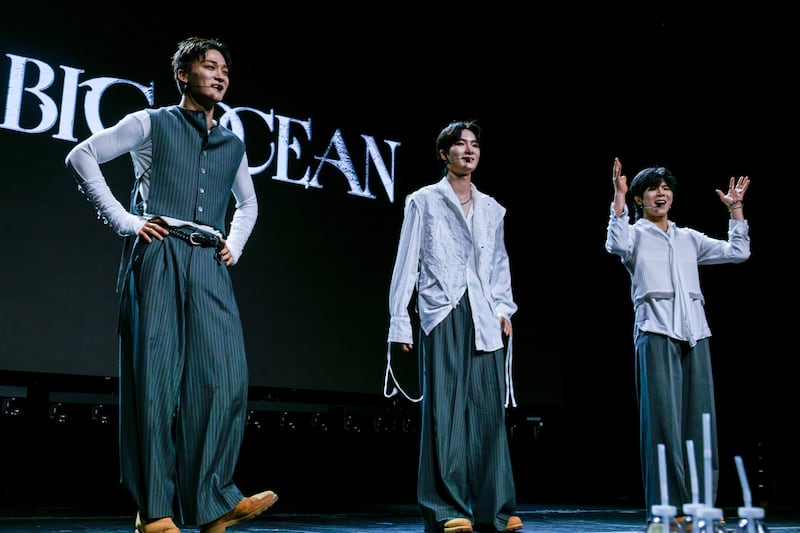 Big Ocean members P.J, Jiseok and Chanyeon interact with fans between performances. (Photo courtesy of Lisa Chen)
The tour itself has also brought new challenges.
“Our fans’ chants and screams are really loud,” Lee said. “Sometimes you can’t hear the beginning of the song.” Still, he described the challenge as memorable because it reflects the group’s close interaction with fans.
As Kim said, the group treats each rehearsal as if it were already a live performance, leaving little distance between the practice room and the stage. That preparation helps them respond to the crowd in the moment. Park added that performing in front of fans gives the members more confidence and energy, allowing them to show a more passionate side on stage.
Fan feedback has also shaped Big Ocean’s growth. Park said fans had asked for something “more powerful” and “more mature,” so the members have tried to include more of those opinions in their music and performances.
 Audience members cheer for Big Ocean’s performance at Avalon Hollywood & Bardot. (Photo courtesy of Lisa Chen)
By the end of the Los Angeles stop, Big Ocean had shown growth that matched their ambition. From sign language and choreography to live rap, from fan interaction to a more mature stage presence, Big Ocean is building a K-pop performance language of its own — one that moves beyond a single label, reaches toward bigger stages and inspires more people along the way.
Disclosure: Lisa Chen, who contributed photography for this article, also worked as a photographer for Big Ocean/Parastar at the same event.